Knoblich Tanja, Hinz Ulf, Stravodimos Christos, Schön Michael R, Mehrabi Arianeb, Büchler Markus W, Hoffmann Katrin
Department of General, Visceral and Transplant Surgery, Ruprecht-Karls University, Im Neuenheimer Feld 110, 69120, Heidelberg, Germany.
Department of General and Visceral Surgery, Städtisches Klinikum, Moltkestraße 90, 76133, Karlsruhe, Germany.
BMC Surg. 2020 Jan 29;20(1):19. doi: 10.1186/s12893-020-0678-2.
Indications for liver surgery are expanding fast and complexity of procedures increases. Preoperative mortality risk assessment by scoring systems is debatable. A previously published externally validated Mortality Risk Score allowed easy applicable and precise prediction of postoperative mortality. Aim of the study was to compare the performance of the Mortality Risk Score with the standard scores MELD and P-POSSUM.
Data of 529 patients undergoing liver resection were analysed. Mortality Risk Score, the labMELD Score and the P-POSSUM Scores (PS, OS, P-POSSUM mortality %) were calculated. The ROC curves of the three scoring systems were computed and the areas under the curve (C-index) were calculated using logistic regression models. Comparisons between the ROC curves were performed using the corresponding Wald tests.
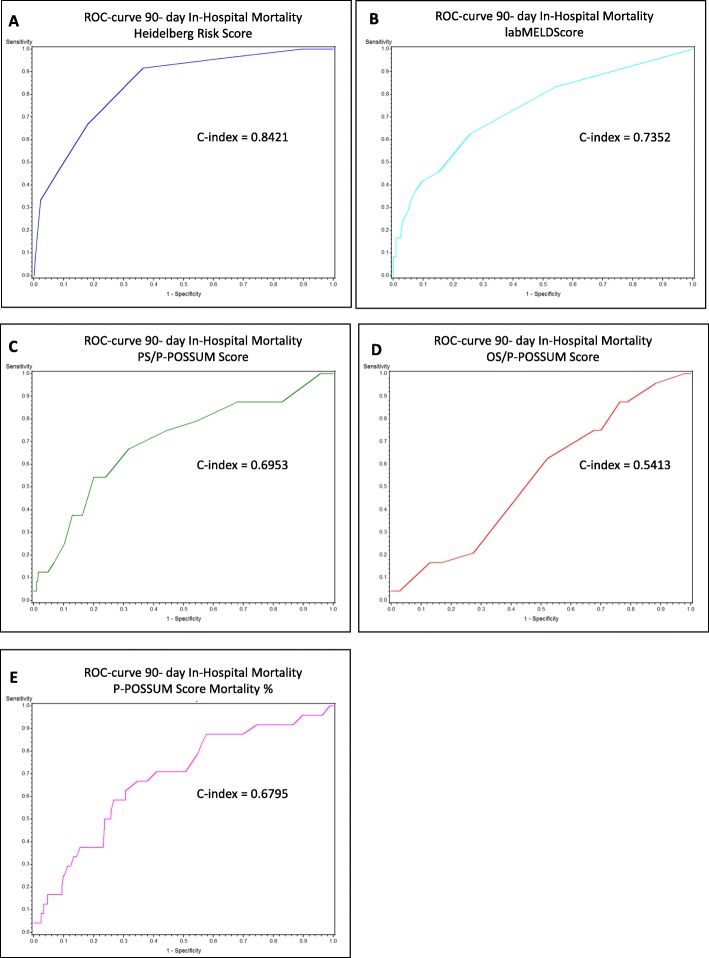
Internal validation confirmed that the risk model was predictive for a 90-day mortality rate with a C-index of 0.8421. The labMELD Score had a C-index of 0.7352 and the P-POSSUM system 0.6795 (PS 0.6953, OS 0.5413). The 90-day mortality rate increased with increasing labMELD values (p < 0.0001). Categorized according to the Mortality Risk Score Groups the labMELD Score showed a linear increase while the POSSUM Scores showed variable results.
By accurately predicting the risk of postoperative mortality after liver surgery the Mortality Risk Score should be useful at the selection stage. Prediction can be adjusted by use of the well-established labMELD Score. In contrast, the performance of standard P-POSSUM Scores is limited.
肝脏手术的适应证正在迅速扩大,手术复杂性增加。通过评分系统进行术前死亡风险评估存在争议。先前发表的经外部验证的死亡风险评分能够轻松应用且精确预测术后死亡率。本研究的目的是比较死亡风险评分与标准评分MELD和P-POSSUM的性能。
分析了529例行肝切除术患者的数据。计算了死亡风险评分、实验室MELD评分和P-POSSUM评分(PS、OS、P-POSSUM死亡率%)。计算了三种评分系统的ROC曲线,并使用逻辑回归模型计算曲线下面积(C指数)。使用相应的Wald检验对ROC曲线进行比较。
内部验证证实风险模型对90天死亡率具有预测性,C指数为0.8421。实验室MELD评分的C指数为0.7352,P-POSSUM系统为0.6795(PS为0.6953,OS为0.5413)。90天死亡率随实验室MELD值的增加而升高(p < 0.0001)。根据死亡风险评分分组,实验室MELD评分呈线性增加,而POSSUM评分结果各异。
通过准确预测肝脏手术后的术后死亡风险,死亡风险评分在选择阶段应具有实用性。可使用成熟的实验室MELD评分对预测进行调整。相比之下,标准P-POSSUM评分的性能有限。