Center for Population Health Sciences, Stanford University School of Medicine, 1701 Page Mill Road, Palo Alto, CA 94304, USA
Department of Psychiatry and Behavioral Sciences, Stanford University School of Medicine, Palo Alto, CA, USA.
BMJ. 2020 Jan 29;368:l6968. doi: 10.1136/bmj.l6968.
To examine the distribution and patterns of opioid prescribing in the United States.
Retrospective, observational study.
National private insurer covering all 50 US states and Washington DC.
An annual average of 669 495 providers prescribing 8.9 million opioid prescriptions to 3.9 million patients from 2003 through 2017.
Standardized doses of opioids in morphine milligram equivalents (MMEs) and number of opioid prescriptions.
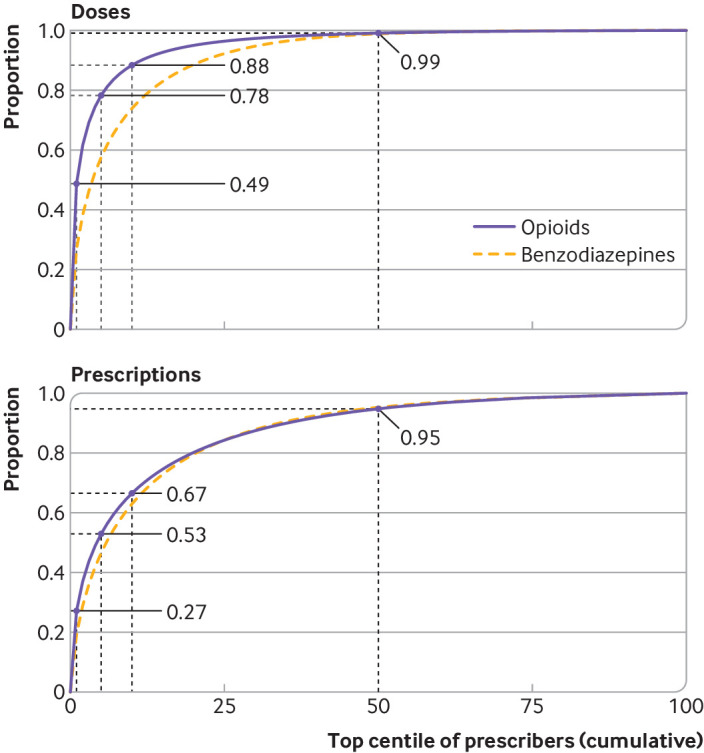
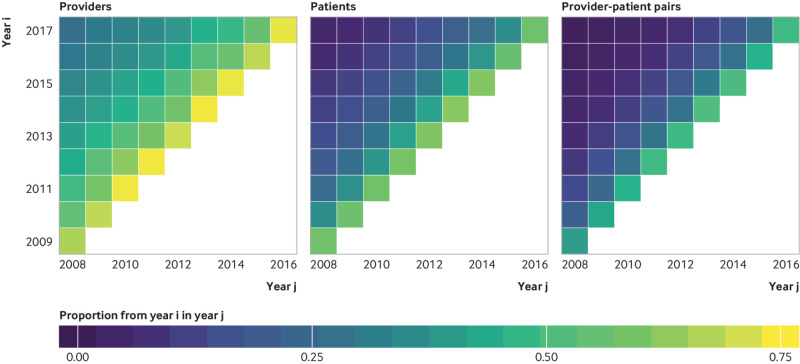
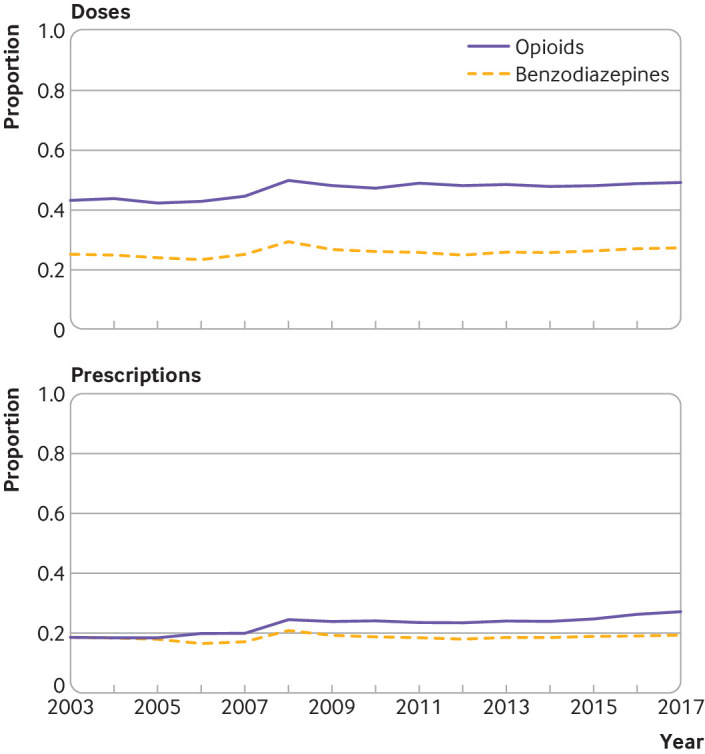
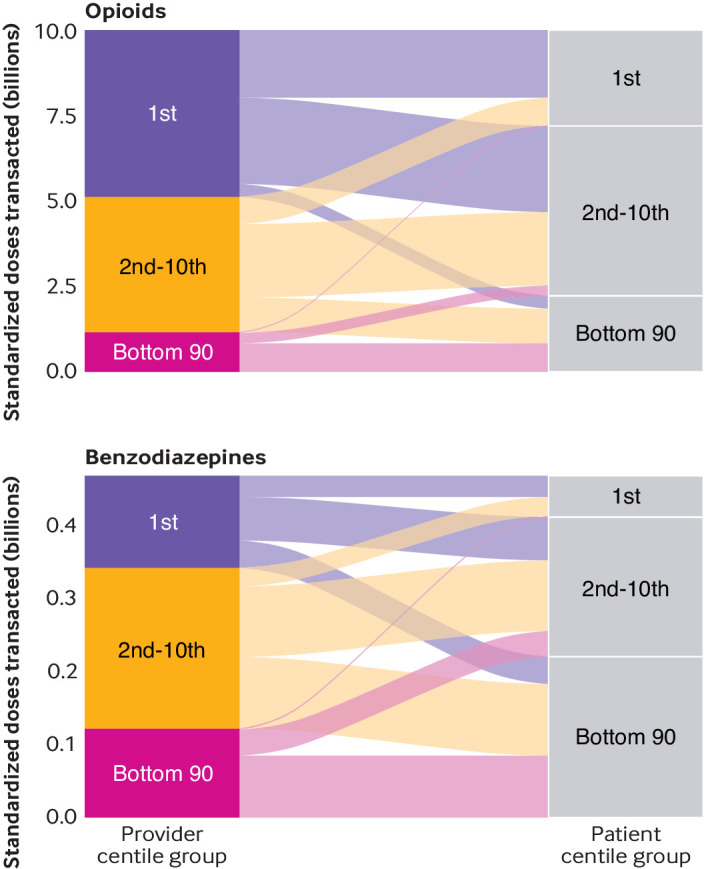
In 2017, the top 1% of providers accounted for 49% of all opioid doses and 27% of all opioid prescriptions. In absolute terms, the top 1% of providers prescribed an average of 748 000 MMEs-nearly 1000 times more than the middle 1%. At least half of all providers in the top 1% in one year were also in the top 1% in adjacent years. More than two fifths of all prescriptions written by the top 1% of providers were for more than 50 MMEs a day and over four fifths were for longer than seven days. In contrast, prescriptions written by the bottom 99% of providers were below these thresholds, with 86% of prescriptions for less than 50 MMEs a day and 71% for fewer than seven days. Providers prescribing high amounts of opioids and patients receiving high amounts of opioids persisted over time, with over half of both appearing in adjacent years.
Most prescriptions written by the majority of providers are under the recommended thresholds, suggesting that most US providers are careful in their prescribing. Interventions focusing on this group of providers are unlikely to effect beneficial change and could induce unnecessary burden. A large proportion of providers have established relationships with their patients over multiple years. Interventions to reduce inappropriate opioid prescribing should be focused on improving patient care, management of patients with complex pain, and reducing comorbidities rather than seeking to enforce a threshold for prescribing.
考察美国阿片类药物处方的分布和模式。
回顾性观察性研究。
覆盖美国 50 个州和华盛顿特区的全国私人保险公司。
2003 年至 2017 年期间,每年平均有 669495 名医生为 390 万名患者开出 890 万份阿片类药物处方。
以吗啡毫克当量(MME)标准化的阿片类药物剂量和阿片类药物处方数量。
2017 年,排名前 1%的医生开出的阿片类药物处方占所有阿片类药物剂量的 49%和所有阿片类药物处方的 27%。就绝对值而言,排名前 1%的医生平均开出 748000 个 MME——几乎是中位数的 1000 倍。在一年中排名前 1%的医生中,至少有一半也在相邻年份中排名前 1%。排名前 1%的医生开出的处方中,超过一半的处方超过 50 MME/天,超过四分之三的处方超过 7 天。相比之下,排名后 99%的医生开出的处方低于这些阈值,86%的处方每天少于 50 MME,71%的处方少于 7 天。开具大量阿片类药物的医生和接受大量阿片类药物的患者随着时间的推移而持续存在,其中超过一半的患者在相邻年份中出现。
大多数大多数医生开出的处方都低于推荐的阈值,这表明大多数美国医生在开处方时都很谨慎。针对这部分医生的干预措施不太可能产生有益的变化,反而可能会带来不必要的负担。很大一部分医生与他们的患者建立了多年的关系。减少不适当阿片类药物处方的干预措施应侧重于改善患者护理、管理复杂疼痛患者和减少合并症,而不是寻求强制规定处方阈值。