Mayo Clinic, 5777 E. Mayo Blvd, Phoenix, AZ, 85054, USA.
Bayer HealthCare Pharmaceuticals, 100 Bayer Blvd, Whippany, NJ, 07981, USA.
BMC Cancer. 2024 Aug 2;24(1):939. doi: 10.1186/s12885-024-12421-4.
The randomized, dose-optimization, open-label ReDOS study in US patients with metastatic colorectal cancer (CRC) showed that, compared with a standard dosing approach, initiating regorafenib at 80 mg/day and escalating to 160 mg/day depending on tolerability increased the proportion of patients reaching their third treatment cycle and reduced the incidence of adverse events without compromising efficacy. Subsequently, the ReDOS dose-escalation strategy was included as an alternative regorafenib dosing option in the National Comprehensive Cancer Network (NCCN) Clinical Practice Guidelines. A retrospective analysis was conducted using a US claims database to assess whether inclusion of this dose-escalation strategy in NCCN Guidelines has influenced the use of flexible dosing in routine US clinical practice, and to describe clinical outcomes pre- and post-inclusion in NCCN Guidelines.
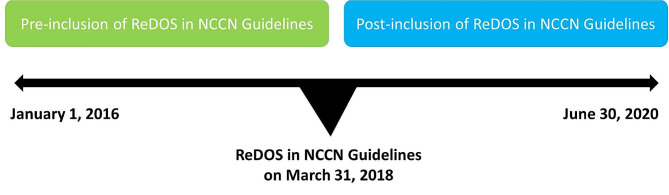
Patients with CRC in the Optum's de-identified Clinformatics® Data Mart database initiating regorafenib for the first time between January 2016 and June 2020 were stratified based on whether they initiated regorafenib pre- or post-inclusion of ReDOS in NCCN Guidelines, and in two groups: flexible dosing (< 160 mg/day; < 84 tablets in the first treatment cycle) and standard dosing (160 mg/day; ≥ 84 tablets in the first treatment cycle). The primary endpoints were the proportion of patients who initiated their third treatment cycle and the mean number of treatment cycles per group.
703 patients initiated regorafenib during the study period, of whom 310 (44%) initiated before and 393 (56%) initiated after inclusion of ReDOS in NCCN Guidelines. After inclusion in the guidelines, the proportion of patients who received flexible dosing increased from 21% (n = 66/310) to 45% (n = 178/393), the proportion who received standard dosing decreased from 79% (n = 244/310) to 55% (n = 215/393), the proportion who initiated their third treatment cycle increased from 36% (n = 113/310) to 46% (n = 179/393), and the mean (standard deviation) number of treatment cycles increased from 2.6 (2.9) to 3.2 (3.1).
Following inclusion of ReDOS in NCCN Guidelines, real-world data suggest that US clinicians have markedly increased use of flexible dosing in clinical practice, potentially maximizing clinical benefits and safety outcomes for patients with metastatic CRC receiving regorafenib.
在美国转移性结直肠癌(CRC)患者中进行的随机、剂量优化、开放标签的 ReDOS 研究表明,与标准剂量方案相比,根据耐受性起始regorafenib 80mg/天并滴定至 160mg/天可增加达到第三个治疗周期的患者比例,并降低不良事件的发生率,而不影响疗效。随后,ReDOS 剂量递增策略被纳入国家综合癌症网络(NCCN)临床实践指南作为 regorafenib 的替代剂量选择。使用美国索赔数据库进行了一项回顾性分析,以评估 NCCN 指南中纳入该剂量递增策略是否影响了常规美国临床实践中灵活剂量的使用,并描述纳入 NCCN 指南前后的临床结果。
在 Optum 的 de-identified Clinformatics® Data Mart 数据库中,2016 年 1 月至 2020 年 6 月期间首次开始接受regorafenib 治疗的 CRC 患者,根据他们在 NCCN 指南中纳入 ReDOS 前后开始接受regorafenib 的情况进行分层,并分为两组:灵活剂量(<160mg/天;第一个治疗周期中<84 片)和标准剂量(160mg/天;第一个治疗周期中≥84 片)。主要终点是开始第三个治疗周期的患者比例和每组的平均治疗周期数。
在研究期间,有 703 名患者开始接受regorafenib 治疗,其中 310 名(44%)在纳入 NCCN 指南之前开始,393 名(56%)在纳入之后开始。纳入指南后,接受灵活剂量的患者比例从 21%(n=66/310)增加到 45%(n=178/393),接受标准剂量的患者比例从 79%(n=244/310)减少到 55%(n=215/393),开始第三个治疗周期的患者比例从 36%(n=113/310)增加到 46%(n=179/393),平均(标准差)治疗周期数从 2.6(2.9)增加到 3.2(3.1)。
纳入 NCCN 指南后,真实世界数据表明,美国临床医生在临床实践中明显增加了灵活剂量的使用,这可能使接受regorafenib 治疗的转移性 CRC 患者的临床获益和安全性结果最大化。