Department of Veterinary and Biomedical Sciences, College of Veterinary Medicine, University of Minnesota, Saint Paul, Minnesota, USA.
Department of Epidemiology, University of North Carolina, Chapel Hill, North Carolina, USA.
J Virol. 2020 Mar 17;94(7). doi: 10.1128/JVI.00127-20.
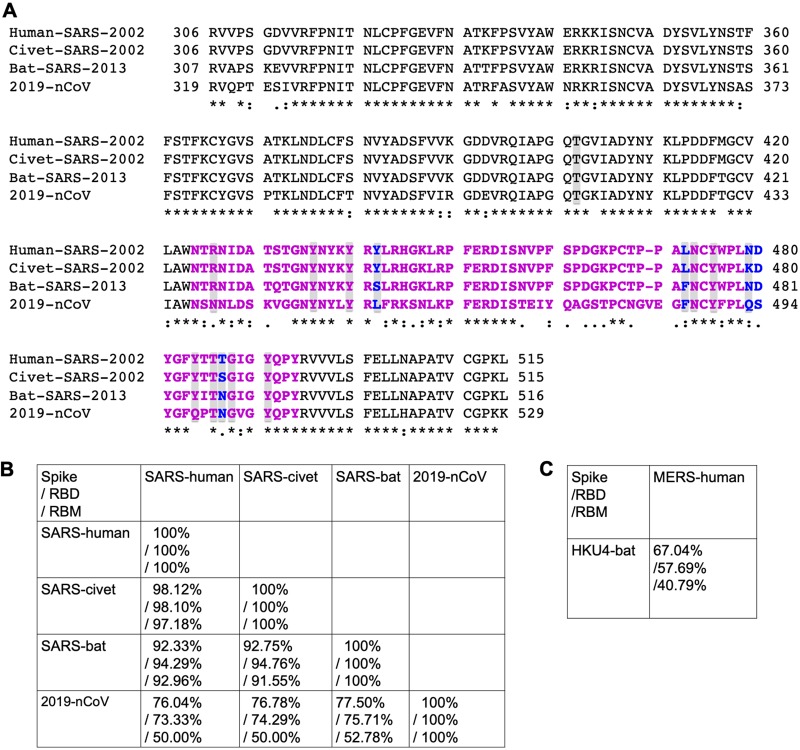
Recently, a novel coronavirus (2019-nCoV) has emerged from Wuhan, China, causing symptoms in humans similar to those caused by severe acute respiratory syndrome coronavirus (SARS-CoV). Since the SARS-CoV outbreak in 2002, extensive structural analyses have revealed key atomic-level interactions between the SARS-CoV spike protein receptor-binding domain (RBD) and its host receptor angiotensin-converting enzyme 2 (ACE2), which regulate both the cross-species and human-to-human transmissions of SARS-CoV. Here, we analyzed the potential receptor usage by 2019-nCoV, based on the rich knowledge about SARS-CoV and the newly released sequence of 2019-nCoV. First, the sequence of 2019-nCoV RBD, including its receptor-binding motif (RBM) that directly contacts ACE2, is similar to that of SARS-CoV, strongly suggesting that 2019-nCoV uses ACE2 as its receptor. Second, several critical residues in 2019-nCoV RBM (particularly Gln493) provide favorable interactions with human ACE2, consistent with 2019-nCoV's capacity for human cell infection. Third, several other critical residues in 2019-nCoV RBM (particularly Asn501) are compatible with, but not ideal for, binding human ACE2, suggesting that 2019-nCoV has acquired some capacity for human-to-human transmission. Last, while phylogenetic analysis indicates a bat origin of 2019-nCoV, 2019-nCoV also potentially recognizes ACE2 from a diversity of animal species (except mice and rats), implicating these animal species as possible intermediate hosts or animal models for 2019-nCoV infections. These analyses provide insights into the receptor usage, cell entry, host cell infectivity and animal origin of 2019-nCoV and may help epidemic surveillance and preventive measures against 2019-nCoV. The recent emergence of Wuhan coronavirus (2019-nCoV) puts the world on alert. 2019-nCoV is reminiscent of the SARS-CoV outbreak in 2002 to 2003. Our decade-long structural studies on the receptor recognition by SARS-CoV have identified key interactions between SARS-CoV spike protein and its host receptor angiotensin-converting enzyme 2 (ACE2), which regulate both the cross-species and human-to-human transmissions of SARS-CoV. One of the goals of SARS-CoV research was to build an atomic-level iterative framework of virus-receptor interactions to facilitate epidemic surveillance, predict species-specific receptor usage, and identify potential animal hosts and animal models of viruses. Based on the sequence of 2019-nCoV spike protein, we apply this predictive framework to provide novel insights into the receptor usage and likely host range of 2019-nCoV. This study provides a robust test of this reiterative framework, providing the basic, translational, and public health research communities with predictive insights that may help study and battle this novel 2019-nCoV.
最近,一种新型冠状病毒(2019-nCoV)从中国武汉出现,其引起人类的症状与严重急性呼吸系统综合征冠状病毒(SARS-CoV)引起的症状相似。自 2002 年 SARS-CoV 爆发以来,广泛的结构分析揭示了 SARS-CoV 刺突蛋白受体结合域(RBD)与其宿主受体血管紧张素转化酶 2(ACE2)之间的关键原子级相互作用,这些相互作用调节了 SARS-CoV 的跨物种和人与人之间的传播。在这里,我们根据 SARS-CoV 的丰富知识和新发布的 2019-nCoV 序列,分析了 2019-nCoV 的潜在受体用途。首先,2019-nCoV 的 RBD 序列,包括其直接与 ACE2 接触的受体结合基序(RBM),与 SARS-CoV 相似,强烈表明 2019-nCoV 使用 ACE2 作为其受体。其次,2019-nCoV RBM 中的几个关键残基(特别是 Gln493)与人类 ACE2 提供有利的相互作用,与 2019-nCoV 感染人类细胞的能力一致。第三,2019-nCoV RBM 中的其他几个关键残基(特别是 Asn501)与结合人类 ACE2 相容,但不理想,表明 2019-nCoV 已获得了一定的人与人之间传播的能力。最后,尽管系统发育分析表明 2019-nCoV 源自蝙蝠,但 2019-nCoV 也可能识别来自多种动物物种(除了小鼠和大鼠)的 ACE2,暗示这些动物物种可能是 2019-nCoV 感染的中间宿主或动物模型。这些分析提供了对 2019-nCoV 的受体用途、细胞进入、宿主细胞感染性和动物起源的深入了解,并可能有助于 2019-nCoV 的流行监测和预防措施。武汉冠状病毒(2019-nCoV)的最近出现引起了全世界的警惕。2019-nCoV 让人想起 2002 年至 2003 年的 SARS-CoV 爆发。我们对 SARS-CoV 受体识别的十年结构研究确定了 SARS-CoV 刺突蛋白与其宿主受体血管紧张素转化酶 2(ACE2)之间的关键相互作用,这些相互作用调节了 SARS-CoV 的跨物种和人与人之间的传播。SARS-CoV 研究的目标之一是建立病毒-受体相互作用的原子级迭代框架,以促进流行监测、预测物种特异性受体用途以及识别潜在的动物宿主和病毒动物模型。基于 2019-nCoV 刺突蛋白的序列,我们应用这个预测框架来深入了解 2019-nCoV 的受体用途和可能的宿主范围。这项研究对这个迭代框架进行了强有力的检验,为基础、转化和公共卫生研究界提供了预测性的见解,这些见解可能有助于研究和对抗这种新型 2019-nCoV。