Microfluidic and Biological Engineering, Helmholtz Pioneer Campus, Helmholtz Zentrum München, Ingolstaedter Landstr. 1, 85764, Neuherberg, Germany.
Microfluidic and Biological Engineering, IMTEK, University of Freiburg, Georges-Koehler-Allee 103, 79110, Freiburg, Germany.
Sci Rep. 2020 Jan 29;10(1):1457. doi: 10.1038/s41598-020-58238-6.
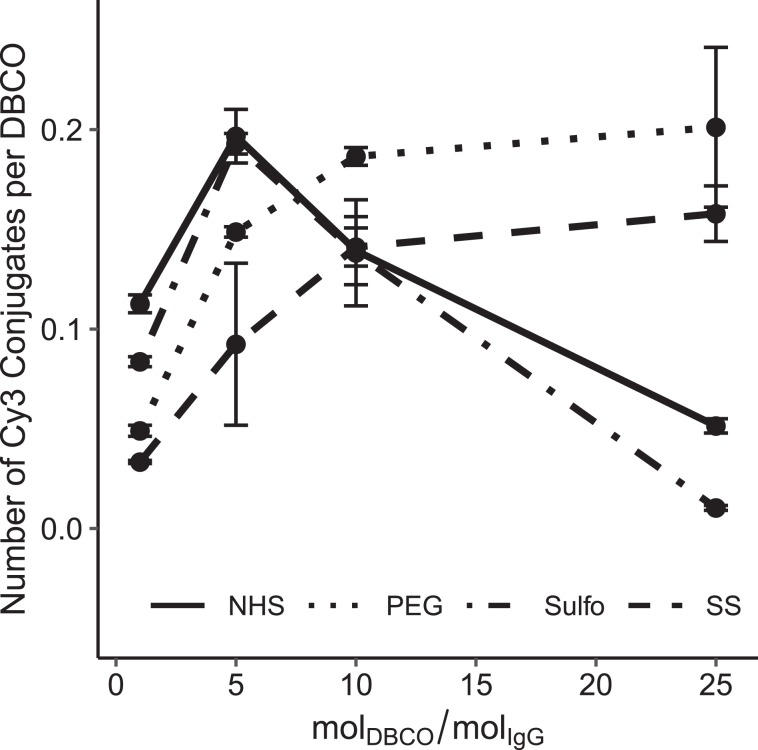
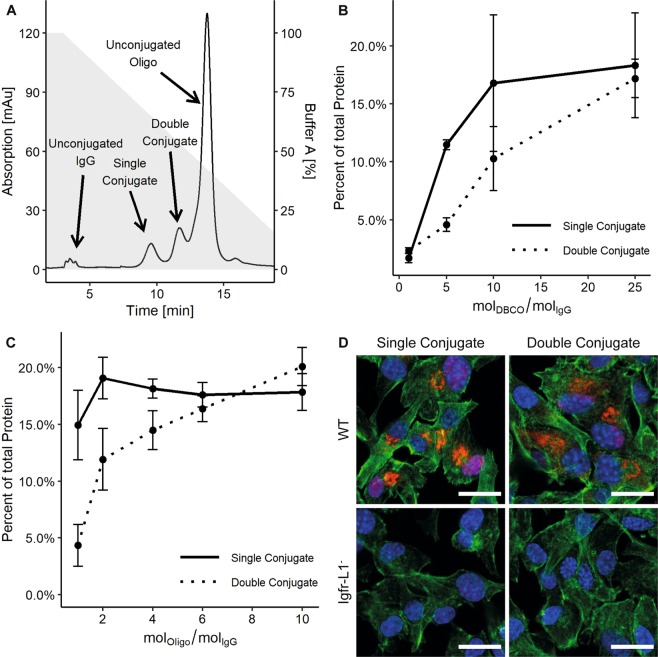
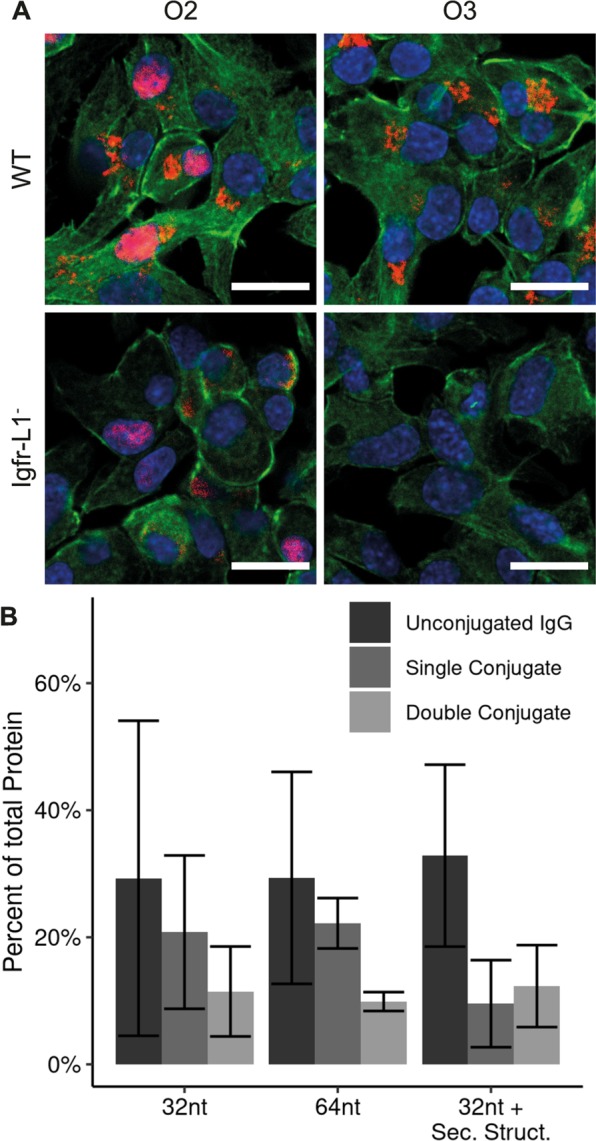
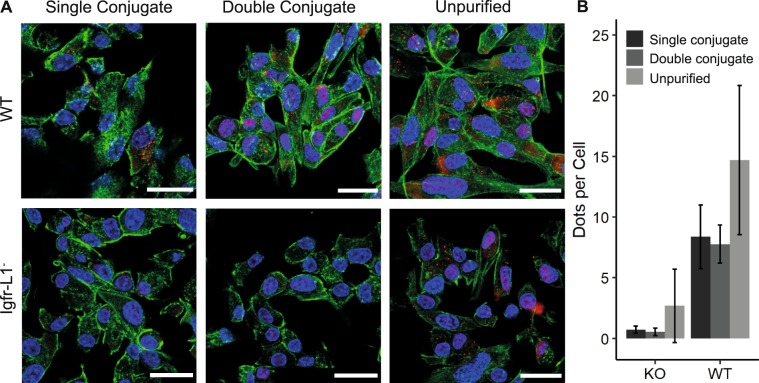
Oligonucleotide-conjugated antibodies have gained importance for their use in protein diagnostics. The possibility to transfer the readout signal from the protein to the DNA level with an oligonucleotide-conjugated antibody increased the sensitivity of protein assays by orders of magnitude and enabled new multiplexing strategies. A bottleneck in the generation of larger oligonucleotide-conjugated antibody panels is the low conjugation yield between antibodies and oligonucleotides, as well as the lack of product purification methods. In this study, we combined a non-site-directed antibody conjugation technique using copper-free click chemistry with ion-exchange chromatography to obtain purified single and double oligonucleotide-conjugated antibodies. We optimized the click conjugation reaction of antibodies with oligonucleotides by evaluating crosslinker, reaction temperature, duration, oligonucleotide length, and secondary structure. As a result, we were able to achieve conjugation yields of 30% at a starting quantity as low as tens of nanograms of antibody, which makes the approach applicable for a wide variety of protein analytical assays. In contrast to previous non-site-directed conjugation methods, we also optimized the conjugation reaction for antibody specificity, confirmed by testing with knockout cell lines. The advantages of using single or double oligonucleotide-conjugated antibodies in regards to signal noise reduction are shown within immunofluorescence, proximity ligation assays, and single cell CITE-seq experiments.
寡核苷酸偶联抗体因其在蛋白质诊断中的应用而受到重视。通过寡核苷酸偶联抗体将读出信号从蛋白质转移到 DNA 水平的可能性,使蛋白质分析的灵敏度提高了几个数量级,并实现了新的多重化策略。在生成更大的寡核苷酸偶联抗体面板时,一个瓶颈是抗体和寡核苷酸之间的低偶联产率,以及缺乏产品纯化方法。在这项研究中,我们结合了一种非定点抗体偶联技术,使用无铜点击化学和离子交换层析来获得纯化的单和双寡核苷酸偶联抗体。我们通过评估交联剂、反应温度、持续时间、寡核苷酸长度和二级结构,优化了抗体与寡核苷酸的点击偶联反应。结果,我们能够在起始抗体数量低至数十纳克的情况下实现 30%的偶联产率,这使得该方法适用于各种蛋白质分析测定。与以前的非定点偶联方法相比,我们还针对抗体特异性优化了偶联反应,通过对敲除细胞系的测试得到了验证。在免疫荧光、邻近连接分析和单细胞 CITE-seq 实验中,展示了单或双寡核苷酸偶联抗体在降低信号噪声方面的优势。