Bach Michael, Meroni Cornelia, Heinrich Sven P
Eye Center, Medical Center, University of Freiburg, Killianstr. 5, 79106, Freiburg, Germany.
Faculty of Medicine, University of Freiburg, Freiburg, Germany.
Doc Ophthalmol. 2020 Aug;141(1):57-64. doi: 10.1007/s10633-020-09751-6. Epub 2020 Jan 29.
To compare dark-adapted (DA) ERG between 10, 15 and 20 min of dark adaptation (DA).
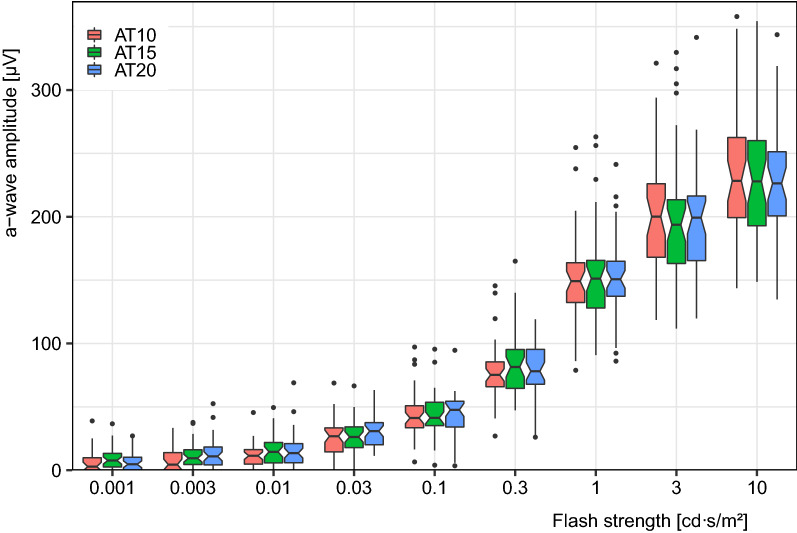
In a counterbalanced random block design, 40 healthy adult subjects were dark-adapted for 10, 15 or 20 min before we recorded ERGs to nine flash strengths from 0.001 to 10.0 cd s/m (dilated pupils) with a DTL-like electrode. Before and between sessions, the room was lit. Apart from choosing a wider range of stimulus strengths, and adding shorter DA times, the recordings fully complied with the ISCEV ERG Standard, namely using corneal electrodes, mydriasis and a standard DA sequence.
The a-wave amplitude was not affected by any adaptation condition. For the b-wave amplitude, effects of reduced DA time are stronger for weaker flashes: Reducing DA from 20 to 10 min had no measurable effect on the DA 3 ERG, but reduced the DA 0.01 b-wave significantly (p < 0.0001) to 87 ± 2% (mean ± SEM). The DA 0.001 b-wave (not part of the ISCEV ERG Standard) was more affected (down to 72 ± 4%). There was a small, but significant, increase, only for weak flashes, in a- and b-wave peak times for 20 compared to 10-min dark adaptation time.
Reducing dark adaptation time from 20 to 10 min in normal participants has no effect on the ISCEV DA 3 and DA 10 ERG. The reduction in DA 0.01 ERGs to 87 ± 2% agrees with Hamilton and Graham (Doc Ophthalmol 133:11-19, 2016. https://doi.org/10.1007/s10633-016-9554-x ) who found 90 ± 2% and with Asakawa et al. (Doc Ophthalmol 139:33-44, 2019. https://doi.org/10.1007/s10633-019-09693-8 ) who found 83%. Pending verification in pathophysiological states, the current results suggest that one might be able to correct for the 10% amplitude loss when gaining 10 min through shortened DA.
比较暗适应10分钟、15分钟和20分钟时的暗适应(DA)视网膜电图(ERG)。
采用平衡随机区组设计,40名健康成年受试者在暗适应10分钟、15分钟或20分钟后,我们使用类似DTL的电极记录了从0.001至10.0cd·s/m的九种闪光强度(散瞳状态下)的ERG。在实验前和各阶段之间,房间保持照明。除了选择更宽范围的刺激强度并增加更短的暗适应时间外,记录完全符合国际临床视觉电生理学会(ISCEV)的ERG标准,即使用角膜电极、散瞳和标准的暗适应程序。
a波振幅不受任何适应条件的影响。对于b波振幅,暗适应时间缩短对较弱闪光的影响更强:将暗适应时间从20分钟减少到10分钟对暗适应3的ERG没有可测量的影响,但显著降低了暗适应0.01的b波(p<0.0001)至87±2%(平均值±标准误)。暗适应0.001的b波(不属于ISCEV ERG标准)受影响更大(降至72±4%)。与暗适应10分钟相比,暗适应20分钟时,仅对于弱闪光,a波和b波的峰值时间有小但显著的增加。
在正常受试者中将暗适应时间从20分钟减少到10分钟对ISCEV暗适应3和暗适应10的ERG没有影响。暗适应0.01的ERG降低至87±2%与汉密尔顿和格雷厄姆(《眼科文献》133:11 - 19, 2016. https://doi.org/10.1007/s10633-016-9554-x )发现的90±2%以及浅川等人(《眼科文献》139:33 - 44, 2019. https://doi.org/10.1007/s10633-019-09693-8 )发现的83%一致。在病理生理状态下进行验证之前,目前的结果表明,当通过缩短暗适应时间节省10分钟时,可能能够校正10%的振幅损失。