State Key Laboratory of Oral Diseases, National Clinical Research Center for Oral Diseases, Chinese Academy of Medical Sciences Research Unit of Oral Carcinogenesis and Management, West China Hospital of Stomatology, Sichuan University, Chengdu, China.
Department of Oral Pathology, Department of Dental Materials, School of Stomatology, China Medical University, Shenyang, China.
Mol Oncol. 2020 Apr;14(4):795-807. doi: 10.1002/1878-0261.12644. Epub 2020 Feb 20.
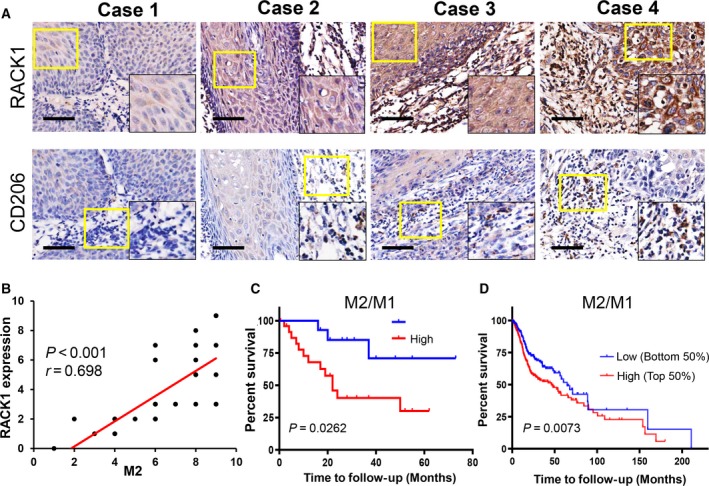
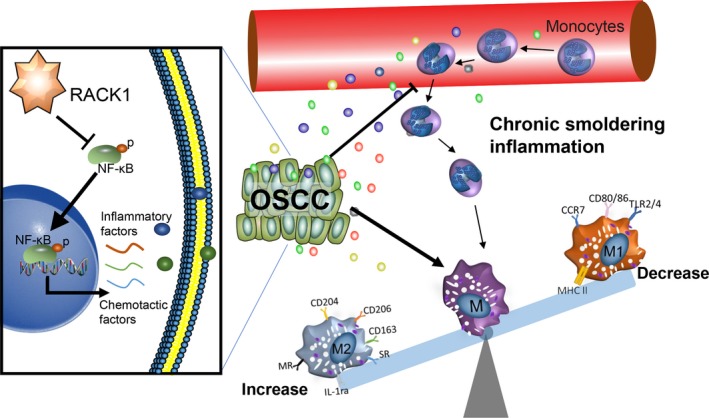
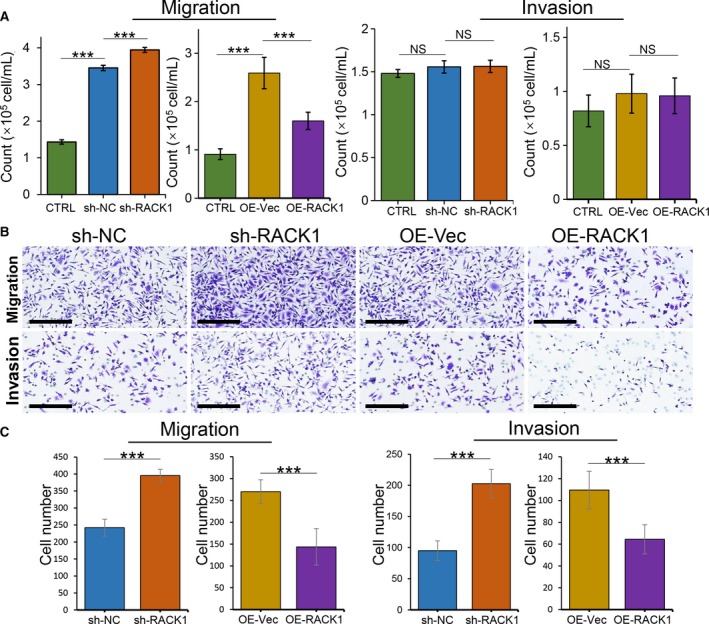
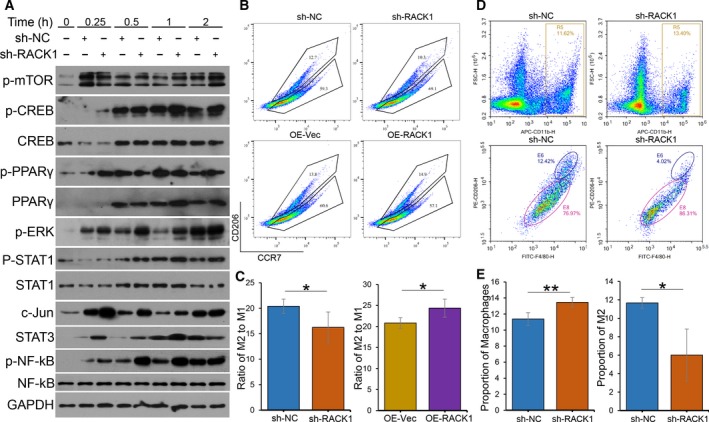
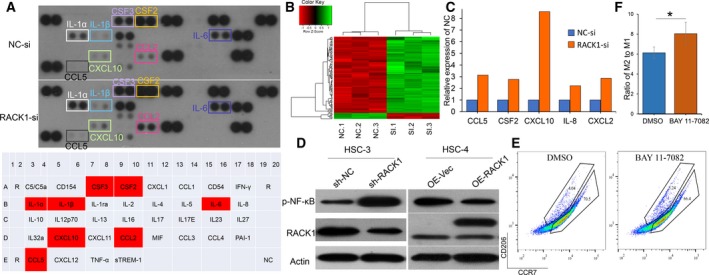
Receptor for activated C kinase 1 (RACK1) has been shown to promote oral squamous cell carcinoma (OSCC) progression, and RACK1 expression levels have been negatively correlated with prognosis in patients with OSCC. Here, we investigated the impact of RACK1 OSCC expression on the recruitment and differentiation of tumor-associated macrophages. High RACK1 expression in OSCC cells correlated with increased M2 macrophage infiltration in tumor samples from a clinical cohort study. Moreover, the combination of RACK1 expression and the M2/M1 ratio could successfully predict prognosis in OSCC. OSCC cells with high RACK1 expression inhibited the migration of THP-1 cells, promoted M2-like macrophage polarization in vitro, and increased the proportion of M2-like macrophages in a xenograft mouse model. Moreover, both M1- and M2-like macrophage polarization-associated proteins were induced in macrophages cocultured with RACK1-silenced cell supernatant. A mechanistic study revealed that the expression and secretion of C-C motif chemokine 2 (CCL2), C-C motif chemokine 5 (CCL5), interleukin-6 (IL-6), and interleukin-1 (IL-1) are closely related to RACK1 expression. In addition, blocking nuclear factor-kappa B (NF-κB) could promote M2-like macrophage polarization. These results indicate that RACK1 and the M2/M1 ratio are predictors of a poor prognosis in OSCC. RACK1 promotes M2-like polarization by regulating NF-κB and could be used as a potential therapeutic target for antitumor immunity.
受体激活蛋白激酶 1(RACK1)已被证明可促进口腔鳞状细胞癌(OSCC)的进展,并且 RACK1 的表达水平与 OSCC 患者的预后呈负相关。在这里,我们研究了 RACK1 在 OSCC 中的表达对肿瘤相关巨噬细胞的募集和分化的影响。临床队列研究的肿瘤样本中,OSCC 细胞中 RACK1 高表达与 M2 巨噬细胞浸润增加相关。此外,RACK1 表达与 M2/M1 比值的组合可成功预测 OSCC 的预后。RACK1 高表达的 OSCC 细胞抑制 THP-1 细胞的迁移,在体外促进 M2 样巨噬细胞极化,并增加异种移植小鼠模型中 M2 样巨噬细胞的比例。此外,与 M1 和 M2 样巨噬细胞极化相关的蛋白在与沉默 RACK1 的细胞上清共培养的巨噬细胞中均被诱导。一项机制研究表明,C-C 基序趋化因子 2(CCL2)、C-C 基序趋化因子 5(CCL5)、白细胞介素 6(IL-6)和白细胞介素 1(IL-1)的表达和分泌与 RACK1 表达密切相关。此外,阻断核因子-κB(NF-κB)可促进 M2 样巨噬细胞极化。这些结果表明,RACK1 和 M2/M1 比值是 OSCC 预后不良的预测因子。RACK1 通过调节 NF-κB 促进 M2 样极化,可作为抗肿瘤免疫的潜在治疗靶点。