Department of Ultrasound, Sun Yat-Sen University Cancer Center, State Key Laboratory of Oncology in South China, Collaborative Innovation Center for Cancer Medicine, Guangzhou, China.
Department of Anesthesiology, Sun Yat-Sen University Cancer Center, State Key Laboratory of Oncology in South China, Collaborative Innovation Center for Cancer Medicine, Guangzhou, China.
Korean J Radiol. 2020 Feb;21(2):172-180. doi: 10.3348/kjr.2019.0453.
To determine the added value of a shear-wave elastography (SWE) quality map (QM) in the diagnosis of breast lesions and in predicting the biological characteristics of invasive breast cancer.
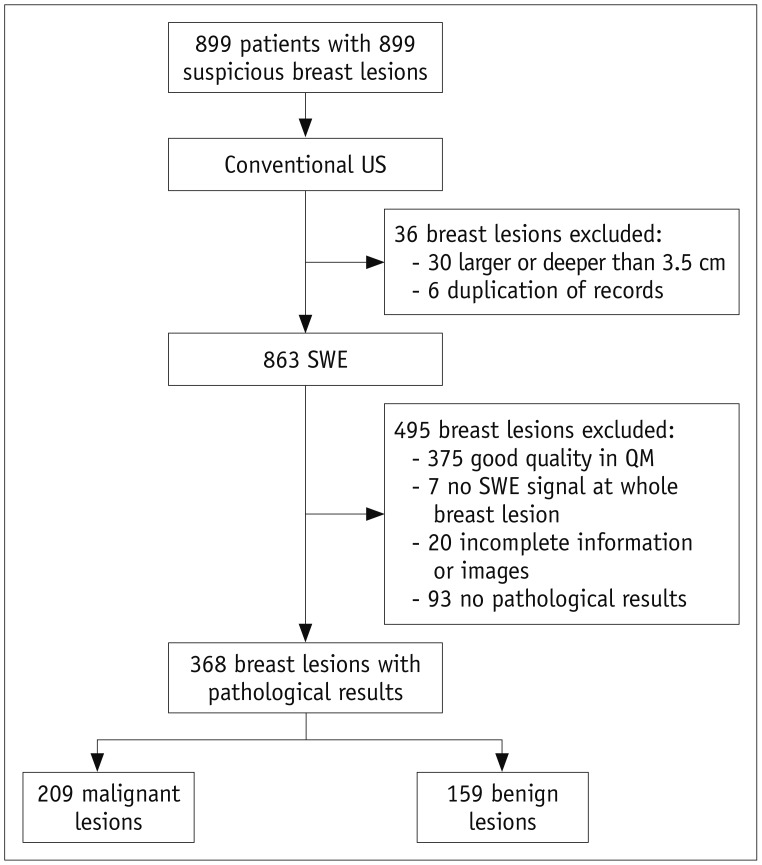
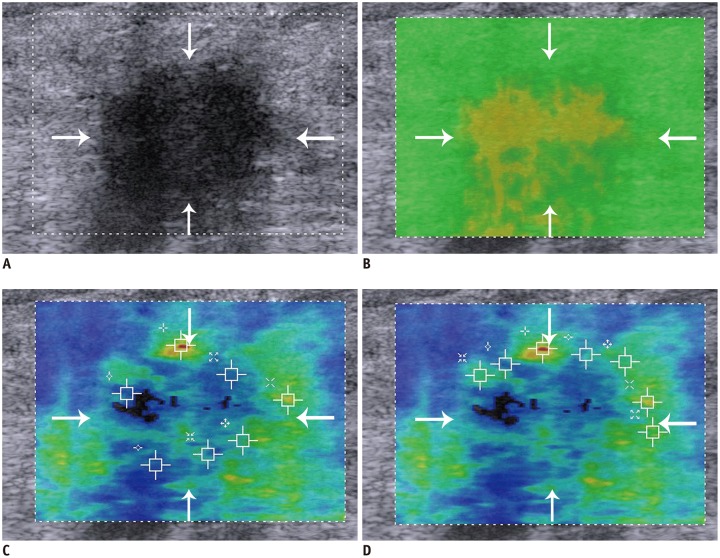
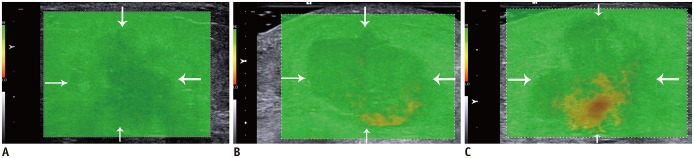
Between January 2016 and February 2019, this study included 368 women with 368 pathologically proven breast lesions, which appeared as poor-quality regions in the QM of SWE. To measure shear-wave velocity (SWV), seven regions of interest were placed in each lesion with and without QM guidance. Under QM guidance, poor-quality areas were avoided. Diagnostic performance was calculated for mean SWV (SWV), max SWV (SWV), and standard deviation (SD) with QM guidance (SWV + QM, SWV + QM, and SD + QM, respectively) and without QM guidance (SWV - QM, SWV - QM, and SD - QM, respectively). For invasive cancers, the relationship between SWV findings and biological characteristics was investigated with and without QM guidance.
Of the 368 women (mean age, 47 years; SD, 10.8 years) enrolled, 159 had benign breast lesions and 209 had malignant breast lesions. SWV + QM (3.6 ± 1.39 m/s) and SD + QM (1.02 ± 0.84) were significantly different from SWV - QM (3.29 ± 1.22 m/s) and SD - QM (1.46 ± 1.06), respectively (all < 0.001). For differential diagnosis of breast lesions, the sensitivity and areas under the receiver operating characteristic curve (AUC) of SWV + QM (sensitivity: 89%; AUC: 0.932) were better than those of SWV - QM (sensitivity, 84.2%; AUC, 0.912) (all < 0.05). There was no significant difference in sensitivity and specificity between SD + QM and SD - QM (all = 1.000). Among the biological characteristics of invasive cancers, lymphovascular involvement, axillary lymph node metastasis, negative estrogen receptor status, negative progesterone receptor status, positive human epidermal growth factor receptor status, and aggressive molecular subtypes showed higher SWV + QM (all < 0.05), while only lymphovascular involvement showed higher SWV - QM ( = 0.036).
The use of QM in SWE might improve the diagnostic performance for breast lesions and facilitate prediction of the biological characteristics of invasive breast cancers.
确定剪切波弹性成像(SWE)质量图(QM)在诊断乳腺病变和预测浸润性乳腺癌生物学特征方面的附加价值。
本研究纳入了 2016 年 1 月至 2019 年 2 月期间 368 名经病理证实的乳腺病变女性患者,这些患者的 SWE QM 呈现为质量差的区域。为了测量剪切波速度(SWV),在有和没有 QM 引导的情况下,每个病变的 7 个感兴趣区域被放置。在 QM 引导下,避开质量差的区域。分别在有和没有 QM 引导(SWV-QM、SWV-QM 和 SD-QM)的情况下计算平均 SWV(SWV)、最大 SWV(SWV)和标准差(SD)的诊断性能(SWV+QM、SWV+QM 和 SD+QM)。对于浸润性癌,研究了有和没有 QM 引导时 SWV 结果与生物学特征之间的关系。
在纳入的 368 名女性(平均年龄 47 岁,标准差 10.8 岁)中,159 名患有良性乳腺病变,209 名患有恶性乳腺病变。SWV+QM(3.6±1.39m/s)和 SD+QM(1.02±0.84)与 SWV-QM(3.29±1.22m/s)和 SD-QM(1.46±1.06)之间存在显著差异(均<0.001)。对于乳腺病变的鉴别诊断,SWV+QM 的敏感性和受试者工作特征曲线(ROC)下面积(AUC)(敏感性:89%;AUC:0.932)优于 SWV-QM(敏感性,84.2%;AUC,0.912)(均<0.05)。SD+QM 和 SD-QM 的敏感性和特异性之间没有显著差异(均=1.000)。在浸润性癌的生物学特征中,脉管侵犯、腋窝淋巴结转移、雌激素受体阴性、孕激素受体阴性、人表皮生长因子受体阳性和侵袭性分子亚型的 SWV+QM 较高(均<0.05),而仅脉管侵犯的 SWV-QM 较高(=0.036)。
SWE 中 QM 的使用可能会提高乳腺病变的诊断性能,并有助于预测浸润性乳腺癌的生物学特征。