Department of Medical Imaging, Jinling Hospital, Medical School of Nanjing University, Nanjing, China.
Division of Cardiovascular Imaging, Department of Radiology and Radiological Science, Medical University of South Carolina, Charleston, SC, USA.
Korean J Radiol. 2020 Feb;21(2):192-202. doi: 10.3348/kjr.2019.0230.
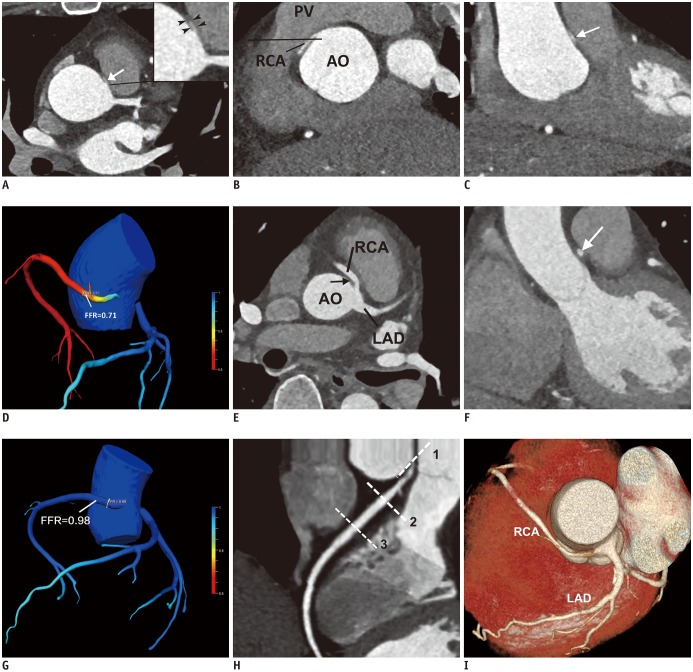
To examine the fractional flow reserve derived from computed tomographic angiography (CT-FFR) in patients with anomalous origin of the right coronary artery from the left coronary sinus (R-ACAOS) with an interarterial course, assess the relationship of CT-FFR with the anatomical features of interarterial R-ACAOS on coronary computed tomographic angiography (CCTA), and determine its clinical relevance.
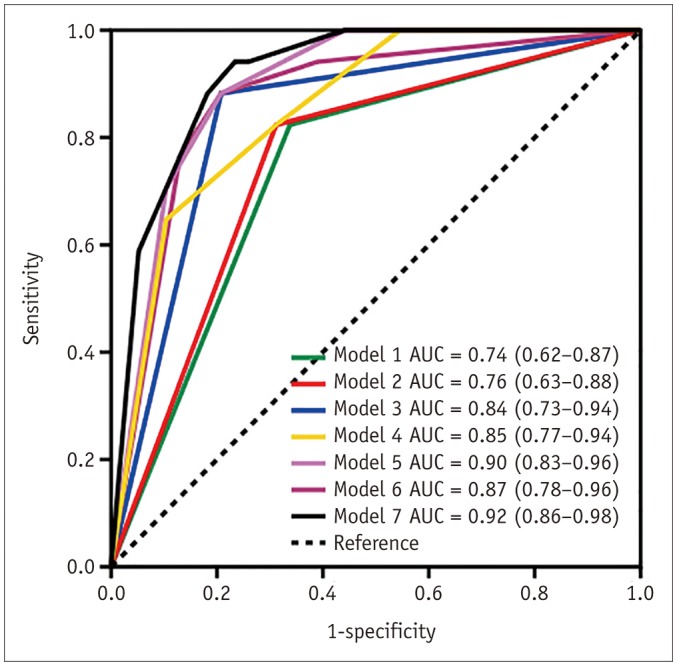
Ninety-four patients with interarterial R-ACAOS undergoing CCTA were retrospectively included. Anatomic features (proximal vessel morphology [oval or slit-like], take-off angle, take-off level [below or above the pulmonary valve], take-off type, intramural course, % proximal narrowing area, length of narrowing, minimum luminal area [MLA] at systole and diastole, and vessel compression index) on CCTA associated with CT-FFR ≤ 0.80 were analyzed. Receiver operating characteristic analysis was performed to describe the diagnostic performance of CT-FFR ≤ 0.80 in detecting interarterial R-ACAOS.
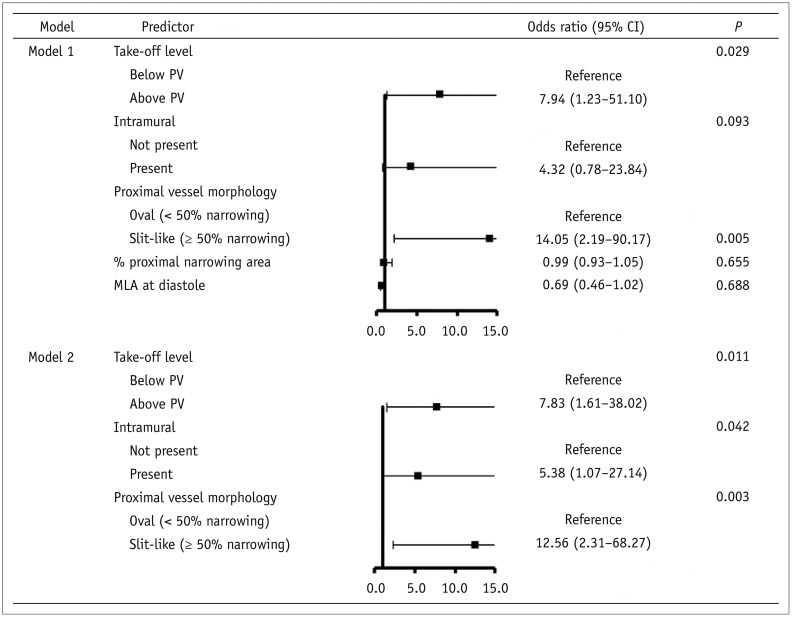
Significant differences were found in proximal vessel morphology, take-off level, intramural course, % proximal narrowing area, and MLA at diastole (all < 0.05) between the normal and abnormal CT-FFR groups. Take-off level, intramural course, and slit-like ostium (all < 0.05) predicted hemodynamic abnormality (CT-FFR ≤ 0.80) with accuracies of 0.69, 0.71, and 0.81, respectively. Patients with CT-FFR ≤ 0.80 had a higher prevalence of typical angina (29.4% vs. 7.8%, = 0.025) and atypical angina (29.4% vs. 6.5%, = 0.016).
Take-off level, intramural course, and slit-like ostium were the main predictors of abnormal CT-FFR values. Importantly, patients with abnormal CT-FFR values showed a higher prevalence of typical angina and atypical angina, indicating that CT-FFR is a potential tool to gauge the clinical relevance in patients with interarterial R-ACAOS.
探讨冠状动脉计算机断层血管造影术(CCTA)显示的右冠状动脉(RCA)发自左冠状动脉窦(LCX)伴体动脉型起源(R-ACAOS)患者的分流量储备(FFR)值,分析其与 CCTA 显示的 RCA 体动脉型起源解剖特征的相关性,并探讨其临床意义。
回顾性纳入 94 例 RCA 体动脉型起源患者的 CCTA 资料。分析 CCTA 显示的解剖特征(近端血管形态[卵圆形或裂隙样]、起始角度、起始水平[肺动脉瓣下或上]、起始类型、壁内走行、近端狭窄面积百分比、狭窄长度、收缩期和舒张期最小管腔面积[MLA]、血管受压指数)与 CT-FFR 值≤0.80 的关系。采用受试者工作特征(ROC)曲线分析 CT-FFR 值≤0.80 对 RCA 体动脉型起源的诊断效能。
CT-FFR 值正常组与异常组间近端血管形态、起始水平、壁内走行、近端狭窄面积百分比、舒张期 MLA 差异均有统计学意义(均<0.05)。起始水平、壁内走行、裂隙样开口(均<0.05)对 RCA 体动脉型起源伴 RCA 血流动力学异常(CT-FFR 值≤0.80)有较高的预测价值,其准确度分别为 0.69、0.71、0.81。CT-FFR 值≤0.80 组患者更易出现典型心绞痛(29.4%比 7.8%, = 0.025)和不典型心绞痛(29.4%比 6.5%, = 0.016)。
起始水平、壁内走行、裂隙样开口是 RCA 体动脉型起源伴 RCA 血流动力学异常的主要预测因素。重要的是,CT-FFR 值异常患者更易出现典型心绞痛和不典型心绞痛,提示 CT-FFR 值可能是评估 RCA 体动脉型起源患者临床意义的一种潜在工具。