Pangtey Ruchira, Basu Saurav, Meena Gajendra Singh, Banerjee Bratati
Department of Community Medicine, Maulana Azad Medical College, New Delhi, India.
Indian J Psychol Med. 2020 Jan 6;42(1):80-86. doi: 10.4103/IJPSYM.IJPSYM_528_18. eCollection 2020 Jan-Feb.
Increasing stress has been recognized as a major public health problem in the developing world accelerated by an ongoing demographic, economic, and sociocultural transition. Our study objectives were to validate a Hindi version of the 10-item Perceived Stress Scale (PSS-10) and to also assess the extent of perceived stress and its correlates among an adult population in an urban area of Delhi.
A community-based cross-sectional study was conducted in an urban resettlement colony of Delhi among 480 adult subjects aged 25--65 years, during the period from January to December 2015. The PSS-10 was translated into Hindi and validated in the study population. Data was analyzed using IBM SPSS Version 25.
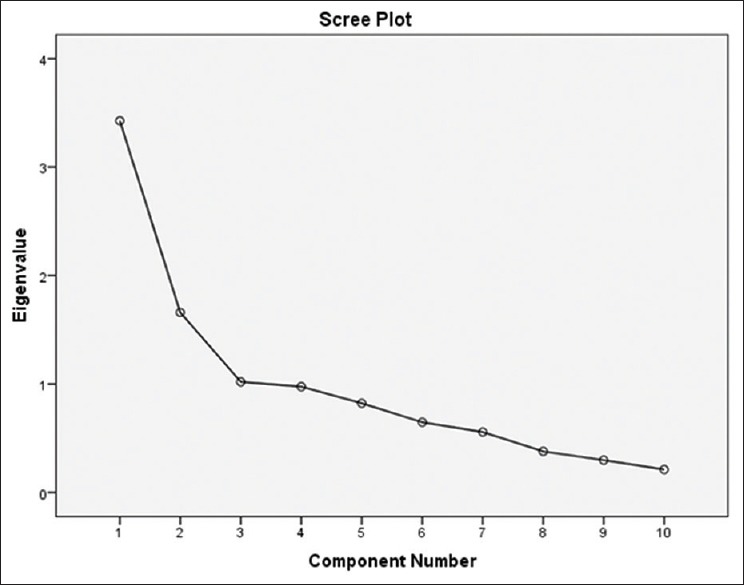
A total of 243 (50.6%) men and 237 (49.4%) women were enrolled. The scale had an acceptable level of internal consistency (Cronbach's alpha = 0.731). A principal component analysis was run on the PSS-10 data, based on which a three-component structure was accepted, which explained 61% of the total variance. The mean PSS score was 19.25 (SD = 4.50) years. Perceived stress was highest in the 35--50 age group. On multivariate analysis, low socioeconomic status and a white-collar occupation were found to be associated with increased perceived stress ( < 0.001).
A high burden of perceived stress exists in residents of a low-income urban population in India.
日益增加的压力已被公认为是发展中世界的一个主要公共卫生问题,这一问题因持续的人口、经济和社会文化转型而加速。我们的研究目标是验证印地语版的10项感知压力量表(PSS-10),并评估德里市区成年人群中感知压力的程度及其相关因素。
2015年1月至12月期间,在德里的一个城市安置区对480名年龄在25至65岁之间的成年受试者进行了一项基于社区的横断面研究。PSS-10被翻译成印地语并在研究人群中进行了验证。使用IBM SPSS 25版对数据进行分析。
共纳入243名男性(50.6%)和237名女性(49.4%)。该量表具有可接受的内部一致性水平(Cronbach's α = 0.731)。对PSS-10数据进行了主成分分析,在此基础上接受了一个三成分结构,该结构解释了总方差的61%。PSS平均得分是19.25(标准差 = 4.50)。35至50岁年龄组的感知压力最高。多因素分析显示,低社会经济地位和白领职业与感知压力增加相关(<0.001)。
印度低收入城市居民中存在着较高的感知压力负担。