Faay Margo D M, van Os Jim
Department of Psychiatry, University Medical Center Utrecht, Utrecht, Netherlands.
Department of Psychosis Studies, Institute of Psychiatry, King's College London, King's Health Partners, London, United Kingdom.
Front Psychiatry. 2020 Jan 8;10:934. doi: 10.3389/fpsyt.2019.00934. eCollection 2019.
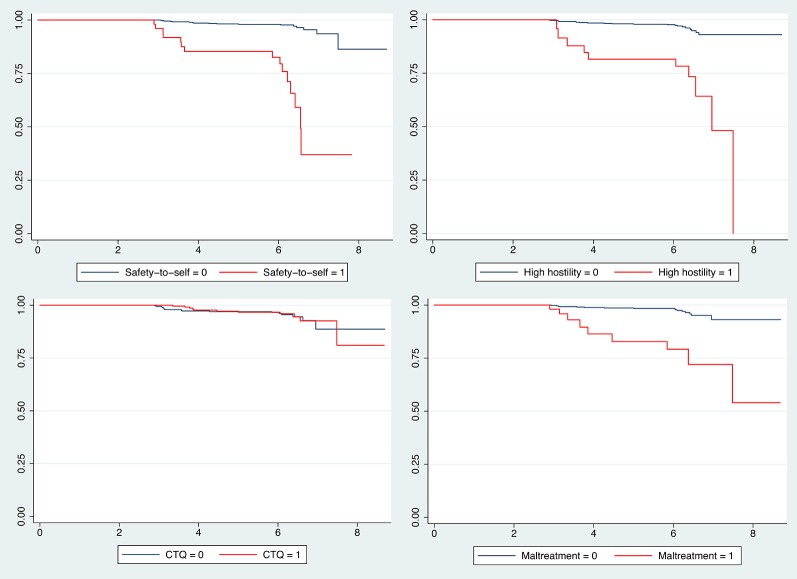
Hostility and aggressive behavior in patients with psychotic disorders are associated with demographic and clinical risk factors, as well as with childhood adversity and neglect. Care needs are an essential concept in clinical practice; care needs in the domain of safety for others reflect the actual problem the patient has. Hostility, aggressive behavior, and associated care needs, however, are often studied in retrospect. In a sample of 1,119 patients with non-affective psychotic disorders, who were interviewed three times over a period of 6 years, we calculated the incidence of hostility, self-reported maltreatment to others and care needs associated with safety for other people (safety-to-others). Regression analysis was used to analyze the association between these outcomes and risk factors. The population attributable fraction (PAF) was used to calculate the proportion of the outcome that could potentially be prevented if previous expressions of adverse behavior were eliminated. The yearly incidence of hostility was 2.8%, for safety-to-others 0.8% and for maltreatment this was 1.8%. Safety-to-others was associated with previous hostility and vice versa, but, assuming causality, only 18% of the safety-to-others needs was attributable to previous hostility while 26% was attributable to impulsivity. Hostility, maltreatment and safety-to-others were all associated with number of unmet needs, suicidal ideation and male sex. Hostility and maltreatment, but not safety-to-others, were associated with childhood adversity. Neither safety-to-others, maltreatment nor hostility were associated with premorbid adjustment problems. The incidence of hostility, self-reported aggressive behaviors, and associated care needs is low and linked to childhood adversity. Known risk factors for prevalence also apply to incidence and for care needs associated with safety for other people. Clinical symptoms can index aggressive behaviors years later, providing clinicians with some opportunity for preventing future incidents.
精神障碍患者的敌意和攻击行为与人口统计学及临床风险因素相关,也与童年逆境和忽视有关。护理需求是临床实践中的一个重要概念;对他人安全领域的护理需求反映了患者实际存在的问题。然而,敌意、攻击行为及相关护理需求通常是进行回顾性研究。在一个包含1119例非情感性精神障碍患者的样本中,这些患者在6年时间里接受了3次访谈,我们计算了敌意、自我报告的对他人的虐待行为以及与他人安全相关的护理需求(对他人安全)的发生率。采用回归分析来分析这些结果与风险因素之间的关联。人群归因分数(PAF)用于计算如果消除先前的不良行为表现,可能预防的结果比例。敌意的年发生率为2.8%,对他人安全为0.8%,虐待行为为1.8%。对他人安全与先前的敌意相关,反之亦然,但假设存在因果关系,只有18%的对他人安全需求可归因于先前的敌意,而26%可归因于冲动性。敌意、虐待行为和对他人安全均与未满足需求的数量、自杀意念和男性性别相关。敌意和虐待行为与童年逆境相关,但对他人安全与之无关。对他人安全、虐待行为和敌意均与病前适应问题无关。敌意、自我报告的攻击行为及相关护理需求的发生率较低,且与童年逆境有关。已知的患病率风险因素也适用于发病率以及与他人安全相关的护理需求。临床症状可以在数年后指示攻击行为,为临床医生提供一些预防未来事件的机会。