González Matías Nicolás, Massa Gabriela Alejandra, Andersson Mariette, Turesson Helle, Olsson Niklas, Fält Ann-Sofie, Storani Leonardo, Décima Oneto Cecilia Andrea, Hofvander Per, Feingold Sergio Enrique
Consejo Nacional de Investigaciones Científicas y Técnicas (CONICET), Buenos Aires, Argentina.
Laboratorio de Agrobiotecnología, INTA - EEA Balcarce, Balcarce, Argentina.
Front Plant Sci. 2020 Jan 9;10:1649. doi: 10.3389/fpls.2019.01649. eCollection 2019.
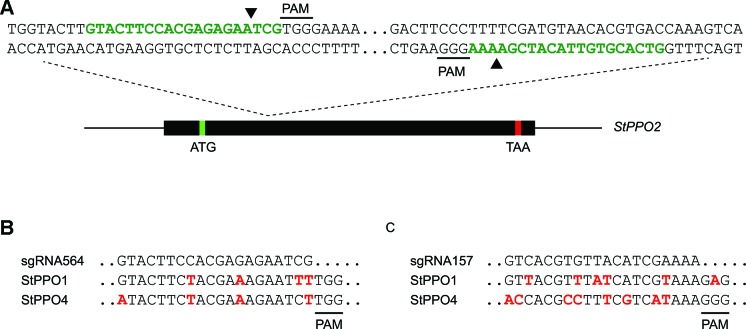
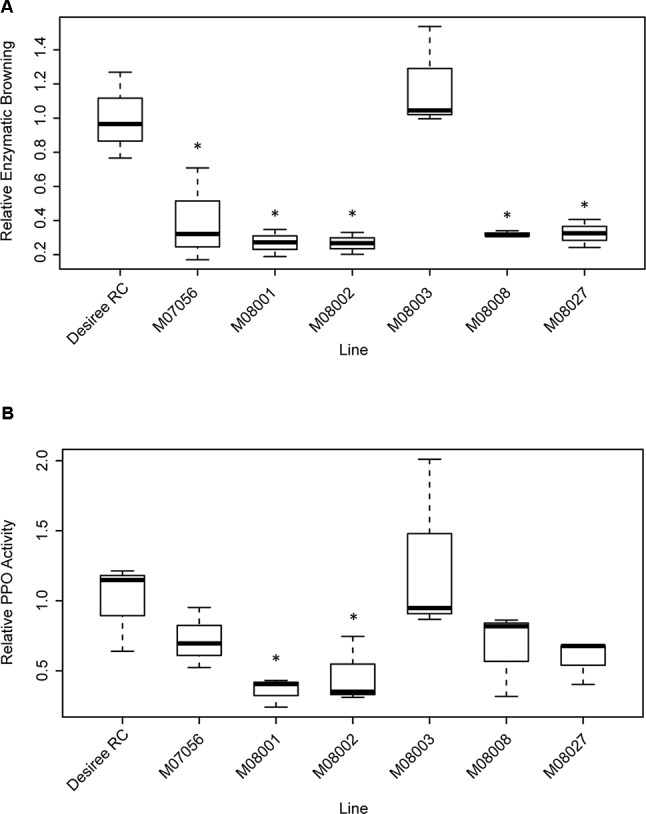
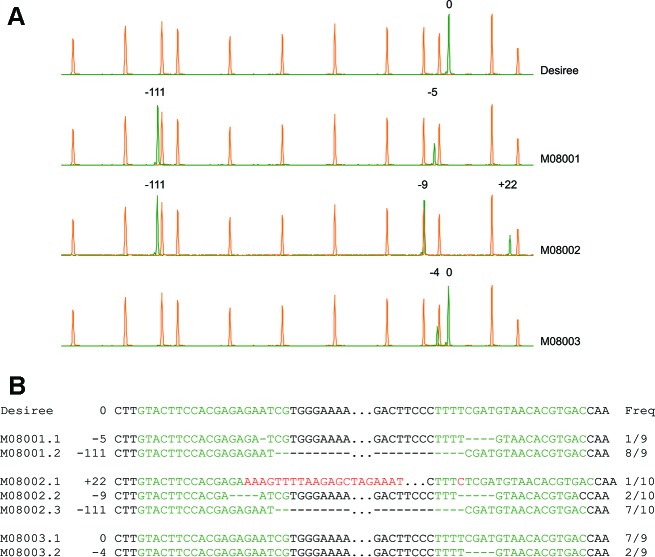
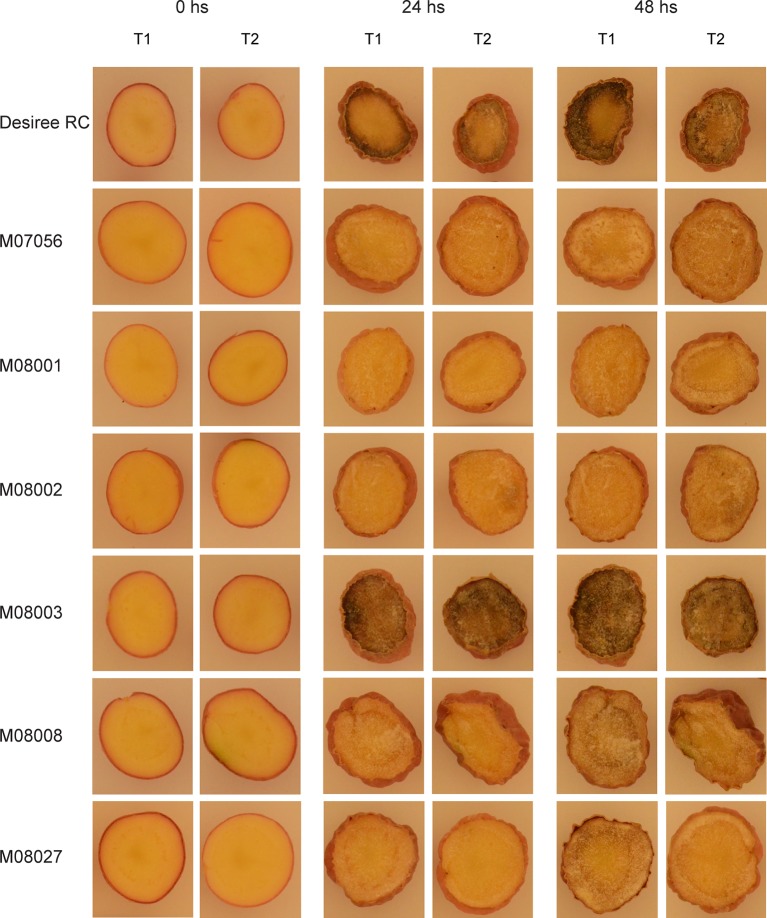
Polyphenol Oxidases (PPOs) catalyze the conversion of phenolic substrates to quinones, leading to the formation of dark-colored precipitates in fruits and vegetables. This process, known as enzymatic browning, is the cause of undesirable changes in organoleptic properties and the loss of nutritional quality in plant-derived products. In potato ( L.), PPOs are encoded by a multi-gene family with different expression patterns. Here, we have studied the application of the CRISPR/Cas9 system to induce mutations in the gene in the tetraploid cultivar Desiree. We hypothesized that the specific editing of this target gene would result in a lower PPO activity in the tuber with the consequent reduction of the enzymatic browning. Ribonucleoprotein complexes (RNPs), formed by two sgRNAs and Cas9 nuclease, were transfected to potato protoplasts. Up to 68% of regenerated plants contained mutations in at least one allele of the target gene, while 24% of edited lines carried mutations in all four alleles. No off-target mutations were identified in other analyzed genes. Mutations induced in the four alleles of gene, led to lines with a reduction of up to 69% in tuber PPO activity and a reduction of 73% in enzymatic browning, compared to the control. Our results demonstrate that the CRISPR/Cas9 system can be applied to develop potato varieties with reduced enzymatic browning in tubers, by the specific editing of a single member of the gene family.
多酚氧化酶(PPOs)催化酚类底物转化为醌类,导致水果和蔬菜中形成深色沉淀。这个过程,即酶促褐变,是植物源产品感官特性发生不良变化以及营养品质损失的原因。在马铃薯(Solanum tuberosum L.)中,PPOs由一个具有不同表达模式的多基因家族编码。在此,我们研究了CRISPR/Cas9系统在四倍体品种德西蕾中诱导该基因发生突变的应用。我们假设对这个靶基因进行特异性编辑会导致块茎中PPO活性降低,从而减少酶促褐变。由两个单向导RNA(sgRNAs)和Cas9核酸酶形成的核糖核蛋白复合物(RNPs)被转染到马铃薯原生质体中。高达68%的再生植株在靶基因的至少一个等位基因中含有突变,而24%的编辑株系在所有四个等位基因中都携带突变。在其他分析基因中未发现脱靶突变。与对照相比,该基因四个等位基因中诱导产生的突变导致块茎PPO活性降低高达69%,酶促褐变降低73%。我们的结果表明,通过对该基因家族的单个成员进行特异性编辑,CRISPR/Cas9系统可用于培育块茎酶促褐变降低的马铃薯品种。