Salama Esraa A, Adbeltawab Reda E, El Tayebi Hend M
Molecular Pharmacology Research Group, Department of Pharmacology and Toxicology, Faculty of Pharmacy and Biotechnology, German University in Cairo, Cairo, Egypt.
Department of Surgery, Faculty of Medicine, Ain Shams University, Cairo, Egypt.
Front Oncol. 2020 Jan 10;9:1459. doi: 10.3389/fonc.2019.01459. eCollection 2019.
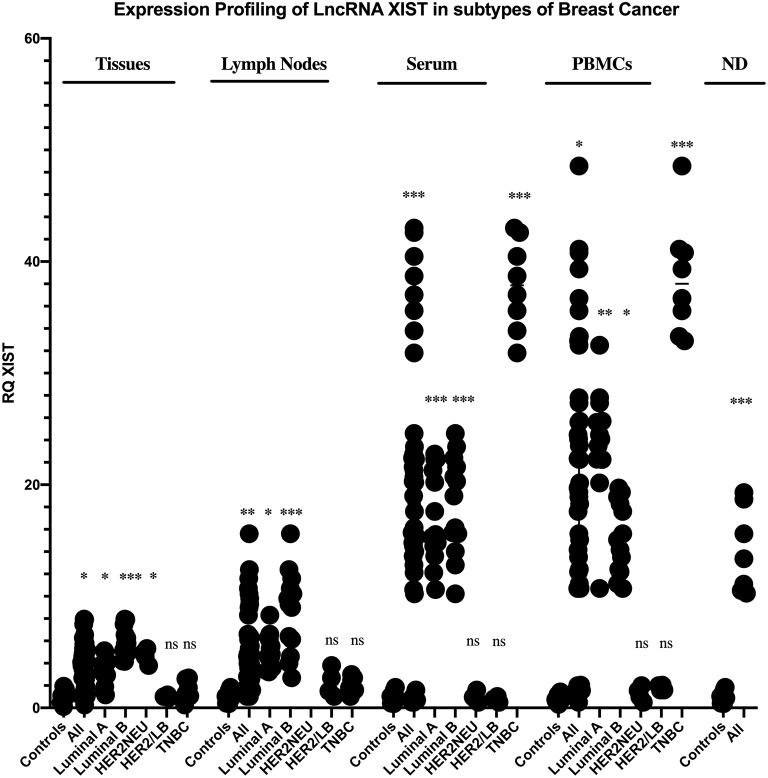
Escaping antitumor immunity is a hallmark in cancer progression. Programmed cell death protein 1 (PD-1) is an immune checkpoint receptor responsible for the maintenance of immune tolerance; PD-1 ligand (PD-L1) is overexpressed in tumor cells, simplifying their escape from the immune system through T-cell function suppression. Notwithstanding that cancer antigen (CA)125, carcinoembryonic antigen (CEA), CA15-3, and alpha-fetoprotein (AFP) are among conventional breast cancer diagnostic biomarkers, their lack of sensitivity and specificity resides among their major limitations. Furthermore, human epidermal growth factor receptor (HER)2 and interleukin (IL)-6-demonstrated as breast cancer immune biomarkers-still possess limitations, for instance, technical detection problems and stability problems, which necessitate the discovery of novel, stable non-invasive cancer immune biomarkers. XIST and TSIX are two long non-coding (lnc)RNAs possessing a role in X chromosome inactivation (XCI) as well as in breast cancer (BC). In the present study, they were investigated as stable non-invasive breast cancer immune biomarkers. The study demonstrated that PD-L1 was overexpressed in the different molecular subtypes of breast cancer patients as well as in MDA-MB-231 cells. Furthermore, lncRNAs XIST and TSIX were markedly increased in the tissues, lymph nodes, and different body fluids of breast cancer patients compared to controls. In addition, XIST and TSIX were differentially expressed in subtypes of BC patients, and their levels were correlated to PD-L1 expression level. In conclusion, this correlative study has shed light on the role of both lncRNAs XIST and TSIX as potential non-invasive BC immune biomarkers reflecting the evaded immune system of the patient and overcoming the instability problem of common BC biomarkers.
逃避抗肿瘤免疫是癌症进展的一个标志。程序性细胞死亡蛋白1(PD-1)是一种负责维持免疫耐受的免疫检查点受体;PD-1配体(PD-L1)在肿瘤细胞中过度表达,通过抑制T细胞功能使其更容易逃避免疫系统。尽管癌抗原(CA)125、癌胚抗原(CEA)、CA15-3和甲胎蛋白(AFP)是传统的乳腺癌诊断生物标志物,但它们缺乏敏感性和特异性是其主要局限性。此外,作为乳腺癌免疫生物标志物的人类表皮生长因子受体(HER)2和白细胞介素(IL)-6仍然存在局限性,例如技术检测问题和稳定性问题,这就需要发现新型、稳定的非侵入性癌症免疫生物标志物。XIST和TSIX是两种长链非编码(lnc)RNA,它们在X染色体失活(XCI)以及乳腺癌(BC)中发挥作用。在本研究中,它们被作为稳定非侵入性乳腺癌免疫生物标志物进行研究。研究表明,PD-L1在乳腺癌患者的不同分子亚型以及MDA-MB-231细胞中均过度表达。此外,与对照组相比,lncRNAs XIST和TSIX在乳腺癌患者的组织、淋巴结及不同体液中均显著增加。另外,XIST和TSIX在BC患者的亚型中存在差异表达,且它们的水平与PD-L1表达水平相关。总之,这项相关性研究揭示了lncRNAs XIST和TSIX作为潜在的非侵入性BC免疫生物标志物的作用,反映了患者逃避的免疫系统,并克服了常见BC生物标志物的不稳定性问题。