Laboratory of Molecular Parasitology, Center of Health Science, Carlos Chagas Filho Biophysics Institute, Federal University of Rio de Janeiro, Rio de Janeiro, Brazil.
Front Cell Infect Microbiol. 2020 Jan 10;9:453. doi: 10.3389/fcimb.2019.00453. eCollection 2019.
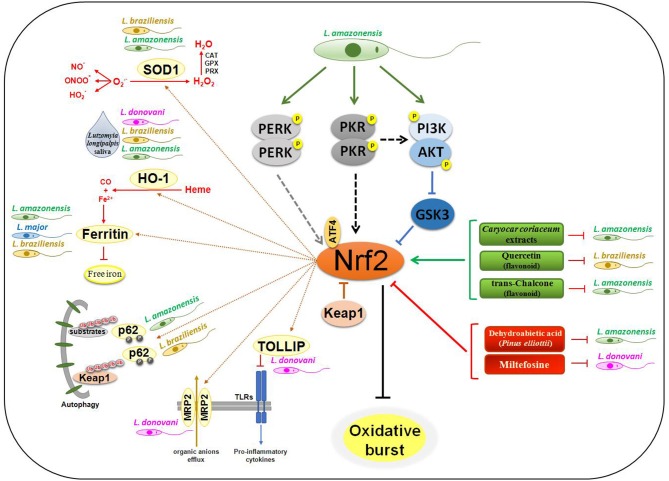
Nrf2 [nuclear factor erythroid 2-related factor 2 (Nrf2)] regulates the expression of a plethora of genes involved in the response to oxidative stress due to inflammation, aging, and tissue damage, among other pathological conditions. Deregulation of this cytoprotective system may also interfere with innate and adaptive immune responses. Oxidative burst, one of the main microbicidal mechanisms, could be impaired during initial phagocytosis of parasites, which could lead to the successful establishment of infection and promote susceptibility to diseases. A wide diversity of infections, mainly those caused by intracellular pathogens such as viruses, bacteria, and protozoan parasites, modulate the activation of Nrf2 by interfering with post-translational modifications, interactions between different protein complexes and the immune response. Nrf2 may be induced by pathogens via distinct pathways such as those involving the engagement of Toll-like receptors, the activation of PI3K/Akt, and endoplasmic reticulum stress. Recent studies have revealed the importance of Nrf2 on leishmaniasis. This mini-review discusses relevant findings that reveal the connection between Leishmania-induced modifications of the host pathways and their relevance to the modulation of the Nrf2-dependent antioxidative response to the infection.
Nrf2(核因子红细胞 2 相关因子 2 (Nrf2))调节了大量基因的表达,这些基因参与了炎症、衰老和组织损伤等病理情况下的氧化应激反应。这种细胞保护系统的失调也可能干扰先天和适应性免疫反应。氧化爆发是主要的杀菌机制之一,在寄生虫的初始吞噬过程中可能受到损害,这可能导致感染的成功建立,并促进对疾病的易感性。广泛的感染,主要是由病毒、细菌和原生动物寄生虫等细胞内病原体引起的,通过干扰翻译后修饰、不同蛋白复合物之间的相互作用和免疫反应来调节 Nrf2 的激活。病原体可以通过不同的途径诱导 Nrf2,如涉及 Toll 样受体的参与、PI3K/Akt 的激活和内质网应激。最近的研究揭示了 Nrf2 在利什曼病中的重要性。这篇小综述讨论了相关的发现,这些发现揭示了利什曼原虫诱导的宿主途径修饰与 Nrf2 依赖性抗氧化反应对感染的调节之间的联系。