Cortés María Paz, Acuña Vicente, Travisany Dante, Siegel Anne, Maass Alejandro, Latorre Mauricio
Center for Mathematical Modeling, Universidad de Chile and UMI CNRS 2807, Santiago, Chile.
Center for Genome Regulation, Universidad de Chile, Santiago, Chile.
Front Mol Biosci. 2020 Jan 10;6:155. doi: 10.3389/fmolb.2019.00155. eCollection 2019.
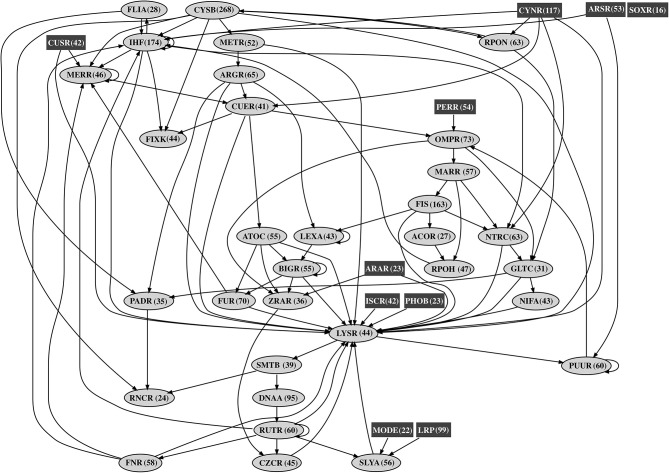
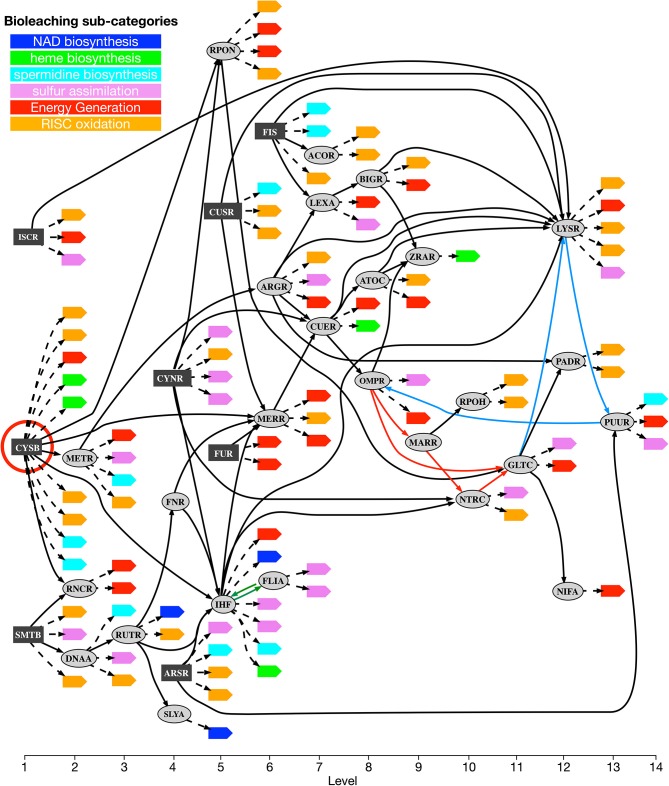
is one of the most studied biomining species, highlighting its ability to oxidize reduced inorganic sulfur compounds, coupled with its elevated capacity to live under an elevated concentration of heavy metals. In this work, using an semi-automatic genome scale approach, two biological networks for Licanantay were generated: (i) An affinity transcriptional regulatory network composed of 42 regulatory family genes and 1,501 operons (57% genome coverage) linked through 2,646 putative DNA binding sites (arcs), (ii) A metabolic network reconstruction made of 523 genes and 1,203 reactions (22 pathways related to biomining processes). Through the identification of confident connections between both networks (V-shapes), it was possible to identify a sub-network of transcriptional factor (34 regulators) regulating genes (61 operons) encoding for proteins involved in biomining-related pathways. Network analysis suggested that transcriptional regulation of biomining genes is organized into different modules. The topological parameters showed a high hierarchical organization by levels inside this network (14 layers), highlighting transcription factors CysB, LysR, and IHF as complex modules with high degree and number of controlled pathways. In addition, it was possible to identify transcription factor modules named primary regulators (not controlled by other regulators in the sub-network). Inside this group, CysB was the main module involved in gene regulation of several bioleaching processes. In particular, metabolic processes related to energy metabolism (such as sulfur metabolism) showed a complex integrated regulation, where different primary regulators controlled several genes. In contrast, pathways involved in iron homeostasis and oxidative stress damage are mainly regulated by unique primary regulators, conferring Licanantay an efficient, and specific metal resistance response. This work shows new evidence in terms of transcriptional regulation at a systems level and broadens the study of bioleaching in species.
是研究最多的生物采矿物种之一,突出了其氧化还原态无机硫化合物的能力,以及在高浓度重金属环境下生存的较高能力。在这项工作中,使用半自动基因组规模方法,构建了利卡南泰的两个生物网络:(i)一个由42个调控家族基因和1501个操纵子(基因组覆盖率57%)组成的亲和转录调控网络,通过2646个假定的DNA结合位点(弧)相连;(ii)一个由523个基因和1203个反应(22条与生物采矿过程相关的途径)组成的代谢网络重建。通过识别两个网络之间的可靠连接(V形),有可能识别出一个转录因子子网络(34个调控因子),该子网络调控编码参与生物采矿相关途径的蛋白质的基因(61个操纵子)。网络分析表明,生物采矿基因的转录调控被组织成不同的模块。拓扑参数显示该网络内部按层次具有高度的层级组织(14层),突出了转录因子CysB、LysR和IHF作为具有高度和大量受控途径的复杂模块。此外,有可能识别出名为主要调控因子的转录因子模块(在子网络中不受其他调控因子控制)。在这个群体中,CysB是参与几种生物浸出过程基因调控的主要模块。特别是,与能量代谢相关的代谢过程(如硫代谢)表现出复杂的综合调控,其中不同的主要调控因子控制多个基因。相比之下,参与铁稳态和氧化应激损伤的途径主要由独特的主要调控因子调控,赋予利卡南泰高效且特异的金属抗性反应。这项工作在系统水平的转录调控方面展示了新的证据,并拓宽了对该物种生物浸出的研究。