Department of Oncology, Longhua Hospital, Shanghai University of Traditional Chinese Medicine, Shanghai 200032, China.
Institute of Physiological Chemistry and Pathobiochemistry, University of Muenster, Münster 48149, Germany.
Biomed Res Int. 2020 Jan 10;2020:2147397. doi: 10.1155/2020/2147397. eCollection 2020.
Establishing prognostic gene signature to predict clinical outcomes and guide individualized adjuvant therapy is necessary. Here, we aim to establish the prognostic efficacy of a gene signature that is closely related to tumor immune microenvironment (TIME).
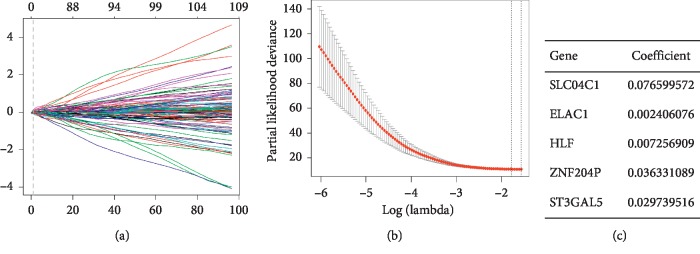
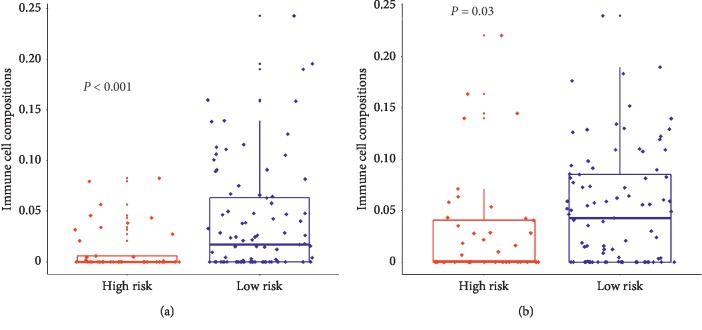
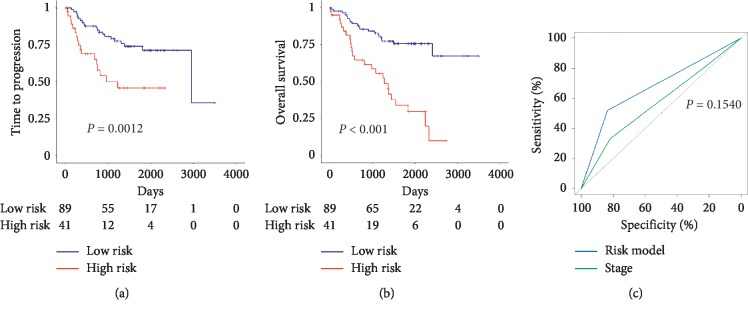
There are 13,035 gene expression profiles from 130 tumor samples of the non-small cell lung cancer (NSCLC) in the data set GSE103584. A 5-gene signature was identified by using univariate survival analysis and Least Absolute Shrinkage and Selection Operator (LASSO) to build risk models. Then, we used the CIBERSORT method to quantify the relative levels of different immune cell types in complex gene expression mixtures. It was found that the ratio of dendritic cells (DCs) activated and mast cells (MCs) resting in the low-risk group was higher than that in the high-risk group, and the difference was statistically significant ( < 0.001 and < 0.001 and < 0.001 and < 0.001 and < 0.001 and < 0.001 and < 0.001 and < 0.001 and < 0.001 and < 0.001 and < 0.001 and < 0.001 and.
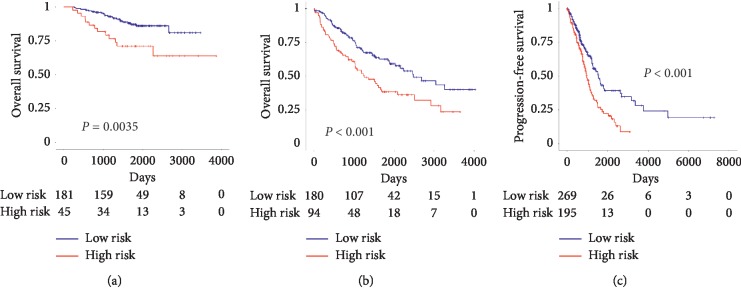
The 5-gene signature is a powerful and independent predictor that could predict the prognosis of NSCLC patients. In addition, our gene signature is correlated with TIME parameters, such as DCs activated and MCs resting. Our findings suggest that the 5-gene signature closely related to TIME could predict the prognosis of NSCLC patients and provide some reference for immunotherapy.
建立预后基因特征以预测临床结果并指导个体化辅助治疗很有必要。在此,我们旨在建立与肿瘤免疫微环境(TIME)密切相关的基因特征的预后效能。
数据集GSE103584中有来自130例非小细胞肺癌(NSCLC)肿瘤样本的13035个基因表达谱。通过单变量生存分析和最小绝对收缩和选择算子(LASSO)确定了一个5基因特征以构建风险模型。然后,我们使用CIBERSORT方法量化复杂基因表达混合物中不同免疫细胞类型的相对水平。发现低风险组中活化树突状细胞(DCs)与静息肥大细胞(MCs)的比例高于高风险组,差异具有统计学意义(<0.001和<0.001和<0.001和<0.001和<0.001和<0.001和<0.001和<0.001和<0.001和<0.001和<0.001和<0.001和。(注:原文此处部分重复的<0.001表述似乎有误,未完整呈现正确内容)
5基因特征是一种强大且独立的预测指标,可预测NSCLC患者的预后。此外,我们的基因特征与TIME参数相关,如活化的DCs和静息的MCs。我们的研究结果表明,与TIME密切相关的5基因特征可预测NSCLC患者的预后,并为免疫治疗提供一些参考。