Department of Orthopedic Trauma, East Hospital, Tongji University School of Medicine, 150 Jimo Rd, 200120 Shanghai, China.
Department of Orthopaedic Surgery, Zhongshan Hospital, Fudan University, 180 Fenglin Road, Shanghai 200032, China.
Biomed Res Int. 2020 Jan 8;2020:6745626. doi: 10.1155/2020/6745626. eCollection 2020.
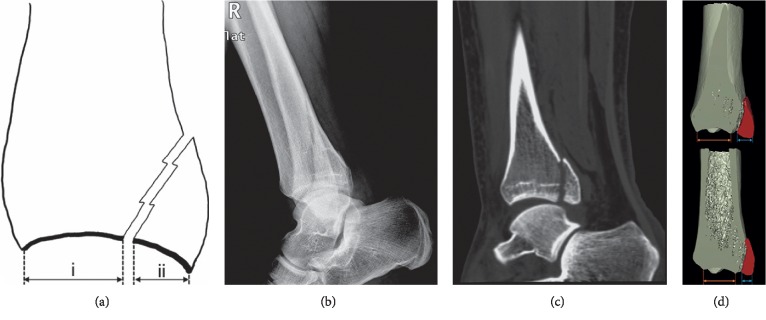
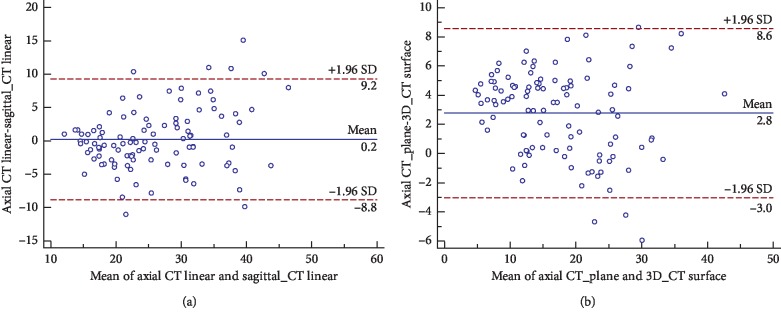
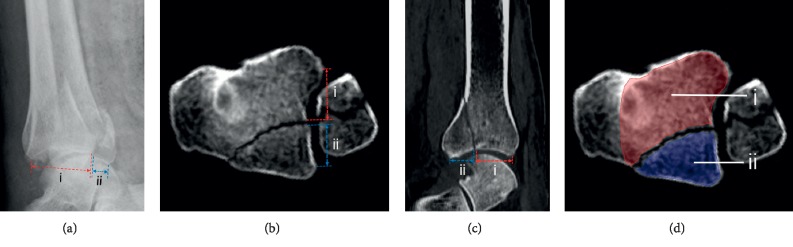
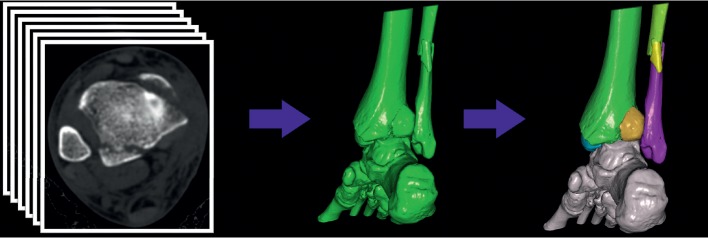
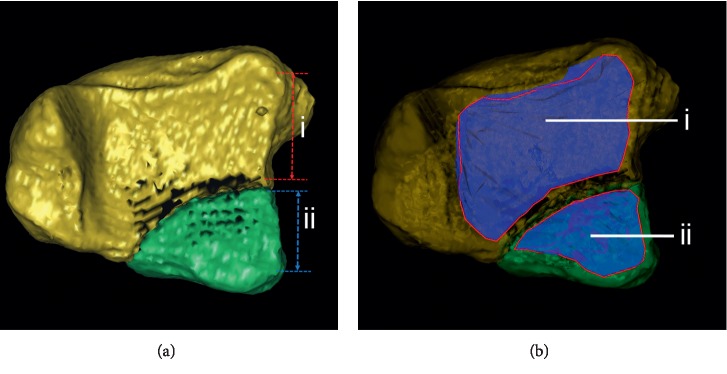
The aim of this study was to compare the values of six methods in measuring the involvement of posterior malleolus and to demonstrate the reliability and reproducibility of each method. Three independent orthopaedic surgeons, retrospectively, measured 106 cases. The difference between the six methods was analyzed using Bonferroni-corrected paired -tests after one-way ANOVA. The agreement between the six methods was analyzed using Bland-Altman analysis. The intraclass correlation coefficient (ICC) was used to assess intraobserver reproducibility and interobserver reliability. Significant differences were observed between values of any two of the six measurement methods ( < 0.0033), except between any two of the plane radiograph linear, axial CT linear, sagittal CT linear, and 3D CT linear. The Bland-Altman plots demonstrated poor agreement between values of any two of the six methods. The lowest intraobserver reproducibility was 0.46 (moderate) for resident surgeon using plain radiographs. The intraobserver reproducibility for three surgeons using two-dimensional (2D) and 3D images was almost perfect (ICC, 0.82-0.96). The lowest interobserver reliability was 0.41 (moderate) between chief and attending surgeon using plain radiographs, and it improved to almost perfect (ICC, 0.81-0.95) with the use of 3D CT images. The standard error of measurement showed almost the same results as ICC values. The existing operative indications which were determined based on plain radiography are neither reliable nor suitable for other measurement methods. Both 3D linear and 3D surface measurement methods are reliable and reproducible in measuring posterior fragment involvement, and experience is not so crucial. Operative indications for posterior malleolar fractures need to be redefined based on the 3D measurement method.
本研究旨在比较六种方法测量后踝累及程度的价值,并展示每种方法的可靠性和可重复性。三位独立的骨科医生回顾性地测量了 106 例患者。使用单向方差分析后,Bonferroni 校正配对检验分析了六种方法之间的差异。使用 Bland-Altman 分析评估了六种方法之间的一致性。采用组内相关系数(ICC)评估观察者内的可重复性和观察者间的可靠性。除了平面 X 线线性、轴向 CT 线性、矢状 CT 线性和 3D CT 线性之间的任意两种方法之间的差异无统计学意义(P>0.05)外,其余六种方法之间的差异均有统计学意义(P<0.0033)。 Bland-Altman 图显示六种方法中任意两种方法之间的一致性较差。使用普通 X 线的住院医师的观察者内可重复性最低,为 0.46(中等)。三位医生使用二维(2D)和 3D 图像的观察者内可重复性几乎为完美(ICC,0.82-0.96)。使用普通 X 线的主任医生和主治医生之间的观察者间可靠性最低,为 0.41(中等),使用 3D CT 图像后提高至几乎完美(ICC,0.81-0.95)。测量标准误差的结果与 ICC 值几乎相同。基于普通 X 线确定的现有手术适应证既不可靠也不适合其他测量方法。3D 线性和 3D 表面测量方法在后踝骨折块累及程度的测量中均可靠且可重复,经验并非至关重要。需要根据 3D 测量方法重新定义后踝骨折的手术适应证。