Marlene and Stewart Greenebaum Comprehensive Cancer Center, University of Maryland School of Medicine, Baltimore, MD 21201, USA.
Department of Neurosurgery, University of Maryland School of Medicine, Baltimore, MD 21201, USA.
Sci Adv. 2020 Jan 15;6(3):eaax3931. doi: 10.1126/sciadv.aax3931. eCollection 2020 Jan.
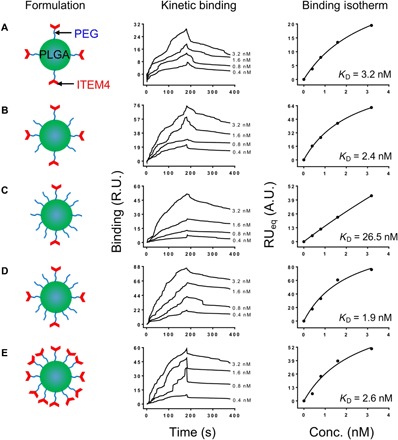
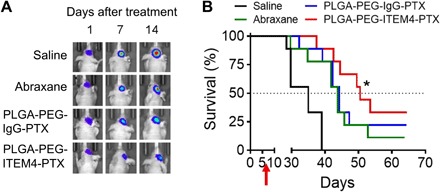
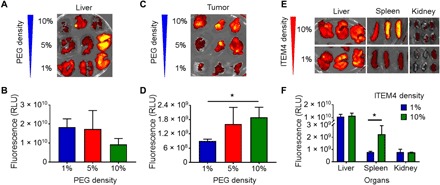
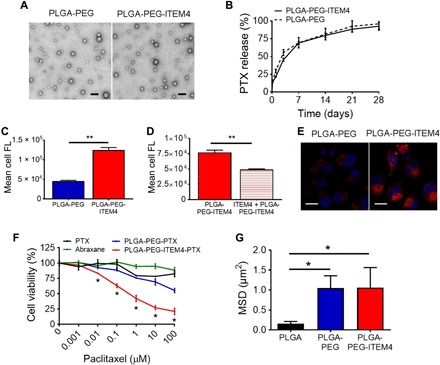
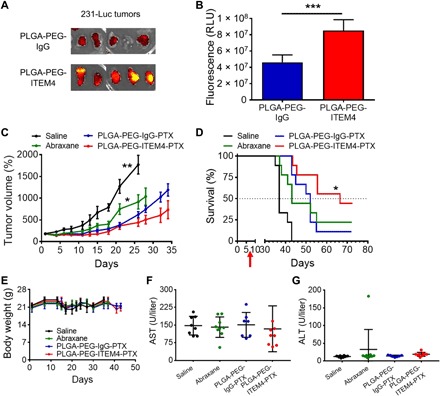
Development of effective tumor cell-targeted nanodrug formulations has been quite challenging, as many nanocarriers and targeting moieties exhibit nonspecific binding to cellular, extracellular, and intravascular components. We have developed a therapeutic nanoparticle formulation approach that balances cell surface receptor-specific binding affinity while maintaining minimal interactions with blood and tumor tissue components (termed "DART" nanoparticles), thereby improving blood circulation time, biodistribution, and tumor cell-specific uptake. Here, we report that paclitaxel (PTX)-DART nanoparticles directed to the cell surface receptor fibroblast growth factor-inducible 14 (Fn14) outperformed both the corresponding PTX-loaded, nontargeted nanoparticles and Abraxane, an FDA-approved PTX nanoformulation, in both a primary triple-negative breast cancer (TNBC) model and an intracranial model reflecting TNBC growth following metastatic dissemination to the brain. These results provide new insights into methods for effective development of therapeutic nanoparticles as well as support the continued development of the DART platform for primary and metastatic tumors.
开发有效的肿瘤细胞靶向纳米药物制剂极具挑战性,因为许多纳米载体和靶向部分与细胞、细胞外和血管成分表现出非特异性结合。我们开发了一种治疗性纳米颗粒制剂方法,在保持与血液和肿瘤组织成分最小相互作用的同时平衡细胞表面受体特异性结合亲和力(称为“DART”纳米颗粒),从而提高血液循环时间、生物分布和肿瘤细胞特异性摄取。在这里,我们报告说,针对细胞表面受体成纤维细胞生长因子诱导 14(Fn14)的紫杉醇(PTX)-DART 纳米颗粒在原发性三阴性乳腺癌(TNBC)模型和反映转移性扩散至大脑后 TNBC 生长的颅内模型中,均优于相应的负载 PTX 的非靶向纳米颗粒和 FDA 批准的 PTX 纳米制剂 Abraxane。这些结果为有效开发治疗性纳米颗粒提供了新的见解,并支持 DART 平台在原发性和转移性肿瘤中的持续发展。