Lopez Oscar L, Klunk William E, Mathis Chester A, Snitz Beth E, Chang Yuefang, Tracy Russell P, Kuller Lewis H
Department of Neurology, University of Pittsburgh, Pittsburgh, PA 15261, USA.
Department of Psychiatry, University of Pittsburgh, Pittsburgh, PA 15261, USA.
Brain Commun. 2020;2(1):fcz038. doi: 10.1093/braincomms/fcz038. Epub 2019 Nov 27.
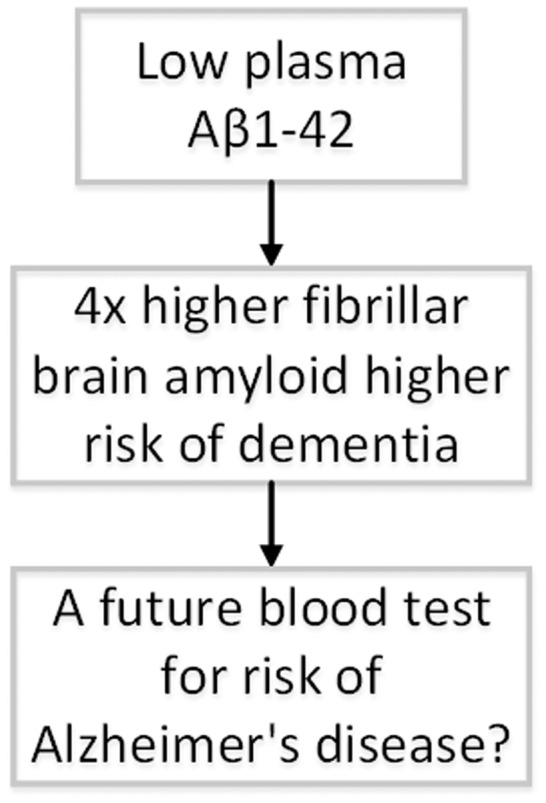
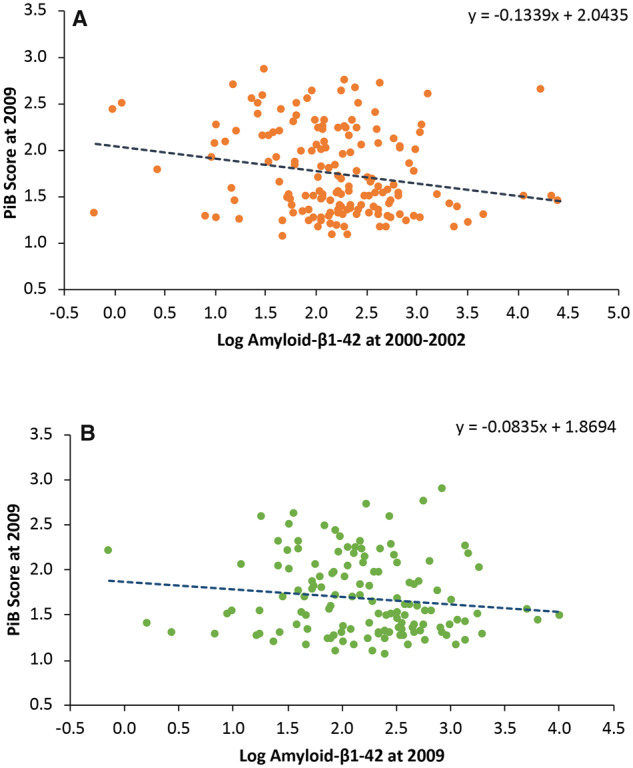
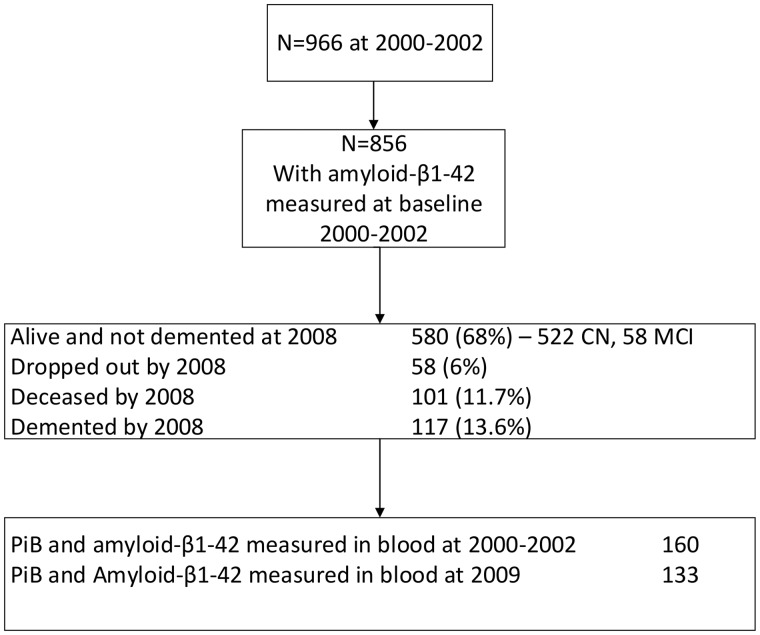
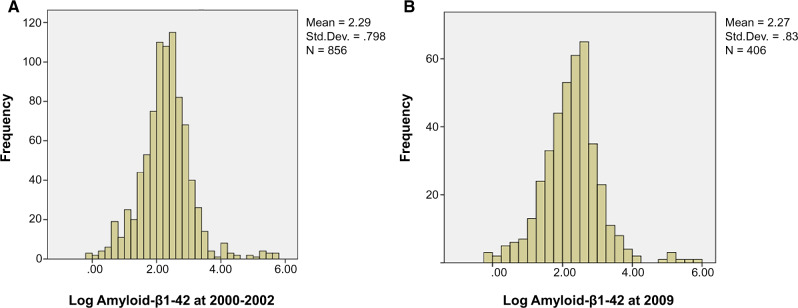
A blood test that predicts the extent of amyloid plaques in the brain and risk of Alzheimer's disease would have important benefits for the early identification of higher risk of dementia and Alzheimer's disease and the evaluation of new preventative therapies. The goal of this study was to determine whether plasma levels of amyloid-β1-42, 1-40 and the amyloid-β1-42/1-40 ratio among participants in the Pittsburgh centre of the Ginkgo Evaluation of Memory Study were related to the extent of brain fibrillar amyloid plaques measured in 2009 using Pittsburgh compound-B PET imaging, hippocampal volume, cortical thickness in the temporal lobe and white matter lesions. There were 194 participants who had Pittsburgh compound-B measurements in 2009 with the mean age of 85 years; 96% were white and 60% men. Pittsburgh compound-B positivity was defined as a standardized uptake value ratio of ≥1.57. Amyloid-β in blood was measured using a sandwich enzyme-linked immunosorbent assay developed by Eli Lilly and modified at the University of Vermont. All participants were nondemented as of 2008 at the time of study close out. The study sample included 160 with blood samples drawn in 2000-02 and 133 from 2009 and also had brain amyloid measured in 2009. All blood samples were analysed at the same time in 2009. Plasma amyloid-β1-42 was inversely related to the percent Pittsburgh compound-B positive (standardized uptake value ratio ≥1.57), -0.04, = 0.005. Practically all participants who were apolipoprotein-E4 positive at older ages were also Pittsburgh compound-B positive for fibrillar amyloid. Among apolipoprotein-E4-negative participants, quartiles of amyloid-β1-42 were inversely related to Pittsburgh compound-B positivity. In multiple regression models, plasma amyloid-β1-42 measured in 2000-02 or 2009 were significantly and inversely related to Pittsburgh compound-B positivity as was the amyloid-β1-42/1-40 ratio. There was a 4-fold increase in the odds ratio for the presence of Pittsburgh compound-B positivity in the brain in 2009 for the first quartile of amyloid-β1-42 as compared with the fourth quartile in the multiple logistic model. This is one of the first longitudinal studies to evaluate the relationship between amyloid-β1-42 in the blood and the extent of brain amyloid deposition measured by PET imaging using Pittsburgh compound-B. Our findings showed that remote and recent low plasma amyloid-β1-42 levels were inversely associated with brain amyloid deposition in cognitively normal individuals. However, changes in plasma amyloid-β1-42 over time (8 years) were small and not related to the amount of Pittsburgh compound-B.
一项能够预测大脑中淀粉样斑块程度及阿尔茨海默病风险的血液检测,对于早期识别痴呆症和阿尔茨海默病的高风险以及评估新的预防疗法具有重要意义。本研究的目的是确定参与银杏记忆评估研究匹兹堡中心的受试者血浆中淀粉样蛋白β1-42、1-40水平以及淀粉样蛋白β1-42/1-40比值,是否与2009年使用匹兹堡化合物B正电子发射断层显像(PET)成像测量的脑纤维状淀粉样斑块程度、海马体积、颞叶皮质厚度和白质病变相关。共有194名受试者在2009年进行了匹兹堡化合物B检测,平均年龄85岁;96%为白人,60%为男性。匹兹堡化合物B阳性定义为标准化摄取值比值≥1.57。血液中的淀粉样蛋白β采用礼来公司开发并经佛蒙特大学改良的夹心酶联免疫吸附测定法进行检测。截至2008年研究结束时,所有受试者均未患痴呆症。研究样本包括2000 - 2002年采集血样的160名受试者以及2009年采集血样且在2009年也进行了脑淀粉样蛋白检测的133名受试者。所有血样均于2009年同时进行分析。血浆淀粉样蛋白β1-42与匹兹堡化合物B阳性百分比(标准化摄取值比值≥1.57)呈负相关,r = -0.04,P = 0.005。实际上,所有老年时载脂蛋白E4阳性的受试者匹兹堡化合物B检测的纤维状淀粉样蛋白也呈阳性。在载脂蛋白E4阴性的受试者中,淀粉样蛋白β1-42的四分位数与匹兹堡化合物B阳性呈负相关。在多元回归模型中,2000 - 2002年或2009年测量的血浆淀粉样蛋白β1-42以及淀粉样蛋白β1-42/1-40比值均与匹兹堡化合物B阳性呈显著负相关。在多因素逻辑模型中,与淀粉样蛋白β1-42第四四分位数相比,第一四分位数的受试者在2009年大脑中出现匹兹堡化合物B阳性的比值比增加了4倍。这是首批评估血液中淀粉样蛋白β1-42与使用匹兹堡化合物B的PET成像测量的脑淀粉样蛋白沉积程度之间关系的纵向研究之一。我们的研究结果表明,在认知正常个体中,既往和近期较低的血浆淀粉样蛋白β1-42水平与脑淀粉样蛋白沉积呈负相关。然而,血浆淀粉样蛋白β1-42随时间(8年)的变化很小,且与匹兹堡化合物B的量无关。