Chen Hailong, Tao Rui, Zhao Hui, Jiang Jianjun, Yang Jin
Department of Respiratory Medicine, The Second Affiliated Hospital of Anhui Medical University.
Department of Respiratory Medicine, The First Affiliated Hospital of Anhui Medical University, Hefei, China.
Medicine (Baltimore). 2020 Jan;99(5):e19000. doi: 10.1097/MD.0000000000019000.
Patients with cancer are of a high level risk of venous thromboembolism (VTE). Low molecular weight heparin (LMWH) is recommended as the normal treatment for cancer-associated venous thrombosis. Recently, some studies suggest that patients with cancer-associated venous thrombosis can get a good efficacy and safety profile from treating with direct oral anticoagulants (DOACs) compared with other anticoagulants. However, when it comes to the efficacy of DAOCs in preventing VTE in patient with cancer, the data are limited. Thus, we performed such a meta-analysis to determine the efficacy and safety of DOACs in preventing VTE in patient with cancer compared with LMWHs.
Medline/PubMed and CENTRAL (The Cochrane Central Register of Controlled Trials) were systematically searched for relevant studies. For each trial, data on VTE, major bleeding, or bleeding were extracted by 2 reviewers independently. Pooled risk ratios (RRs) were calculated by using Review Manager 5.3 software and the significance was determined by the Z test.
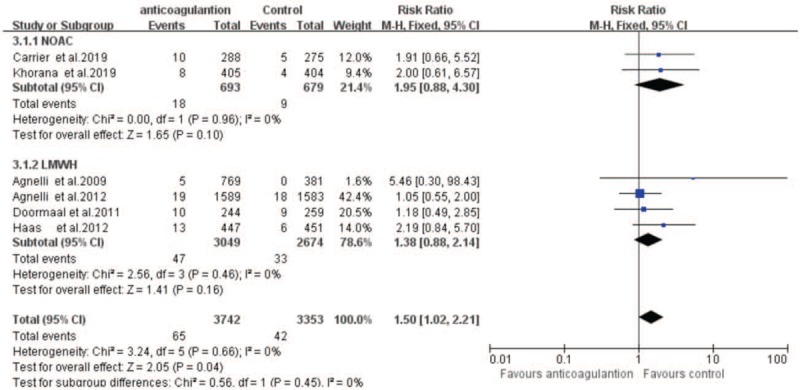
A total of 6 studies with 7185 patients were included in our meta-analysis. DOACs (RR = 0.55, 95% confidence interval [95%CI]: 0.34-0.90, I = 31%) had a similar prevention effect of VTE to LMWH (RR = 0.59, 95% CI: 0.37-0.95, I = 59%). DOACs (RR = 1.52, 95% CI: 0.99-2.33, I = 0%) yielded a similar bleeding occurrence rate compared with LMWH (RR = 1.35, 95% CI: 1.07-1.70, I = 35%). DOACs (RR = 1.95, 95% CI: 0.88-4.30, I = 0%) showed a sight higher major bleeding occurrence rate than LMWH (RR = 1.38, 95% CI: 0.88-2.14, I = 0%).
DOACs show comparable efficacy to LMWH in cancer patients without VTE with a slightly higher major bleeding occurrence rate. DOACs are inclined to be an alternative thromboprophylaxis strategy in cancer patients as they have superiorities compared to traditional anticoagulation agents. Further studies are still demanded as exiting relevant researches are limited.
癌症患者发生静脉血栓栓塞(VTE)的风险很高。低分子量肝素(LMWH)被推荐作为癌症相关静脉血栓形成的常规治疗方法。最近,一些研究表明,与其他抗凝剂相比,癌症相关静脉血栓形成患者使用直接口服抗凝剂(DOACs)治疗可获得良好的疗效和安全性。然而,关于DOACs在预防癌症患者VTE方面的疗效,数据有限。因此,我们进行了这项荟萃分析,以确定DOACs与LMWHs相比在预防癌症患者VTE方面的疗效和安全性。
系统检索Medline/PubMed和CENTRAL(Cochrane对照试验中央注册库)中的相关研究。对于每项试验,由2名审阅者独立提取VTE、大出血或出血的数据。使用Review Manager 5.3软件计算合并风险比(RRs),并通过Z检验确定其显著性。
我们的荟萃分析共纳入6项研究,涉及7185例患者。DOACs(RR = 0.55,95%置信区间[95%CI]:0.34 - 0.90,I = 31%)在预防VTE方面与LMWH(RR = 0.59,95%CI:0.37 - 0.95,I = 59%)效果相似。DOACs(RR = 1.52,95%CI:0.99 - 2.33,I = 0%)与LMWH(RR = 1.35,95%CI:1.07 - 1.70,I = 35%)相比,出血发生率相似。DOACs(RR = 1.95,95%CI:0.88 - 4.30,I = 0%)的大出血发生率略高于LMWH(RR = 1.38,95%CI:0.88 - 2.14,I = 0%)。
在无VTE的癌症患者中,DOACs与LMWH疗效相当,但大出血发生率略高。DOACs相较于传统抗凝剂具有优势,倾向于成为癌症患者的一种替代血栓预防策略。由于现有相关研究有限,仍需要进一步研究。