Yun Donghwan, Kim Dong Ki, Oh Kook-Hwan, Joo Kwon Wook, Moon Kyung Chul, Kim Yon Su, Lee Kyoungbun, Han Seung Seok
Department of Internal Medicine, Seoul National University College of Medicine, 103 Daehakro, Jongno-gu, Seoul, 03080, South Korea.
Department of Biomedical Sciences, Seoul National University College of Medicine, Seoul, South Korea.
BMC Nephrol. 2020 Jan 30;21(1):33. doi: 10.1186/s12882-020-1691-5.
Henoch-Schönlein purpura nephritis (HSPN), a small-vessel vasculitis, shares renal pathological features with immunoglobulin A nephropathy. Oxford classification of immunoglobulin A nephropathy pathology has been updated to the MEST-C score, but its application in HSPN remains unresolved.
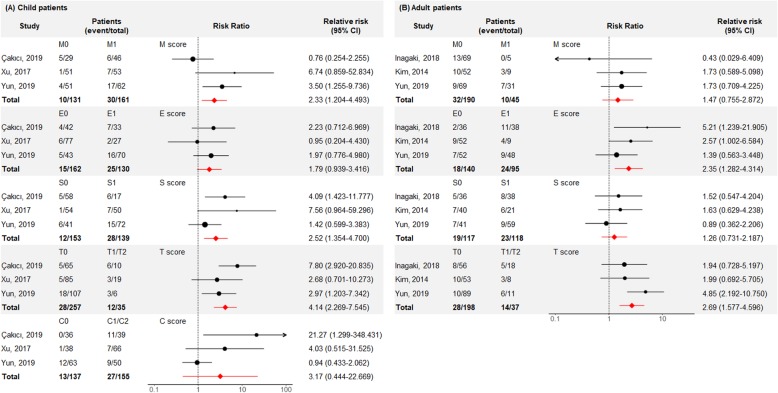
Two hundred and thirteen patients with biopsy-proven HSPN were retrieved from the Seoul National University Hospital between 2000 and 2017. Renal outcome risks (i.e., end-stage renal disease or doubling of serum creatinine) were evaluated according to MEST-C scores after stratification by age: 113 children aged < 18 years (9.2 ± 3.6 years) and 100 adults aged ≥18 years (38.6 ± 18.3 years). We pooled our data with four previous cohort studies in which MEST or MEST-C scores were described in detail.
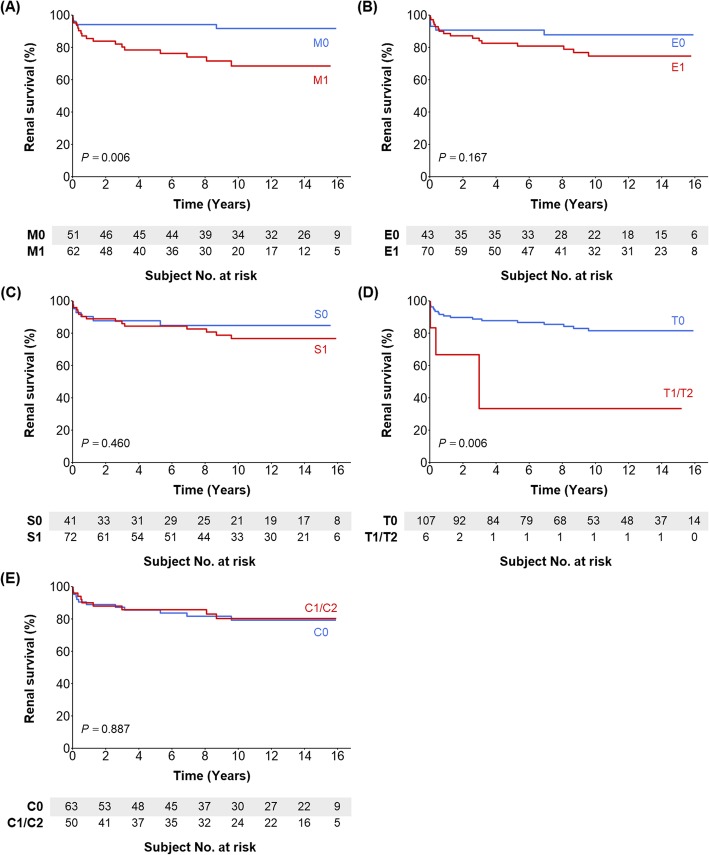
Twenty-one child (19%) and 16 adult (16%) patients reached the renal outcome during the median follow-up periods of 12 years and 13 years, respectively (maximum 19 years). In children, M1 and T1/T2 scores revealed worse renal outcomes than did M0 and T0 scores, respectively, whereas the T score was the only factor related to worse outcomes in adult patients after adjusting for multiple clinical and laboratory variables. The pooled data showed that M1, S1, and T1/T2 in children and E1 and T1/T2 in adults were correlated with poorer renal outcomes than those of their counterpart scores.
The Oxford classification MEST-C scores can predict long-term renal outcomes in patients with HSPN.
过敏性紫癜性肾炎(HSPN)是一种小血管炎,与免疫球蛋白A肾病具有相同的肾脏病理特征。免疫球蛋白A肾病病理的牛津分类已更新为MEST-C评分,但其在HSPN中的应用仍未明确。
从首尔国立大学医院检索2000年至2017年间213例经活检证实的HSPN患者。根据年龄分层后,依据MEST-C评分评估肾脏预后风险(即终末期肾病或血清肌酐翻倍):113例年龄<18岁的儿童(9.2±3.6岁)和100例年龄≥18岁的成人(38.6±18.3岁)。我们将自己的数据与之前四项详细描述了MEST或MEST-C评分的队列研究的数据进行了汇总。
在分别为12年和13年(最长19年)的中位随访期内,21例儿童(19%)和16例成人(16%)患者达到肾脏预后终点。在儿童中,M1和T1/T2评分分别显示出比M0和T0评分更差的肾脏预后,而在调整了多个临床和实验室变量后,T评分是成人患者预后较差的唯一相关因素。汇总数据显示,儿童中的M1、S1和T1/T2以及成人中的E1和T1/T2与较差的肾脏预后相关,而与其对应评分相比。
牛津分类MEST-C评分可预测HSPN患者的长期肾脏预后。