Wang Wenchao, Wu Xinchun, Lan Xiaoyu
Beijing Key Laboratory of Applied Experimental Psychology, National Demonstration Center for Experimental Psychology Education (Beijing Normal University), Faculty of Psychology, Beijing Normal University, Beijing, China.
Eur J Psychotraumatol. 2020 Jan 10;11(1):1704993. doi: 10.1080/20008198.2019.1704993. eCollection 2020.
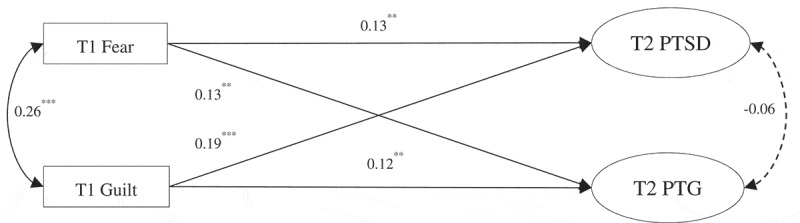
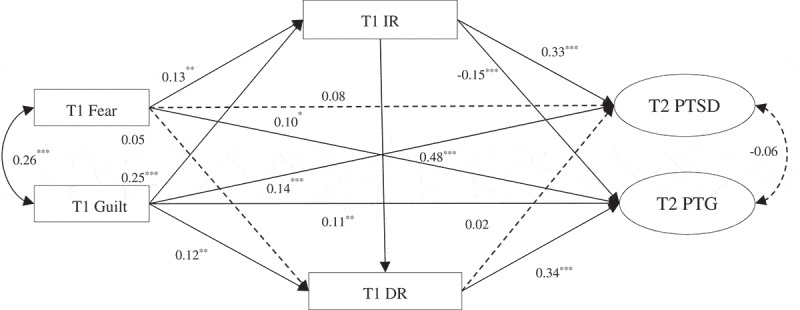
: Although previous research has demonstrated that fear and guilt have an effect on posttraumatic stress disorder (PTSD), it is still unclear how these two emotions affect posttraumatic growth (PTG). Moreover, few studies have examined the mechanisms by which fear and guilt affect PTSD and PTG. Guided by Lee et al.'s theory of PTSD generation mechanisms and Calhoun and Tedeschi's PTG theory, the current study proposes that intrusive rumination (IR) and deliberate rumination (DR) may play a mediating role in the effects of guilt and fear on PTSD and PTG. : This study aimed to simultaneously examine the mediating roles of IR and DR in the relationship between fear, guilt, PTSD, and PTG. : This study employed a two-wave longitudinal design. A total of 408 adolescent survivors were assessed using self-report questionnaires after the Ya'an earthquake in China. Measures were obtained for trauma exposure, subjective fear, survivor guilt, IR, and DR at three and a half years after the Ya'an earthquake (Time 1), while PTSD and PTG were assessed at time point four and a half years after the Ya'an earthquake (Time 2). : The results showed that both fear and guilt had a direct and positive effect on PTSD and PTG. Fear and guilt were positive predictors of PTSD and negative predictors of PTG through the mediating variable of IR. DR mediated the relationship between guilt and PTG but not PTSD, and also mediated the relationship between IR and PTG. : Study findings indicate that fear, guilt, and intrusive rumination may contribute to PTSD symptoms in adolescent trauma survivors. Results also suggest that adolescent survivors can grow emotionally and psychologically following traumatic events, and that directed rumination may contribute to such growth. Interventions that reduce fear, guilt, and intrusive rumination while increasing directed rumination may assist adolescent trauma survivors in recovery and growth.
尽管先前的研究表明恐惧和内疚会对创伤后应激障碍(PTSD)产生影响,但这两种情绪如何影响创伤后成长(PTG)仍不清楚。此外,很少有研究探讨恐惧和内疚影响PTSD和PTG的机制。在Lee等人的PTSD产生机制理论以及Calhoun和Tedeschi的PTG理论的指导下,本研究提出侵入性反刍思维(IR)和刻意反刍思维(DR)可能在内疚和恐惧对PTSD和PTG的影响中起中介作用。本研究旨在同时检验IR和DR在恐惧、内疚、PTSD和PTG之间关系中的中介作用。本研究采用两波纵向设计。在中国雅安地震后,通过自我报告问卷对408名青少年幸存者进行了评估。在雅安地震三年半后(时间1)获取了创伤暴露、主观恐惧、幸存者内疚、IR和DR的测量数据,而PTSD和PTG则在雅安地震四年半后(时间2)进行评估。结果表明,恐惧和内疚对PTSD和PTG均有直接的正向影响。通过IR这一中介变量,恐惧和内疚是PTSD的正向预测因子,是PTG的负向预测因子。DR介导了内疚与PTG之间的关系,但未介导与PTSD的关系,并且还介导了IR与PTG之间的关系。研究结果表明,恐惧、内疚和侵入性反刍思维可能导致青少年创伤幸存者出现PTSD症状。结果还表明,青少年幸存者在经历创伤事件后能够在情绪和心理上成长,并且有针对性的反刍思维可能有助于这种成长。减少恐惧、内疚和侵入性反刍思维同时增加有针对性的反刍思维的干预措施可能有助于青少年创伤幸存者的恢复和成长。