Primary Health Care, School of Public Health and Community Medicine, Institute of Medicine, Sahlgrenska Academy, University of Gothenburg, Gothenburg, Sweden.
School of Public Health and Community Medicine, Institute of Medicine, University of Gothenburg, Gothenburg, Sweden.
Scand J Prim Health Care. 2020 Mar;38(1):56-65. doi: 10.1080/02813432.2020.1717083. Epub 2020 Jan 31.
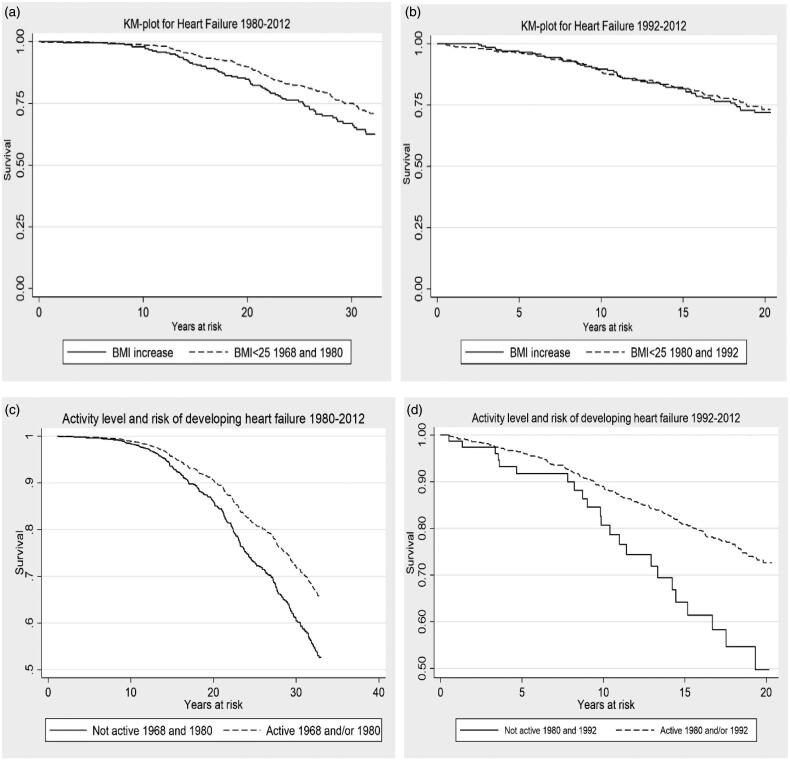
To longitudinally evaluate the impact of change in physical activity or change in body mass index (BMI) over time on the risk of developing heart failure (HF) in women without a previous diagnosis of HF. Longitudinal, observational, prospective study of women in Gothenburg, Sweden. Data on BMI and level of physical activity were collected from examinations 1968-1992 and hospital diagnoses and mortality data were ascertained from 1980 to 2012. Data were obtained from 1749 women included in the Prospective Population Study of Women in Gothenburg. Hazard ratio (HR) for HF was calculated, using a Cox regression model. Women with stable high physical activity during 1968-1980 and 1980-1992 reduced their risk of subsequent HF compared to the non-active women (for 1968-1980 HR 0.66, 95% Confidence Interval (CI) 0.44-0.99 and for 1980-1992 HR 0.47, 95% CI 0.29-0.74). Women with increasing levels of physical activity during 1980-1992 reduced their risk of HF compared to the non-active women (HR 0.40, 95% CI 0.22-0.72). Increase in BMI from overweight to obesity during 1968-1980 predicted increased risk of developing HF (HR 1.93, 95% CI 1.18-3.14). Reduced risk of future HF in healthy women may be achieved by remaining physically active from young middle age and throughout life or by increasing the level of physical activity. This is particularly important for sedentary women in middle age. The role of physical activity in preventing the development of obesity must be taken into account.Key pointsA sedentary lifestyle and obesity are risk factors for developing heart failure (HF) in women.The risk of developing HF may be reduced by increasing the level of activity in sedentary middle-aged women.For younger women, avoiding obesity is most important to reduce the risk of later HF.Primary care has a key role in guiding women towards the most effective lifestyle changes to prevent development of HF.
纵向评估女性的体力活动变化或体重指数(BMI)变化随时间推移对心力衰竭(HF)发病风险的影响,这些女性在之前均无 HF 诊断。方法:在瑞典哥德堡进行的一项纵向、观察性、前瞻性女性研究。1968-1992 年期间采集 BMI 和体力活动水平数据,1980 年至 2012 年期间采集医院诊断和死亡率数据。1749 名参加哥德堡前瞻性女性人群研究的女性纳入研究。使用 Cox 回归模型计算 HF 的风险比(HR)。1968-1980 年和 1980-1992 年期间稳定高体力活动的女性与非活跃女性相比,发生后续 HF 的风险降低(1968-1980 年 HR 0.66,95%置信区间[CI] 0.44-0.99,1980-1992 年 HR 0.47,95% CI 0.29-0.74)。1980-1992 年期间体力活动水平增加的女性与非活跃女性相比,HF 风险降低(HR 0.40,95% CI 0.22-0.72)。1968-1980 年期间从超重到肥胖的 BMI 增加预示着 HF 发病风险增加(HR 1.93,95% CI 1.18-3.14)。从年轻的中年到终生保持体力活动或增加体力活动水平可能会使健康女性未来发生 HF 的风险降低。这对于中年久坐不动的女性尤为重要。必须考虑体力活动在预防肥胖发展中的作用。主要发现:久坐的生活方式和肥胖是女性发生 HF 的危险因素。增加久坐中年女性的活动水平可能会降低发生 HF 的风险。对于年轻女性,避免肥胖对于降低以后发生 HF 的风险最重要。初级保健在指导女性采取最有效的生活方式改变以预防 HF 发展方面具有关键作用。