Björck Lena, Novak Masuma, Schaufelberger Maria, Giang Kok Wai, Rosengren Annika
Department of Molecular and Clinical Medicine, University of Gothenburg, Gothenburg, Sweden.
Institute of Health and Care Sciences, Sahlgrenska Academy, University of Gothenburg, Gothenburg, Sweden.
BMC Cardiovasc Disord. 2015 Mar 10;15:19. doi: 10.1186/s12872-015-0008-2.
This study aimed to determine whether midlife obesity predicts heart failure (HF) over an extended follow-up into old age.
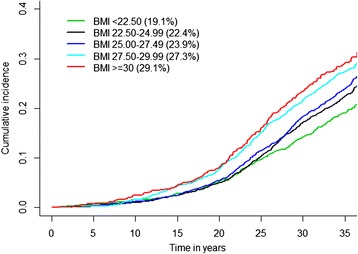
We studied 7495 men (from a population sample of 9,998 men) without HF, who were 47-55 years old when investigated in 1970 to 1973. All participants were followed up for 35 years, or until death, using the Swedish National Inpatient Register (IPR) and the Cause of Death Register. Over follow-up, 1855 men (24.7%) were discharged from hospital or died with a diagnosis of HF.
There was a strong relation between obesity and future risk of HF, which was accentuated over the last years of the long follow-up. After adjusting for age, the risk of HF increased stepwise with increasing body mass index (BMI), even in those with a normal BMI (22.5-24.9) The subdistribution hazard ratio (SHR) was 1.20 (95% CI: 1.02-1.39) in men with a normal BMI, 1.29 (95% CI: 1.11-1.50) for a BMI of 25-27.49, 1.50 (95% CI: 1.27-1.77) for a BMI of 27.5-29.99, and 1.62 (95% CI: 1.33-1.97) for a BMI >30. After adjusting for, age, smoking, occupational class, and physical activity, the results were unchanged.
Obesity in midlife is strongly related to the long-term risk of developing HF extending into old age where the risk is highest. Even normal body weight (BMI <25) was related to an increased risk of developing HF during life. Because overweight and obesity are largely preventable, our findings further emphasize the importance of public health interventions against the development of obesity.
本研究旨在确定中年肥胖是否能在延长至老年的随访期内预测心力衰竭(HF)。
我们对7495名男性(来自9998名男性的人群样本)进行了研究,这些男性在1970年至1973年接受调查时年龄为47至55岁,且无HF。所有参与者通过瑞典国家住院登记册(IPR)和死亡原因登记册进行了35年的随访,直至死亡。在随访期间,1855名男性(24.7%)因HF诊断而出院或死亡。
肥胖与未来发生HF的风险之间存在很强的相关性,在长期随访的最后几年这种相关性更加明显。调整年龄后,即使是正常体重指数(BMI,22.5 - 24.9)的人群,HF风险也随着BMI的增加而逐步上升。BMI正常的男性亚分布风险比(SHR)为1.20(95%置信区间:1.02 - 1.39),BMI为25 - 27.49时为1.29(95%置信区间:1.11 - 1.50),BMI为27.5 - 29.99时为1.50(95%置信区间:1.27 - 1.77),BMI >30时为1.62(95%置信区间:1.33 - 1.97)。调整年龄、吸烟、职业阶层和身体活动后,结果不变。
中年肥胖与发生HF的长期风险密切相关,这种风险在老年时最高。即使正常体重(BMI<25)也与一生中发生HF的风险增加有关。由于超重和肥胖在很大程度上是可以预防的,我们的研究结果进一步强调了针对肥胖发展进行公共卫生干预的重要性。