WorldFish, Honiara, Solomon Islands.
Agriculture and Food, Commonwealth Scientific and Industrial Research Organisation (CSIRO), St Lucia, Queensland, Australia.
Matern Child Nutr. 2020 Apr;16(2):e12921. doi: 10.1111/mcn.12921. Epub 2020 Jan 31.
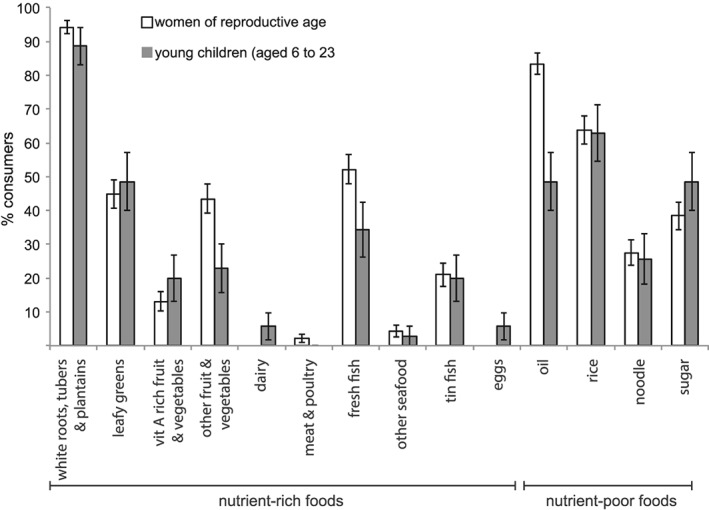
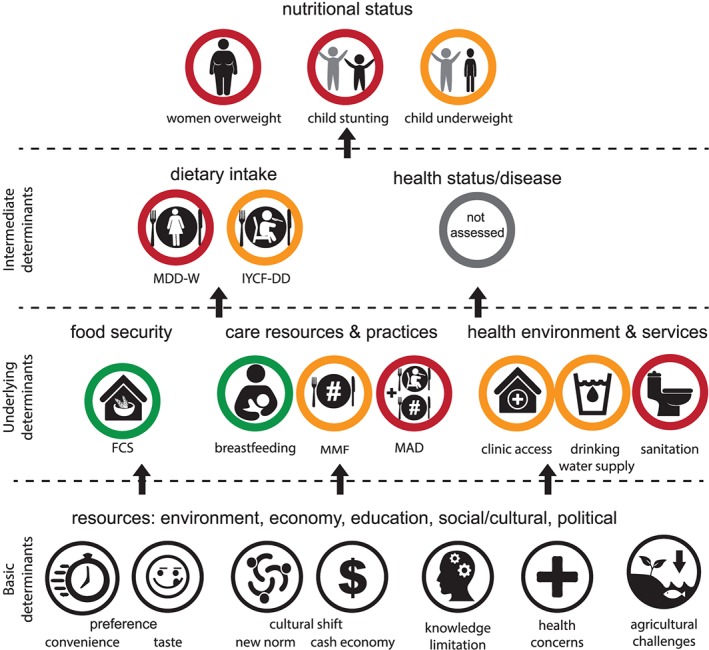
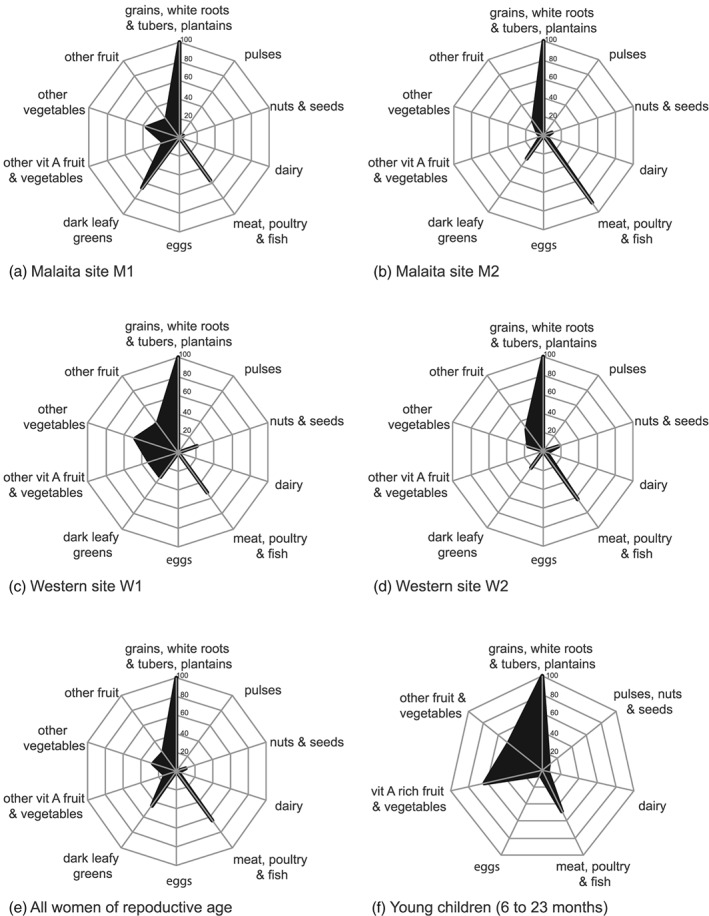
Solomon Islands, like many Pacific Island nations, suffer from the burden of malnutrition. External drivers including population growth, declining agriculture and fisheries productivity and global food trade have contributed to the transition to greater reliance on imported foods. Globally, diets are recognized as both a cause of and solution to the burden of malnutrition. Using a mixed-method approach this study assessed nutritional status and key determinants of malnutrition among women and young children in rural Solomon Island communities. Quantitative 24-hour recall surveys identified diets of women and young children in these communities to be very limited in diversity. Typical daily diets comprised of fish, sweet potato (and/or rice) and slippery cabbage (a leafy green) usually boiled in coconut milk or baked. Participatory research using problem tree and biocultural approaches identified basic determinants of poor diets and opportunities to address these challenges. We highlight three domains of opportunity to improve diets across multiple scales; 1) improve nutrition-sensitive agriculture and fisheries to produce and distribute diverse, productive and nutrient rich foods; 2) nutrition education and empowerment, focusing on the first 1000 days of life, to influence and inform choices regarding food consumption; and 3) reducing the consumption of imported, energy-rich nutrient poor foods through national and regional policies. These multi-scale domains highlight that food system approaches that strengthen integrated policy and empower people are essential for healthy and sustainable diets in Solomon Islands and more broadly in the Pacific region.
所罗门群岛与许多太平洋岛国一样,深受营养不良问题的困扰。包括人口增长、农业和渔业生产力下降以及全球粮食贸易在内的外部因素,导致人们越来越依赖进口食品。在全球范围内,饮食被认为是导致和解决营养不良问题的一个因素。本研究采用混合方法,评估了所罗门群岛农村社区妇女和幼儿的营养状况及其营养不良的主要决定因素。定量 24 小时回顾调查发现,这些社区的妇女和幼儿的饮食非常单一,通常由鱼、红薯(和/或大米)和椰菜(一种绿叶蔬菜)组成,这些食物通常用椰奶煮或烘烤。采用问题树和生物文化方法进行的参与式研究确定了不良饮食的基本决定因素和解决这些挑战的机会。我们强调了在多个层面上改善饮食的三个机会领域;1)改善营养敏感型农业和渔业,以生产和分配多样化、高产和营养丰富的食物;2)营养教育和赋权,重点关注生命最初的 1000 天,以影响和告知有关食物消费的选择;3)通过国家和区域政策减少对进口、高能量、低营养食物的消费。这些多层面的领域表明,加强综合政策和赋权人民的粮食系统方法,对于所罗门群岛乃至整个太平洋地区的健康和可持续饮食至关重要。