Cancer Center, Renmin Hospital of Wuhan University, Wuhan, 430060, China.
Department of Oncology, Xiangyang Hospital, Hubei University of Chinese Medicine, Xiangyang, 441001, China.
BMC Cancer. 2020 Jan 31;20(1):86. doi: 10.1186/s12885-020-6583-3.
The purpose of the present study was to obtain information on the use of PD-1/PD-L1 inhibitors by oncologists in China through a national questionnaire survey.
Between the 7th and 25th of July in 2019, a questionnaire designed by the Chinese Society of Clinical Oncology Immuno-Oncology (CSCO IO) Committee on the current status of the use of PD-1/PD-L1 inhibitors was distributed online and offline to cancer-related medical departments in thirty different provinces and autonomous regions of China. The national questionnaire consisted of three sections as follows: general information, current status of the application of PD-1/PD-L1 inhibitors in the clinic, and oncologists' concerns regarding utilization.
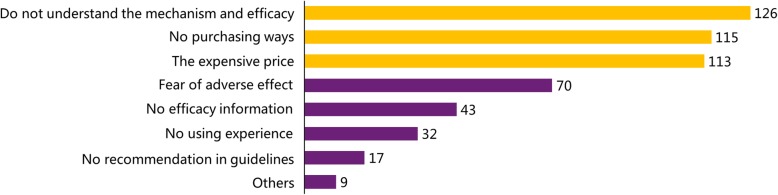
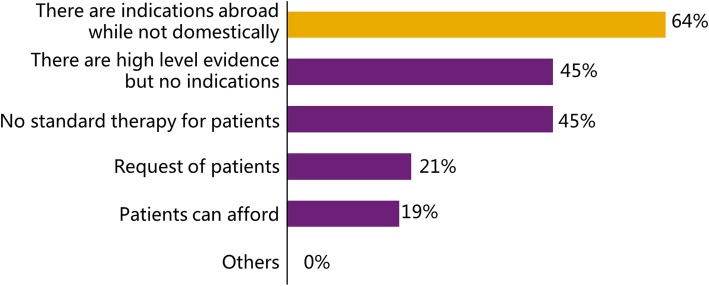
The valid response rate of the current status survey was 76.3%. The proportion of senior doctors (physician-in-charge or a more superior position for more than 3 years) among the respondents was relatively high (67.0% in 588). Of the respondents, 59.2% had prescribed PD-1/PD-L1 inhibitors during clinical treatment, and the most frequent reason for not prescribing these inhibitors was the choice "do not understand the mechanism and the efficacy of PD-1/PD-L1 inhibitors". In addition, 77.9% of the prescribers used the medications in an off-label situation, and the most important motivation for this use was the fact that "there were indications abroad but not domestically". In addition, 77.9% of the prescribers believed that "immunotherapy-related adverse effects could be controlled or intervened through follow-up management". The prescribers were mostly concerned about "how to identify pseudoprogression and hyperprogression" and "immunity-related adverse effects management".
The present study highlights the current status of PD-1/PD-L1 inhibitors in China. Increasing numbers of medical oncologists are interested in PD-1/PD-L1 inhibitors, and they are in need of immunotherapy education.
本研究旨在通过全国问卷调查了解中国肿瘤医生对 PD-1/PD-L1 抑制剂的使用情况。
2019 年 7 月 7 日至 25 日,由中国临床肿瘤学会免疫治疗专家委员会设计的关于 PD-1/PD-L1 抑制剂使用现状的问卷通过线上和线下两种方式分发给全国 30 个省、自治区、直辖市的肿瘤相关医疗科室。全国问卷由三部分组成:一般信息、PD-1/PD-L1 抑制剂在临床应用中的现状和肿瘤医生对利用的关注。
本次现状调查的有效回收率为 76.3%。受访者中高级职称(副主任医师或以上,工作 3 年以上)比例相对较高(588 人中占 67.0%)。59.2%的受访者在临床治疗中开具了 PD-1/PD-L1 抑制剂,未开具这些抑制剂的最常见原因是选择“不了解 PD-1/PD-L1 抑制剂的作用机制和疗效”。此外,77.9%的处方医生在超适应证情况下使用这些药物,最主要的动机是“国外有适应证但国内没有”。此外,77.9%的处方医生认为“免疫治疗相关不良反应可以通过随访管理得到控制或干预”。处方医生最关心的是“如何识别假性进展和超进展”和“免疫相关不良反应的管理”。
本研究突出了中国 PD-1/PD-L1 抑制剂的现状。越来越多的肿瘤内科医生对 PD-1/PD-L1 抑制剂感兴趣,他们需要免疫治疗方面的教育。