The Department of Regional Health Research, University of Southern Denmark, Odense, Denmark.
Surgical Department, Zealand University Hospital, Køge, Denmark.
BMC Neurol. 2020 Jan 31;20(1):41. doi: 10.1186/s12883-020-1625-7.
Epilepsy and multiple sclerosis (MS) are two neurological diseases known to greatly influence a patient's life. The primary aim of this study was to describe the prevalence of sexual dysfunction in patients with epilepsy and MS and investigate whether there is an association between disease, sexual function, and physical and mental health. A secondary aim was to investigate whether there is a difference in sexual function between patients with MS and epilepsy.
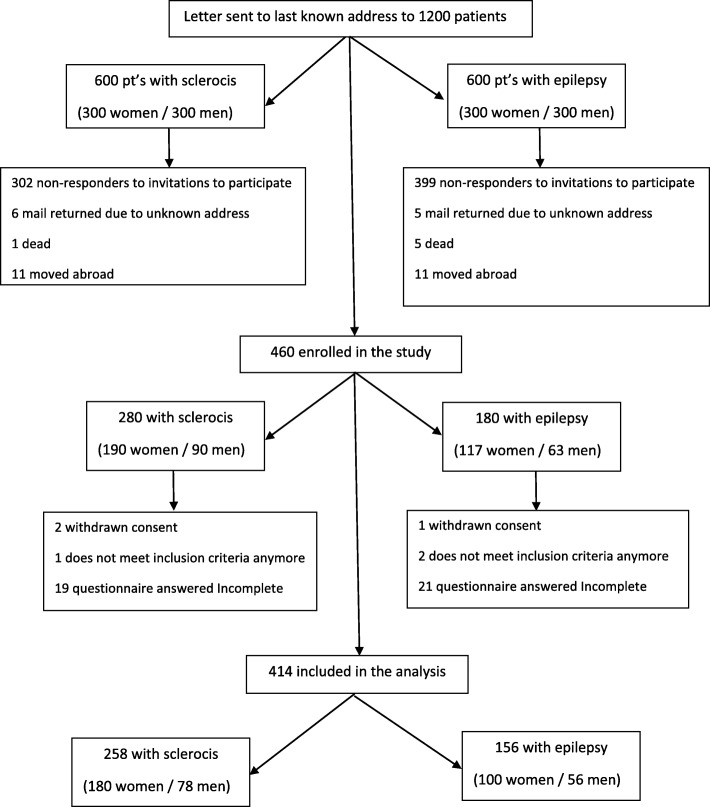
A total of 414 patients were included in this descriptive cross-sectional study. Three patient report questionnaires were used for measurements: the Changes in Sexual Function Questionnaire (CSFQ) cut-off score; the Short Form 36 Health Survey (SF-36) divided into the Physical Component Summary (PCS) and Mental Component Summary (MCS), and the Life Satisfaction-11 (LiSat-11).
Patients with MS constituted 62% (n = 258) of the participants and patients with epilepsy 38% (n = 156). The prevalence of sexual dysfunction was 68% in women and 77% in men. No differences were found between patients with MS and epilepsy (p = 0.184), except for the CSFQ desire domain, as patients with epilepsy more often had a desire problem (p = 0.029). On the SF-36, patients with MS scored significantly worse on the PCS (p = 0.000). Patients with epilepsy scored significantly worse on the MCS (p = 0.002). No significant differences were found on the LiSat-11. Regression analysis with CSFQ as the dependent variable showed an association with the PCS in men and an association with both PCS and MCS in women.
In this study, the cohort of patients with MS and epilepsy had negatively affected sexual function. The only significant difference between patients with MS and epilepsy in sexual function measured by the CSFQ-14, was found in the frequency of desire, in which a larger number of patients with epilepsy reported sexual dysfunction. In the studied cohort, sexual function in women is associated with both physical and mental health, and in men with physical health. These results should be considered when caring for patients with epilepsy and MS.
癫痫和多发性硬化症(MS)是两种已知会极大影响患者生活的神经疾病。本研究的主要目的是描述癫痫和 MS 患者性功能障碍的患病率,并探讨疾病、性功能与身心健康之间是否存在关联。次要目的是研究 MS 和癫痫患者之间的性功能是否存在差异。
本描述性横断面研究共纳入 414 名患者。使用了三个患者报告问卷进行测量:性功能变化问卷(CSFQ)截断值评分;健康调查简表 36 项(SF-36)分为生理成分综合评分(PCS)和心理成分综合评分(MCS),以及生活满意度-11 项(LiSat-11)。
MS 患者占参与者的 62%(n=258),癫痫患者占 38%(n=156)。女性性功能障碍的患病率为 68%,男性为 77%。MS 患者和癫痫患者之间没有差异(p=0.184),除了 CSFQ 欲望域,因为癫痫患者更常出现欲望问题(p=0.029)。在 SF-36 上,MS 患者的 PCS 评分显著较差(p=0.000)。癫痫患者的 MCS 评分显著较差(p=0.002)。LiSat-11 上没有显著差异。以 CSFQ 为因变量的回归分析显示,男性与 PCS 相关,女性与 PCS 和 MCS 相关。
在这项研究中,MS 和癫痫患者的性功能受到负面影响。在 CSFQ-14 测量的性功能方面,MS 患者和癫痫患者之间唯一的显著差异是欲望的频率,有更多的癫痫患者报告存在性功能障碍。在所研究的队列中,女性的性功能与身心健康均相关,而男性仅与身体健康相关。在照顾癫痫和 MS 患者时应考虑这些结果。