Infectious Diseases Unit, Department of Medicine, Queen Elizabeth Hospital, Kota Kinabalu, Sabah, Malaysia.
PLoS Negl Trop Dis. 2013;7(1):e2026. doi: 10.1371/journal.pntd.0002026. Epub 2013 Jan 24.
The simian parasite Plasmodium knowlesi is a common cause of human malaria in Malaysian Borneo and threatens the prospect of malaria elimination. However, little is known about the emergence of P. knowlesi, particularly in Sabah. We reviewed Sabah Department of Health records to investigate the trend of each malaria species over time.
Reporting of microscopy-diagnosed malaria cases in Sabah is mandatory. We reviewed all available Department of Health malaria notification records from 1992-2011. Notifications of P. malariae and P. knowlesi were considered as a single group due to microscopic near-identity.
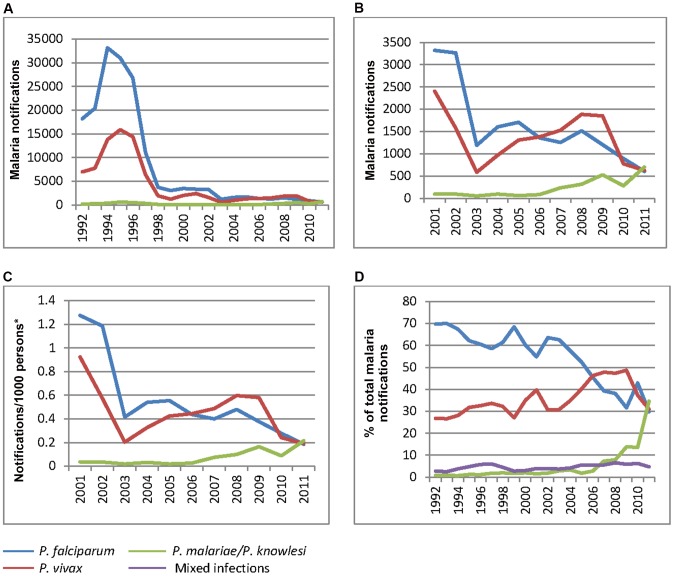
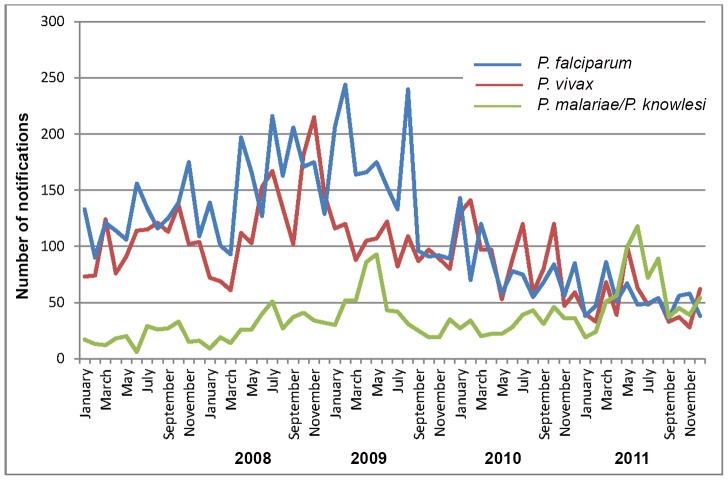
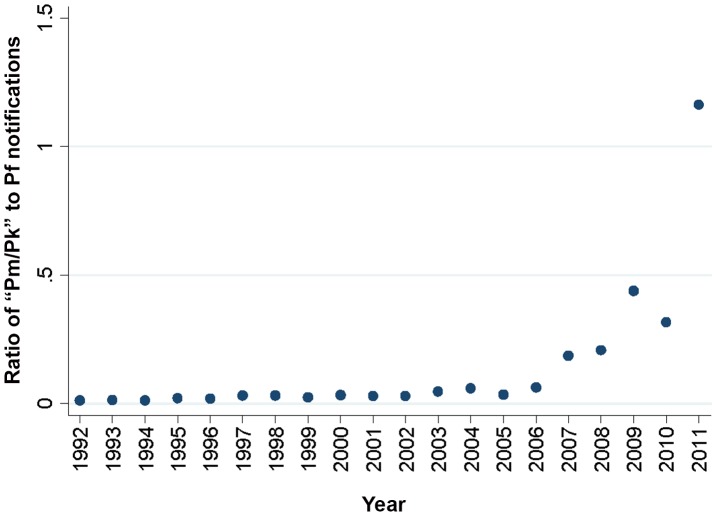
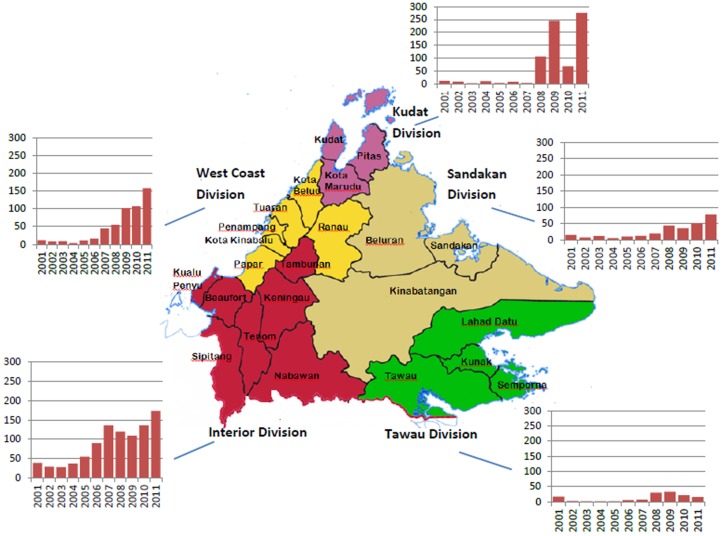
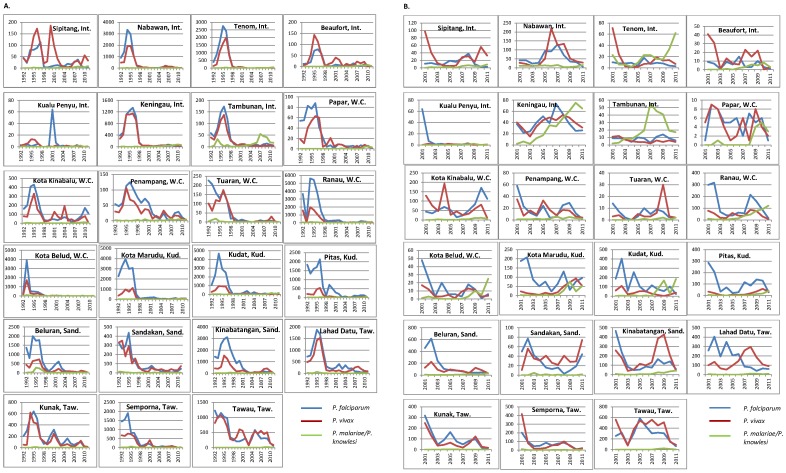
From 1992-2011 total malaria notifications decreased dramatically, with P. falciparum peaking at 33,153 in 1994 and decreasing 55-fold to 605 in 2011, and P. vivax peaking at 15,857 in 1995 and decreasing 25-fold to 628 in 2011. Notifications of P. malariae/P. knowlesi also demonstrated a peak in the mid-1990s (614 in 1994) before decreasing to ≈ 100/year in the late 1990s/early 2000s. However, P. malariae/P. knowlesi notifications increased >10-fold between 2004 (n = 59) and 2011 (n = 703). In 1992 P. falciparum, P. vivax and P. malariae/P. knowlesi monoinfections accounted for 70%, 24% and 1% respectively of malaria notifications, compared to 30%, 31% and 35% in 2011. The increase in P. malariae/P. knowlesi notifications occurred state-wide, appearing to have begun in the southwest and progressed north-easterly.
A significant recent increase has occurred in P. knowlesi notifications following reduced transmission of the human Plasmodium species, and this trend threatens malaria elimination. Determination of transmission dynamics and risk factors for knowlesi malaria is required to guide measures to control this rising incidence.
食蟹猴疟原虫是马来西亚婆罗洲常见的人类疟疾病原体,对消除疟疾的目标构成威胁。然而,人们对食蟹猴疟原虫的出现知之甚少,尤其是在沙巴州。我们查阅了沙巴州卫生局的记录,以调查各疟疾物种随时间的变化趋势。
沙巴州卫生局有义务报告显微镜诊断的疟疾病例。我们查阅了 1992 年至 2011 年期间所有可获得的卫生局疟疾通知记录。由于形态学上的高度相似性,将间日疟原虫和食蟹猴疟原虫的报告视为同一组。
1992 年至 2011 年期间,疟疾总报告数急剧下降,其中恶性疟原虫在 1994 年达到 33153 例的峰值,到 2011 年减少了 55 倍,至 605 例,间日疟原虫在 1995 年达到 15857 例的峰值,到 2011 年减少了 25 倍,至 628 例。间日疟原虫/食蟹猴疟原虫的报告也在 20 世纪 90 年代中期达到峰值(1994 年为 614 例),然后在 20 世纪 90 年代末至 21 世纪初减少至每年约 100 例。然而,2004 年(59 例)和 2011 年(703 例)间,间日疟原虫/食蟹猴疟原虫的报告数增加了 10 倍以上。1992 年,恶性疟原虫、间日疟原虫和间日疟原虫/食蟹猴疟原虫的单一感染分别占疟疾报告的 70%、24%和 1%,而 2011 年则分别占 30%、31%和 35%。间日疟原虫/食蟹猴疟原虫报告的增加是全州范围内的,似乎始于西南部,然后向东北方向发展。
在人类疟原虫传播减少后,食蟹猴疟原虫的报告显著增加,这一趋势对消除疟疾构成威胁。为了指导控制这种发病率上升的措施,需要确定食蟹猴疟的传播动态和危险因素。