Clinic for Ruminants with Ambulatory Clinic and Herd Health Services, Center for Clinical Veterinary Medicine, Ludwig-Maximilians-University Munich, Sonnenstrasse 16, 85764, Oberschleissheim, Germany.
Clinic for Swine, Small Ruminants, Forensic Medicine and Ambulatory Service, University of Veterinary Medicine Hannover Foundation, Bischofsholer Damm 15, 30173, Hannover, Germany.
BMC Vet Res. 2020 Jan 31;16(1):33. doi: 10.1186/s12917-020-2251-8.
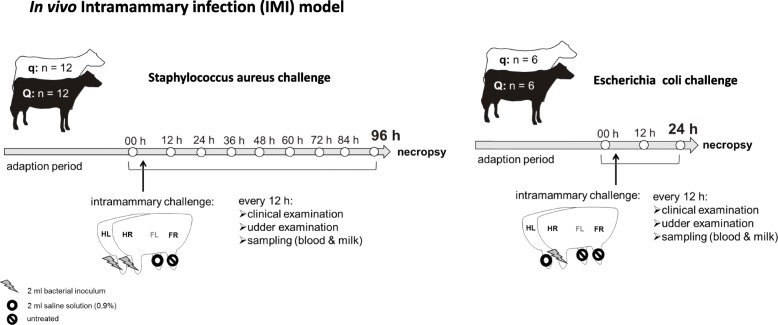
In dairy herds, mastitis causes detrimental economic losses. Genetic selection offers a sustainable tool to select animals with reduced susceptibility towards postpartum diseases. Studying underlying mechanisms is important to assess the physiological processes that cause differences between selected haplotypes. Therefore, the objective of this study was to establish an in vivo infection model to study the impact of selecting for alternative paternal haplotypes in a particular genomic region on cattle chromosome 18 for mastitis susceptibility under defined conditions in uniparous dairy cows.
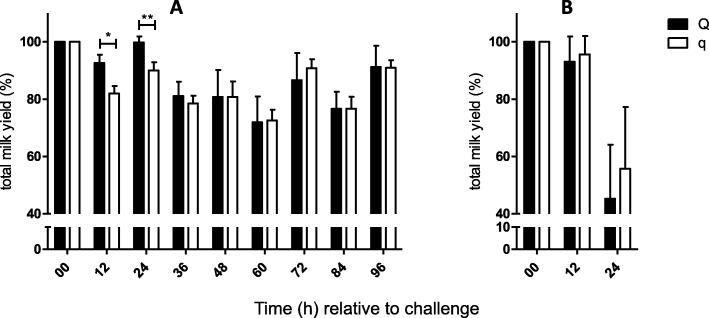
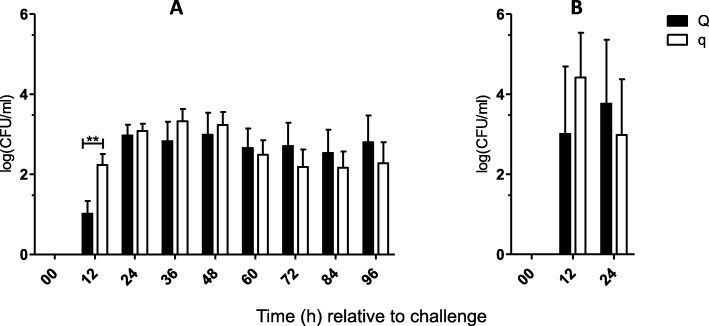
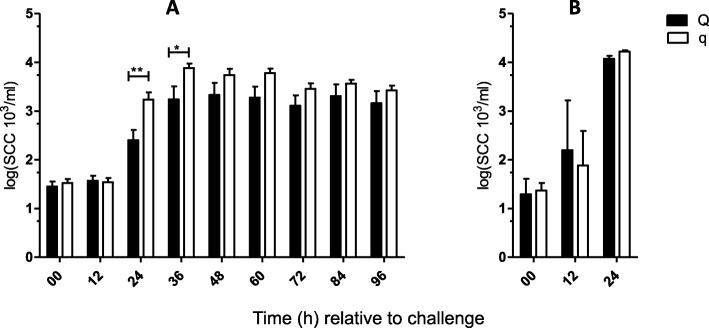
At the start of pathogen challenge, no significant differences between the favorable (Q) and unfavorable (q) haplotypes were detected. Intramammary infection (IMI) with Staphylococcus aureus 1027 (S. aureus, n = 24, 96 h) or Escherichia coli 1303 (E. coli, n = 12, 24 h) was successfully induced in all uniparous cows. This finding was confirmed by clinical signs of mastitis and repeated recovery of the respective pathogen from milk samples of challenged quarters in each animal. After S. aureus challenge, Q-uniparous cows showed lower somatic cell counts 24 h and 36 h after challenge (P < 0.05), lower bacterial shedding in milk 12 h after challenge (P < 0.01) and a minor decrease in total milk yield 12 h and 24 h after challenge (P < 0.01) compared to q-uniparous cows.
An in vivo infection model to study the impact of genetic selection for mastitis susceptibility under defined conditions in uniparous dairy cows was successfully established and revealed significant differences between the two genetically selected haplotype groups. This result might explain their differences in susceptibility towards IMI. These clinical findings form the basis for further in-depth molecular analysis to clarify the underlying genetic mechanisms for mastitis resistance.
在奶牛群体中,乳腺炎会造成巨大的经济损失。遗传选择为选择对产后疾病易感性降低的动物提供了一种可持续的工具。研究潜在机制对于评估导致所选单倍型之间差异的生理过程非常重要。因此,本研究的目的是建立一种体内感染模型,以研究在特定基因组区域选择替代父本单倍型对奶牛 18 号染色体乳腺炎易感性的影响,在未产奶牛中定义条件下。
在病原体挑战开始时,有利(Q)和不利(q)单倍型之间没有发现显著差异。所有未产奶牛均成功感染金黄色葡萄球菌 1027(金黄色葡萄球菌,n=24,96 小时)或大肠杆菌 1303(大肠杆菌,n=12,24 小时)的乳腺内感染(IMI)。这一发现通过乳腺炎的临床症状以及在每个动物的受挑战乳房中从牛奶样本中反复回收各自病原体得到证实。金黄色葡萄球菌挑战后,Q 型未产奶牛在挑战后 24 小时和 36 小时时的体细胞计数较低(P<0.05),挑战后 12 小时时牛奶中细菌脱落量较低(P<0.01),总产奶量在挑战后 12 小时和 24 小时时略有下降(P<0.01)与 q 型未产奶牛相比。
建立了一种在未产奶牛中定义条件下研究乳腺炎易感性遗传选择影响的体内感染模型,并发现了两种遗传选择单倍型群体之间的显著差异。这一结果可能解释了它们对 IMI 易感性的差异。这些临床发现为进一步深入的分子分析奠定了基础,以阐明乳腺炎抗性的潜在遗传机制。