Peay Dylan N, Saribekyan Hovhannes M, Parada Priscilla A, Hanson Elizabeth M, Badaruddin Bryce S, Judd Jessica M, Donnay Megan E, Padilla-Garcia Diego, Conrad Cheryl D
Department of Psychology, Arizona State University, Tempe, AZ, 85287-1104, United States.
Department of Psychology, Arizona State University, Tempe, AZ, 85287-1104, United States.
Behav Brain Res. 2020 Apr 6;383:112519. doi: 10.1016/j.bbr.2020.112519. Epub 2020 Jan 30.
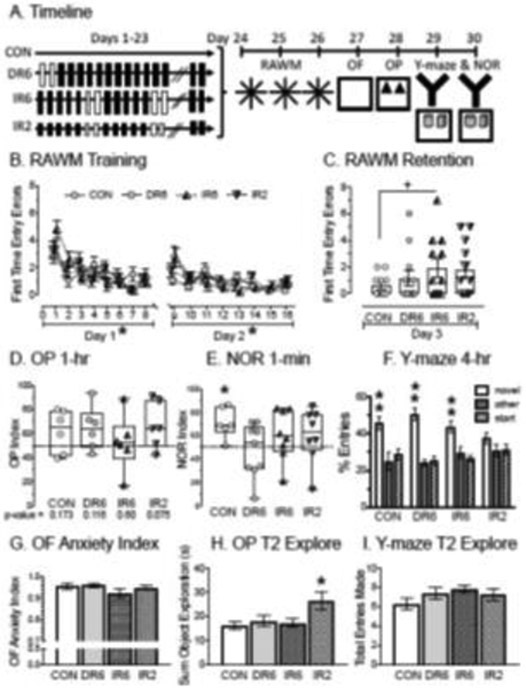
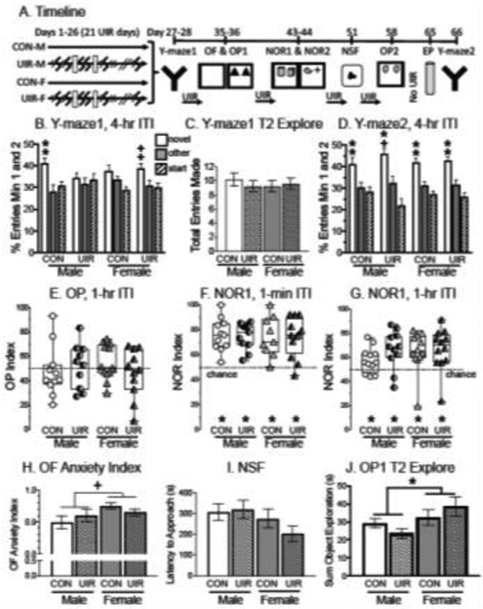
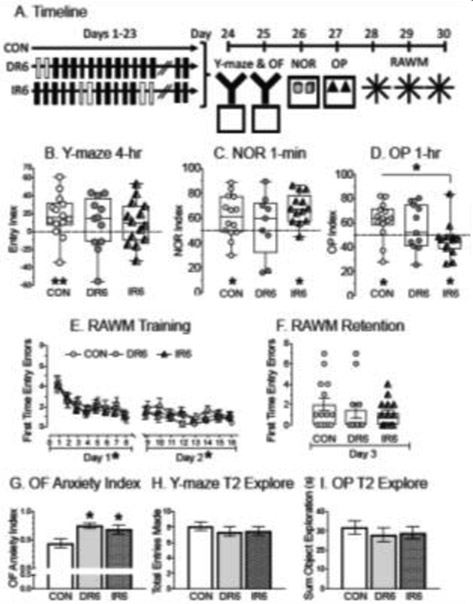
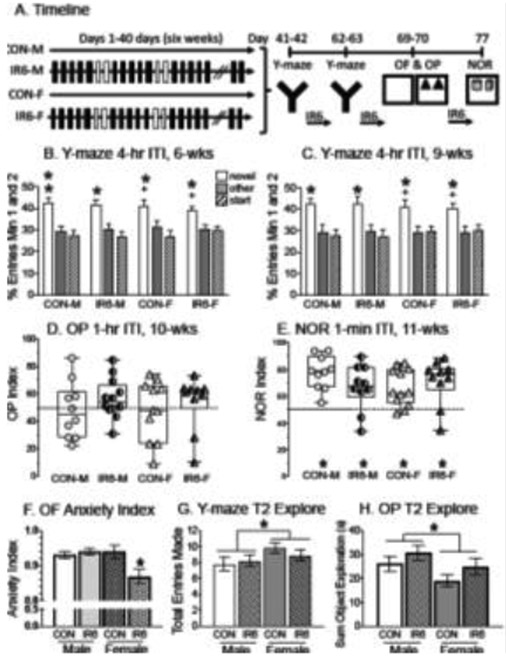
Chronic stress leads to sex-dependent outcomes on spatial memory by producing deficits in males, but not in females. Recently it was reported that compared to daily restraint, intermittent restraint (IR) produced more robust stress and anxiety responses in male rats. Whether IR would be sufficiently robust to impair hippocampal-dependent spatial memory in both male and female rats was investigated. IR involved mixing restraint with non-restraint days over weeks before assessing spatial memory and anxiety profile on the radial arm water maze, object placement, novel object recognition, Y-maze, open field and novelty suppressed feeding. Experiments 1 and 2 used Sprague-Dawley male rats only and determined that IR for 6 h/d (IR6), but not 2 h/d, impaired spatial memory and that task order was important. In experiment 3, IR6 was extended for 6wks before spatial memory testing commenced using both sexes. Unexpectedly, an extended IR6 paradigm failed to impair spatial memory in either sex, suggesting that by 6wks IR6 may have become predictable. In experiment 4, an unpredictable IR (UIR) paradigm was implemented, in which restraint duration (30 or 60-min) combined with orbital shaking, time of day, and the days off from UIR were varied. UIR impaired spatial memory in males, but not in females. Together with other reports, these findings support the interpretation that chronic stress negatively impairs hippocampal-dependent function in males, but not in females. We interpret these findings to show that females are more resilient to chronic stress than are males as it pertains to spatial ability.
慢性应激通过导致雄性而非雌性的空间记忆缺陷,产生性别依赖性的结果。最近有报道称,与每日束缚相比,间歇性束缚(IR)在雄性大鼠中产生了更强的应激和焦虑反应。研究了IR是否足够强烈,足以损害雄性和雌性大鼠中依赖海马体的空间记忆。IR包括在数周内将束缚与非束缚日混合,然后在放射状臂水迷宫、物体放置、新物体识别、Y迷宫、旷场和新奇抑制摄食实验中评估空间记忆和焦虑状况。实验1和2仅使用了斯普拉格-道利雄性大鼠,确定每天6小时的IR(IR6)而非每天2小时的IR会损害空间记忆,并且任务顺序很重要。在实验3中,在开始对两性进行空间记忆测试之前,将IR6延长了6周。出乎意料的是,延长的IR6范式未能损害任何性别的空间记忆,这表明到6周时,IR6可能已变得可预测。在实验4中,实施了不可预测的IR(UIR)范式,其中束缚持续时间(30或60分钟)与轨道摇晃、一天中的时间以及UIR的休息日各不相同。UIR损害了雄性的空间记忆,但未损害雌性的空间记忆。与其他报告一起,这些发现支持这样的解释,即慢性应激对雄性中依赖海马体的功能有负面影响,但对雌性没有。我们对这些发现的解释是,就空间能力而言,雌性比雄性对慢性应激更具弹性。