Coral Reef Research Unit, School of Life Sciences, University of Essex, Colchester, CO4 3SQ, UK.
Marine Biology Department, Faculty of Science, Al-Azhar University, Nasr City, Cairo, 11448, Egypt.
Microbiome. 2020 Feb 3;8(1):8. doi: 10.1186/s40168-019-0776-5.
The capacity of reef-building corals to tolerate (or adapt to) heat stress is a key factor determining their resilience to future climate change. Changes in coral microbiome composition (particularly for microalgal endosymbionts and bacteria) is a potential mechanism that may assist corals to thrive in warm waters. The northern Red Sea experiences extreme temperatures anomalies, yet corals in this area rarely bleach suggesting possible refugia to climate change. However, the coral microbiome composition, and how it relates to the capacity to thrive in warm waters in this region, is entirely unknown.
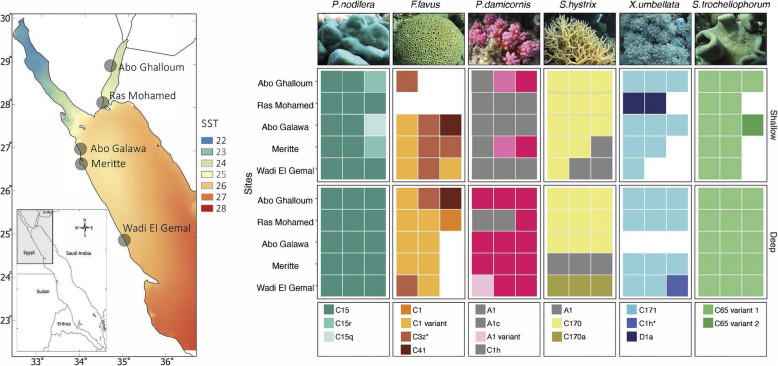
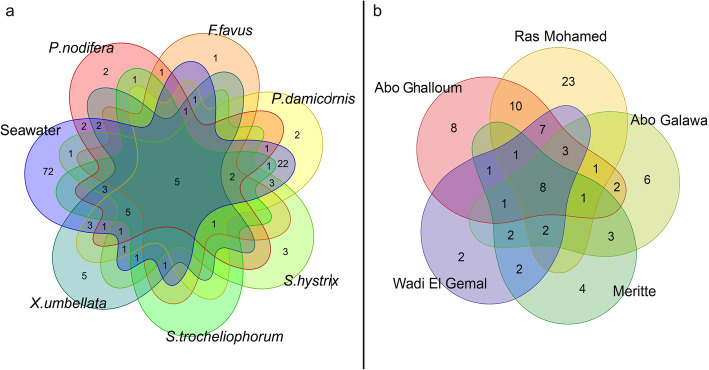
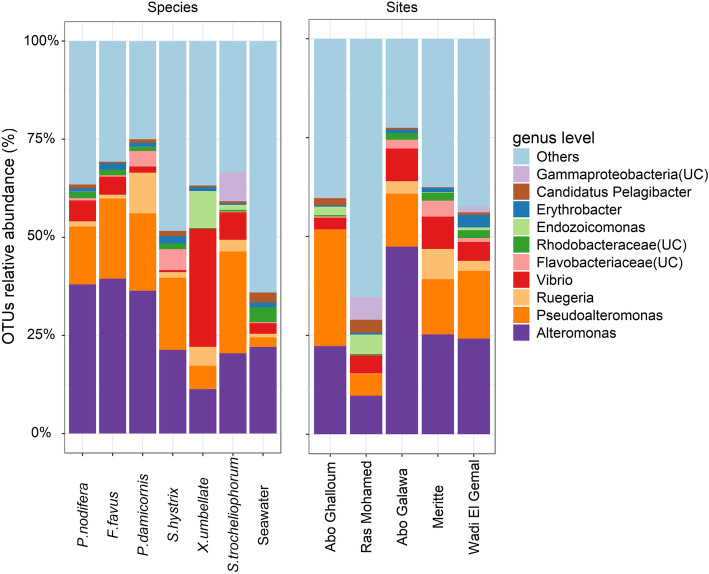
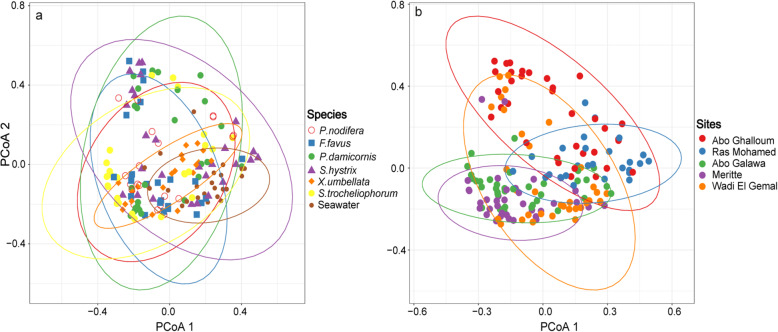
We investigated microbiomes for six coral species (Porites nodifera, Favia favus, Pocillopora damicornis, Seriatopora hystrix, Xenia umbellata, and Sarcophyton trocheliophorum) from five sites in the northern Red Sea spanning 4° of latitude and summer mean temperature ranges from 26.6 °C to 29.3 °C. A total of 19 distinct dinoflagellate endosymbionts were identified as belonging to three genera in the family Symbiodiniaceae (Symbiodinium, Cladocopium, and Durusdinium). Of these, 86% belonged to the genus Cladocopium, with notably five novel types (19%). The endosymbiont community showed a high degree of host-specificity despite the latitudinal gradient. In contrast, the diversity and composition of bacterial communities of the surface mucus layer (SML)-a compartment particularly sensitive to environmental change-varied significantly between sites, however for any given coral was species-specific.
The conserved endosymbiotic community suggests high physiological plasticity to support holobiont productivity across the different latitudinal regimes. Further, the presence of five novel algal endosymbionts suggests selection of certain genotypes (or genetic adaptation) within the semi-isolated Red Sea. In contrast, the dynamic composition of bacteria associated with the SML across sites may contribute to holobiont function and broaden the ecological niche. In doing so, SML bacterial communities may aid holobiont local acclimatization (or adaptation) by readily responding to changes in the host environment. Our study provides novel insight about the selective and endemic nature of coral microbiomes along the northern Red Sea refugia.
造礁珊瑚耐受(或适应)热应激的能力是决定其对未来气候变化的恢复力的关键因素。珊瑚微生物组组成的变化(特别是对微藻类内共生体和细菌)是一种潜在的机制,可以帮助珊瑚在温暖的水中茁壮成长。红海北部经历了极端的温度异常,但该地区的珊瑚很少白化,这表明该地区可能是气候变化的避难所。然而,该地区珊瑚微生物组的组成以及它与在温暖水域中茁壮成长的能力之间的关系尚不清楚。
我们调查了来自红海北部五个地点的六种珊瑚物种(Porites nodifera、Favia favus、Pocillopora damicornis、Seriatopora hystrix、Xenia umbellata 和 Sarcophyton trocheliophorum)的微生物组,这些地点跨越了 4°的纬度,夏季平均温度范围从 26.6°C 到 29.3°C。总共鉴定出 19 种不同的虫黄藻内共生体,它们属于 Symbiodiniaceae 科的三个属(Symbiodinium、Cladocopium 和 Durusdinium)。其中,86%属于 Cladocopium 属,其中有五个新型(19%)。尽管存在纬度梯度,但内共生体群落表现出高度的宿主特异性。相比之下,表面黏液层(SML)——一个对环境变化特别敏感的隔室——的细菌群落的多样性和组成在不同地点之间差异显著,但对于任何给定的珊瑚都是种特异性的。
保守的共生体群落表明,在不同的纬度范围内,共生体具有很高的生理可塑性,以支持共生体的生产力。此外,存在五个新型藻类内共生体表明,在半孤立的红海,某些基因型(或遗传适应)被选择。相比之下,与 SML 相关的细菌在不同地点的动态组成可能有助于共生体的功能,并拓宽生态位。通过这种方式,SML 细菌群落可以通过快速响应宿主环境的变化,帮助共生体实现局部适应(或适应)。我们的研究提供了关于红海北部避难所沿珊瑚微生物组的选择性和特有性的新见解。