Qi Xin, Wen Yan, Li Ping, Liang Chujun, Cheng Bolun, Ma Mei, Cheng Shiqiang, Zhang Lu, Liu Li, Kafle Om Prakash, Zhang Feng
Key Laboratory of Trace Elements and Endemic Diseases of National Health and Family Planning Commission, School of Public Health, Health Science Center, Xi'an Jiaotong University, No. 76 Yan Ta West Road, Xi'an, 710061, People's Republic of China.
Int J Bipolar Disord. 2020 Feb 3;8(1):6. doi: 10.1186/s40345-019-0170-z.
Bipolar disorder (BD) is a complex mood disorder. The genetic mechanism of BD remains largely unknown.
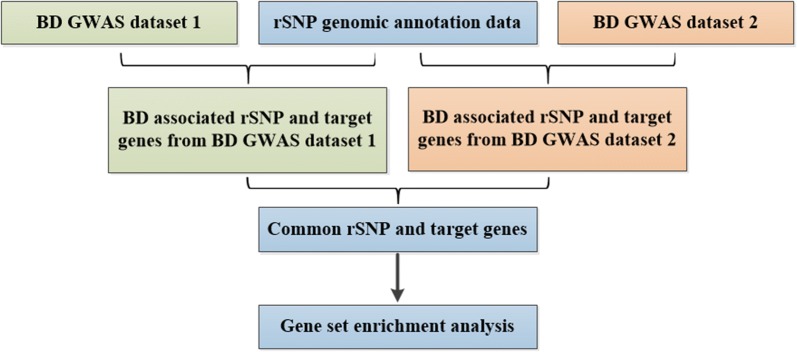
We conducted an integrative analysis of genome-wide association study (GWAS) and regulatory SNP (rSNP) annotation datasets, including transcription factor binding regions (TFBRs), chromatin interactive regions (CIRs), mature microRNA regions (miRNAs), long non-coding RNA regions (lncRNAs), topologically associated domains (TADs) and circular RNAs (circRNAs). Firstly, GWAS dataset 1 of BD (including 20,352 cases and 31,358 controls) and GWAS dataset 2 of BD (including 7481 BD patients and 9250 controls) were integrated with rSNP annotation database to obtain BD associated SNP regulatory elements and SNP regulatory element-target gene (E-G) pairs, respectively. Secondly, a comparative analysis of the two datasets results was conducted to identify the common rSNPs and also their target genes. Then, gene sets enrichment analysis (FUMA GWAS) and HumanNet-XC analysis were conducted to explore the functional relevance of identified target genes with BD.
After the integrative analysis, we identified 52 TFBRs target genes, 44 TADs target genes, 55 CIRs target genes and 21 lncRNAs target genes for BD, such as ITIH4 (P = 6.68 × 10, P = 6.64 × 10), ITIH3 (P = 1.09 × 10, P = 2.00 × 10), SYNE1 (P = 1.80 × 10, P = 4.33 × 10) and OPRM1 (P = 1.80 × 10, P = 4.33 × 10).
We conducted a large-scale integrative analysis of GWAS and 6 common rSNP information datasets to explore the potential roles of rSNPs in the genetic mechanism of BD. We identified multiple candidate genes for BD, supporting the importance of rSNP in the development of BD.
双相情感障碍(BD)是一种复杂的情绪障碍。BD的遗传机制在很大程度上仍然未知。
我们对全基因组关联研究(GWAS)和调控单核苷酸多态性(rSNP)注释数据集进行了综合分析,这些数据集包括转录因子结合区域(TFBRs)、染色质相互作用区域(CIRs)、成熟微小RNA区域(miRNAs)、长链非编码RNA区域(lncRNAs)、拓扑相关结构域(TADs)和环状RNA(circRNAs)。首先,将BD的GWAS数据集1(包括20352例病例和31358例对照)和BD的GWAS数据集2(包括7481例BD患者和9250例对照)与rSNP注释数据库整合,分别获得BD相关的SNP调控元件和SNP调控元件-靶基因(E-G)对。其次,对两个数据集的结果进行比较分析,以识别共同的rSNPs及其靶基因。然后,进行基因集富集分析(FUMA GWAS)和HumanNet-XC分析,以探索已识别的靶基因与BD的功能相关性。
综合分析后,我们确定了BD的52个TFBRs靶基因、44个TADs靶基因、55个CIRs靶基因和21个lncRNAs靶基因,如ITIH4(P = 6.68×10,P = 6.64×10)、ITIH3(P = 1.09×10,P = 2.00×10)、SYNE1(P = 1.80×10,P = 4.33×10)和OPRM1(P = 1.80×10,P = 4.33×10)。
我们对GWAS和6个常见的rSNP信息数据集进行了大规模综合分析,以探索rSNPs在BD遗传机制中的潜在作用。我们确定了多个BD候选基因,支持了rSNP在BD发生发展中的重要性。