Huang Yunqi, Liu Yunjia, Wu Yulu, Tang Yiguo, Zhang Mengting, Liu Siyi, Xiao Liling, Tao Shiwan, Xie Min, Dai Minhan, Li Mingli, Gui Hongsheng, Wang Qiang
Mental Health Center and Psychiatric Laboratory, State Key Laboratory of Biotherapy, West China Hospital of Sichuan University, Chengdu, China.
West China Brain Research Center, West China Hospital of Sichuan University, Chengdu, China.
Front Cell Dev Biol. 2022 Jul 15;10:956265. doi: 10.3389/fcell.2022.956265. eCollection 2022.
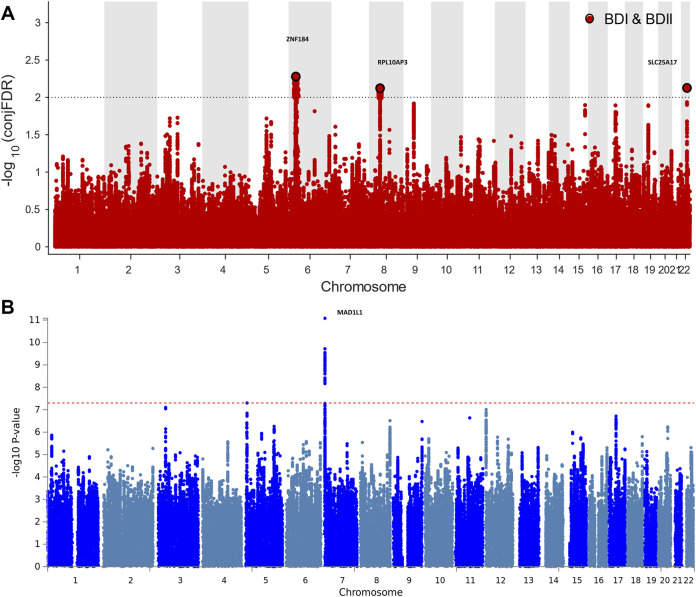
Genome-wide association studies (GWAS) analyses have revealed genetic evidence of bipolar disorder (BD), but little is known about the genetic structure of BD subtypes. We aimed to investigate the genetic overlap and distinction of bipolar type I (BD I) & type II (BD II) by conducting integrative post-GWAS analyses. We utilized single nucleotide polymorphism (SNP)-level approaches to uncover correlated and distinct genetic loci. Transcriptome-wide association analyses (TWAS) were then approached to pinpoint functional genes expressed in specific brain tissues and blood. Next, we performed cross-phenotype analysis, including exploring the potential causal associations between two BD subtypes and lithium responses and comparing the difference in genetic structures among four different psychiatric traits. SNP-level evidence revealed three genomic loci, , and , shared by BD I and II, and one locus () and significant gene sets involved in calcium channel activity, neural and synapsed signals that distinguished two subtypes. TWAS data implicated different genes affecting BD I and II through expression in specific brain regions (nucleus accumbens for BD I). Cross-phenotype analyses indicated that BD I and II share continuous genetic structures with schizophrenia and major depressive disorder, which help fill the gaps left by the dichotomy of mental disorders. These combined evidences illustrate genetic convergence and divergence between BD I and II and provide an underlying biological and trans-diagnostic insight into major psychiatric disorders.
全基因组关联研究(GWAS)分析已经揭示了双相情感障碍(BD)的遗传证据,但对于BD亚型的遗传结构却知之甚少。我们旨在通过进行GWAS后整合分析来研究I型双相情感障碍(BD I)和II型双相情感障碍(BD II)的遗传重叠与差异。我们采用单核苷酸多态性(SNP)水平的方法来发现相关和不同的基因座。然后采用全转录组关联分析(TWAS)来确定在特定脑组织和血液中表达的功能基因。接下来,我们进行了跨表型分析,包括探索两种BD亚型与锂反应之间的潜在因果关联,以及比较四种不同精神疾病特征的遗传结构差异。SNP水平的证据揭示了BD I和BD II共有的三个基因组位点,以及一个位点()和参与钙通道活性、神经和突触信号的重要基因集,这些区分了两种亚型。TWAS数据表明,通过在特定脑区(BD I的伏隔核)的表达,不同的基因影响BD I和BD II。跨表型分析表明,BD I和BD II与精神分裂症和重度抑郁症共享连续的遗传结构,这有助于填补精神障碍二分法留下的空白。这些综合证据说明了BD I和BD II之间的遗传趋同与差异,并为主要精神疾病提供了潜在的生物学和跨诊断见解。