Cardiology Division, Massachusetts General Hospital, Boston, Massachusetts.
Department of Cardiovascular Medicine, Mayo Clinic, Rochester, Minnesota.
J Cardiovasc Electrophysiol. 2020 Apr;31(4):825-833. doi: 10.1111/jce.14376. Epub 2020 Feb 28.
The AdaptivCRT (aCRT) algorithm continuously adjusts cardiac resynchronization therapy (CRT) according to intrinsic atrioventricular conduction, providing synchronized left ventricular pacing in patients with normal PR interval and adaptive BiV pacing in patients with prolonged PR interval. Previous analyses demonstrated an association between aCRT and clinical benefit. We evaluated the incidence of patient mortality and atrial fibrillation (AF) with aCRT compared with standard CRT in a real-world population.
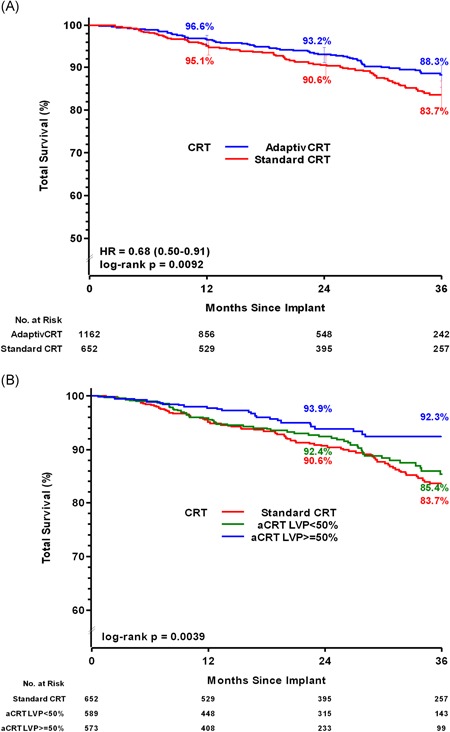
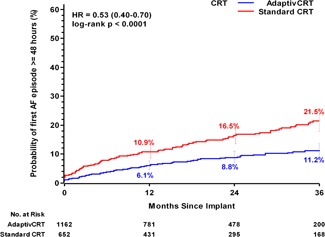
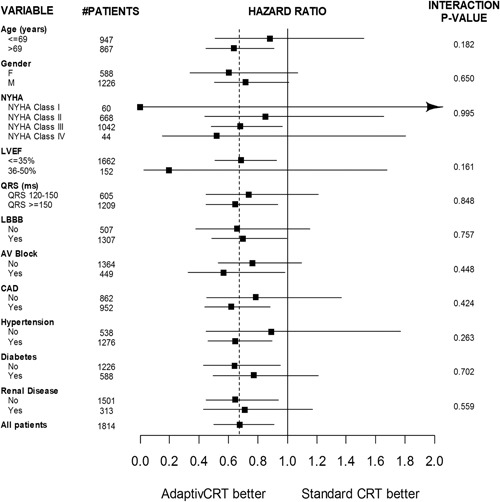
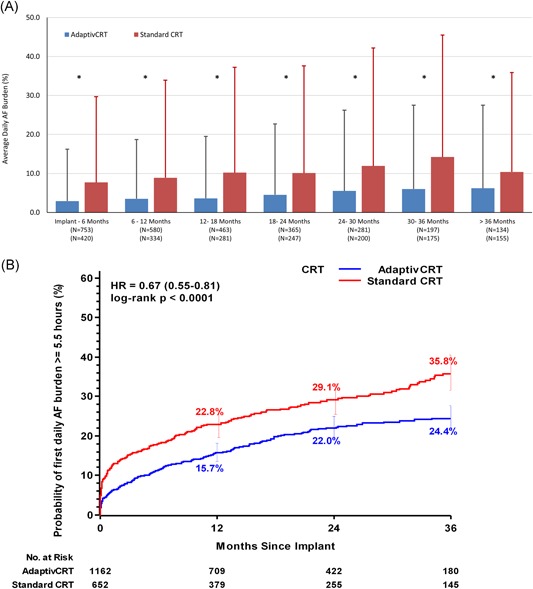
Patients enrolled in the Medtronic Personalized CRT Registry and implanted with a CRT from 2013-2018 were divided into aCRT ON or standard CRT groups based upon device-stored data. A Frailty survival model was used to evaluate the potential survival benefit of aCRT, accounting for patient heterogeneity and center variability. Daily AF burden and first device-detected AF episodes of various durations were recorded by the device during follow-up. A total of 1814 CRT patients with no reported long-standing AF history at implant were included. Mean follow-up time was 26.1 ± 16.5 months and 1162 patients (64.1%) had aCRT ON. Patient survival probability at 36 months was 88.3% for aCRT ON and 83.7% for standard CRT (covariate-adjusted hazard ratio [HR] = 0.71, 95% CI: 0.53-0.96, P = .028). Mean AF burden during follow-up was consistently lower in aCRT ON patients compared with standard CRT. At 36 months, the probability of AF was lower in patients with aCRT ON, regardless of which AF definition threshold was applied (6 minutes-30 days, all P < .001).
Use of the AdaptivCRT algorithm was associated with improved patient survival and lower incidence of AF in a real-world, prospective, nonrandomized registry.
AdaptivCRT(aCRT)算法根据固有房室传导持续调整心脏再同步治疗(CRT),为 PR 间期正常的患者提供同步左心室起搏,为 PR 间期延长的患者提供适应性双心室起搏。先前的分析表明 aCRT 与临床获益之间存在关联。我们评估了与标准 CRT 相比,在真实世界人群中使用 aCRT 的患者死亡率和心房颤动(AF)的发生率。
根据设备存储的数据,将 2013 年至 2018 年植入 Medtronic Personalized CRT 注册研究中接受 CRT 的患者分为 aCRT ON 或标准 CRT 组。使用脆弱性生存模型评估 aCRT 的潜在生存获益,同时考虑患者异质性和中心变异性。在随访期间,设备记录了每日 AF 负担和各种持续时间的首次设备检测到的 AF 发作。共纳入 1814 例植入时无长期 AF 病史报告的 CRT 患者。平均随访时间为 26.1±16.5 个月,1162 例患者(64.1%)使用 aCRT ON。aCRT ON 患者 36 个月时的生存率为 88.3%,标准 CRT 为 83.7%(调整协变量后的危险比[HR]=0.71,95%CI:0.53-0.96,P=0.028)。与标准 CRT 相比,aCRT ON 患者在随访期间的平均 AF 负担始终较低。在 36 个月时,无论应用哪种 AF 定义阈值,aCRT ON 患者的 AF 发生率均较低(6 分钟-30 天,均 P<0.001)。
在真实世界、前瞻性、非随机登记研究中,使用 AdaptivCRT 算法与患者生存率提高和 AF 发生率降低相关。