Yong Shin Jie, Tong Tommy, Chew Jactty, Lim Wei Ling
Department of Biological Sciences, School of Science and Technology, Sunway University, Bandar Sunway, Malaysia.
Front Neurosci. 2020 Jan 14;13:1361. doi: 10.3389/fnins.2019.01361. eCollection 2019.
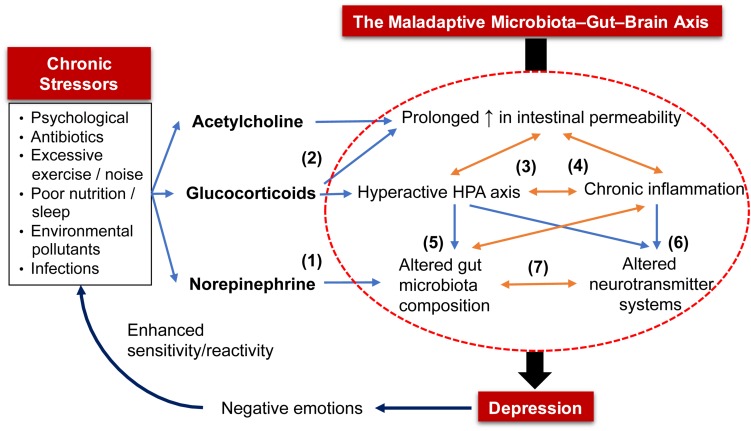
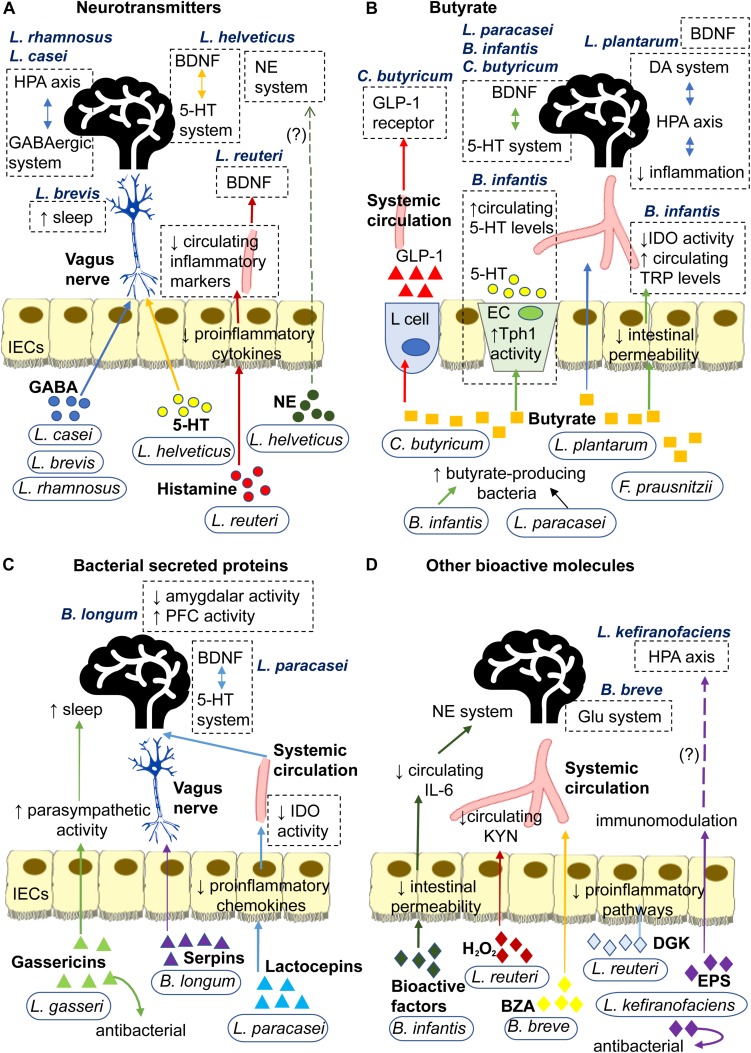
The accumulating knowledge of the host-microbiota interplay gives rise to the microbiota-gut-brain (MGB) axis. The MGB axis depicts the interkingdom communication between the gut microbiota and the brain. This communication process involves the endocrine, immune and neurotransmitters systems. Dysfunction of these systems, along with the presence of gut dysbiosis, have been detected among clinically depressed patients. This implicates the involvement of a maladaptive MGB axis in the pathophysiology of depression. Depression refers to symptoms that characterize major depressive disorder (MDD), a mood disorder with a disease burden that rivals that of heart diseases. The use of probiotics to treat depression has gained attention in recent years, as evidenced by increasing numbers of animal and human studies that have supported the antidepressive efficacy of probiotics. Physiological changes observed in these studies allow for the elucidation of probiotics antidepressive mechanisms, which ultimately aim to restore proper functioning of the MGB axis. However, the understanding of mechanisms does not yet complete the endeavor in applying probiotics to treat MDD. Other challenges remain which include the heterogeneous nature of both the gut microbiota composition and depressive symptoms in the clinical setting. Nevertheless, probiotics offer some advantages over standard pharmaceutical antidepressants, in terms of residual symptoms, side effects and stigma involved. This review outlines antidepressive mechanisms of probiotics based on the currently available literature and discusses therapeutic potentials of probiotics for depression.
对宿主-微生物群相互作用的认识不断积累,催生了微生物群-肠道-脑(MGB)轴。MGB轴描述了肠道微生物群与大脑之间的跨界交流。这一交流过程涉及内分泌、免疫和神经递质系统。在临床抑郁症患者中已检测到这些系统的功能障碍以及肠道菌群失调的存在。这意味着适应不良的MGB轴参与了抑郁症的病理生理过程。抑郁症指的是重度抑郁症(MDD)的特征性症状,MDD是一种疾病负担与心脏病相当的情绪障碍。近年来,使用益生菌治疗抑郁症受到了关注,越来越多的动物和人体研究支持益生菌的抗抑郁功效就证明了这一点。这些研究中观察到的生理变化有助于阐明益生菌的抗抑郁机制,其最终目的是恢复MGB轴的正常功能。然而,对机制的理解尚未完成将益生菌应用于治疗MDD的努力。其他挑战仍然存在,包括临床环境中肠道微生物群组成和抑郁症状的异质性。尽管如此,在残留症状、副作用和相关污名方面,益生菌相对于标准的抗抑郁药物具有一些优势。本综述根据现有文献概述了益生菌的抗抑郁机制,并讨论了益生菌治疗抑郁症的潜在疗效。