Schoenfeld Brad J, Grgic Jozo, Contreras Bret, Delcastillo Kenneth, Alto Andrew, Haun Cody, De Souza Eduardo O, Vigotsky Andrew D
Department of Health Sciences, CUNY Lehman College, New York City, NY, United States.
Institute for Health and Sport, Victoria University, Melbourne, VIC, Australia.
Front Physiol. 2020 Jan 15;10:1571. doi: 10.3389/fphys.2019.01571. eCollection 2019.
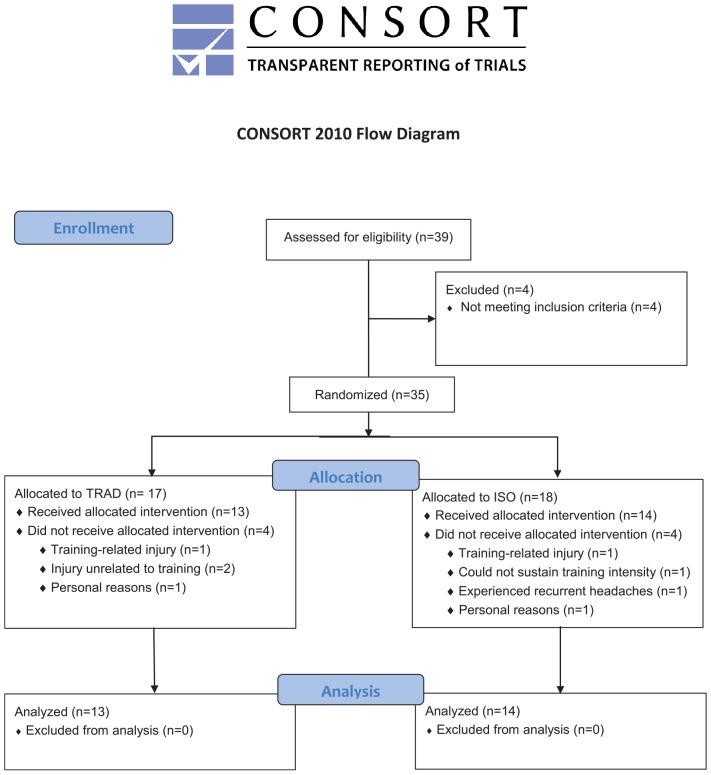
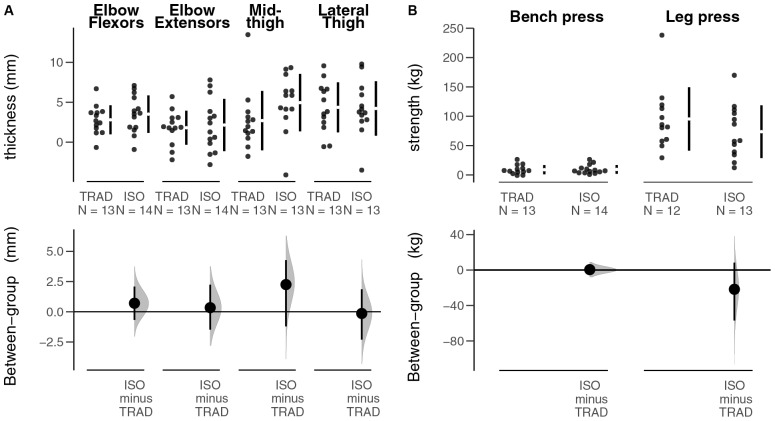
We aimed to investigate the effects of resistance training (RT) combined with no-load isometric actions (iso-holds) during the inter-set recovery period versus RT that involves passive inter-set rest on muscular strength, muscular hypertrophy, and muscular endurance in resistance-trained men. Twenty-seven resistance-trained male volunteers were randomly assigned to either a traditional group (TRAD) that performed a hypertrophy-oriented RT routine with the rest intervals spent passively ( = 13) or to a group that supplemented traditional RT with iso-holds (ISO) for the working muscle group between each set ( = 14). Training for both routines consisted of three weekly sessions performed for 8 weeks. Three sets of 8-12 repetitions were performed per exercise. A 2-min rest interval was afforded between sets; the ISO group performed iso-holds for the first 30 s of each rest interval and then recovered for the final 90 s. Maximal strength was assessed using the one repetition maximum (1RM) tests in the leg press and bench press. Upper-body muscle endurance was assessed by performing the bench press to failure at 50% of 1RM. Muscle thickness (MT) of the elbow flexors, elbow extensors, mid-thigh, and lateral thigh was assessed using B-mode ultrasound. Results indicated a favorable effect of ISO on MT in the mid-thigh. Alternatively, there was a possible detrimental effect for ISO on leg press strength. No other notable differences were seen between conditions. In conclusion, the use of inter-set iso-holds may be a time-efficient strategy to enhance development of the quadriceps femoris; conversely, it may be detrimental to maximizing lower body strength.
我们旨在研究在组间恢复期间进行抗阻训练(RT)并结合无负荷等长动作(等长保持)与进行被动组间休息的RT相比,对有抗阻训练经历的男性的肌肉力量、肌肉肥大和肌肉耐力的影响。27名有抗阻训练经历的男性志愿者被随机分配到传统组(TRAD),该组进行以肌肉肥大训练为主的RT常规训练,组间休息采用被动方式(n = 13),或分配到另一组,即在每组训练之间为工作肌肉群补充等长保持动作的组(ISO组,n = 14)。两种常规训练均为每周进行三次,共持续8周。每个练习进行三组,每组8 - 12次重复。组间给予2分钟的休息间隔;ISO组在每个休息间隔的前30秒进行等长保持,然后在最后90秒进行恢复。使用腿举和卧推的一次重复最大值(1RM)测试来评估最大力量。通过在1RM的50%强度下进行卧推直至力竭来评估上身肌肉耐力。使用B超评估肱二头肌、肱三头肌、大腿中部和大腿外侧的肌肉厚度(MT)。结果表明,ISO组对大腿中部的MT有良好影响。另外,ISO组对腿举力量可能有不利影响。在不同条件之间未观察到其他显著差异。总之,组间进行等长保持可能是一种提高股四头肌发育的省时策略;相反,它可能不利于最大化下肢力量。