Tao Hsiao-Hang, Snaddon Jake L, Slade Eleanor M, Caliman Jean-Pierre, Widodo Rudi H, Willis Kathrine J
1Department of Zoology, University of Oxford, Oxford, Oxfordshire UK.
2Centre for Biological Sciences, University of Southampton, Southampton, UK.
Agron Sustain Dev. 2017;37(4):33. doi: 10.1007/s13593-017-0439-5. Epub 2017 Jul 28.
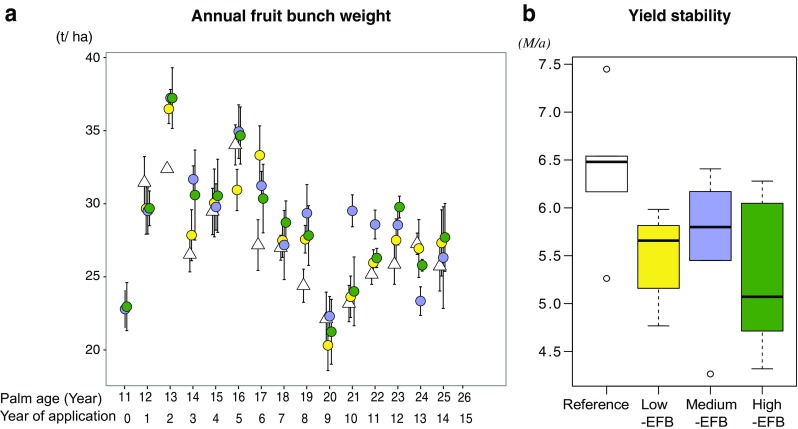
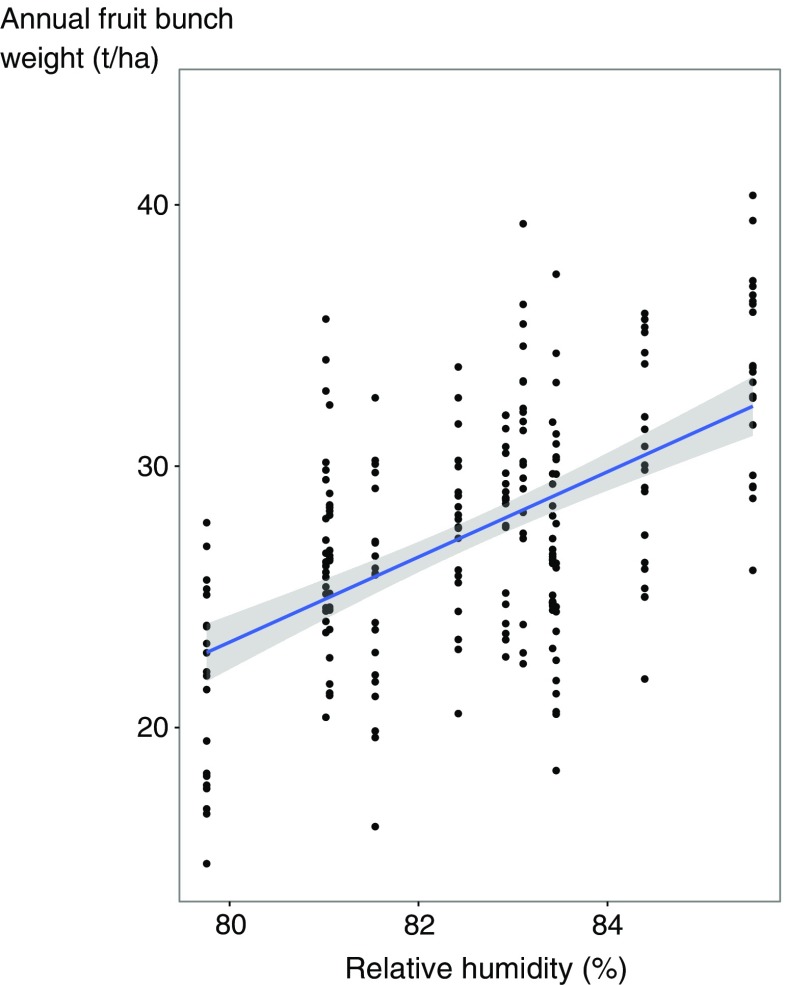
Crop residue management is an important agricultural practice that has a high potential to improve soil health and optimize crop production. Compared to annual crops, relatively little is known about crop residue management effects on the yield and temporal stability of perennial crop production. This study focused on oil palm (), an important tropical crop that had expanded rapidly over the past decades. We aimed to understand the effects of applying a major oil palm residue, the empty fruit bunch, on crop yield and temporal stability of production. We compared 15 years of crop yield performance from a field trial in Sumatra, Indonesia. The treatments included empty fruit bunch application of three application rates (30, 60, and 90 t ha year), and a reference treatment of chemical fertilizers with no addition of empty fruit bunch. Compared to the reference treatment, the cumulative crop yield over 15 years under low, medium, and high application rates of empty fruit bunch increased by 2.4, 5.9, and 4.8%, respectively. The annual crop yield and temporal stability in production were not significantly different between treatments. Soil organic carbon was significantly higher under medium application rate of empty fruit bunch compared to that under the chemical fertilizer treatment. Soil organic carbon and relative humidity were positively associated with annual crop yield with a time lag of 2 years. This study is the first to show that both crop yield and temporal variability of oil palm production can be maintained under crop residue application, compared to chemical fertilizer treatment. Furthermore, climatic conditions had strong effects on the temporal variability of oil palm production. These findings will inform the design of optimal empty fruit bunch application schemes that enhance sustainable intensification of oil palm cultivation.
作物残茬管理是一项重要的农业实践,在改善土壤健康和优化作物生产方面具有很大潜力。与一年生作物相比,人们对作物残茬管理对多年生作物产量和生产时间稳定性的影响了解相对较少。本研究聚焦于油棕(一种在过去几十年中迅速扩张的重要热带作物)。我们旨在了解施用主要油棕残茬——空果串对作物产量和生产时间稳定性的影响。我们比较了印度尼西亚苏门答腊一个田间试验15年的作物产量表现。处理措施包括以三种施用量(30、60和90吨/公顷·年)施用空果串,以及不添加空果串的化肥对照处理。与对照处理相比,低、中、高施用量空果串处理下15年的累计作物产量分别提高了2.4%、5.9%和4.8%。各处理间的年作物产量和生产时间稳定性无显著差异。与化肥处理相比,空果串中等施用量下的土壤有机碳显著更高。土壤有机碳和相对湿度与年作物产量呈正相关,时间滞后2年。本研究首次表明,与化肥处理相比,施用作物残茬时油棕的产量和生产时间变异性均可得到维持。此外,气候条件对油棕生产的时间变异性有强烈影响。这些发现将为设计优化的空果串施用方案提供参考,以促进油棕种植的可持续集约化。