Krystosik Amy, Njoroge Gathenji, Odhiambo Lorriane, Forsyth Jenna E, Mutuku Francis, LaBeaud A Desiree
Division of Infectious Disease, Department of Pediatrics, School of Medicine, Stanford University, Stanford, CA, United States.
School of Public Health, University of California, Berkeley, Berkeley, CA, United States.
Front Public Health. 2020 Jan 17;7:405. doi: 10.3389/fpubh.2019.00405. eCollection 2019.
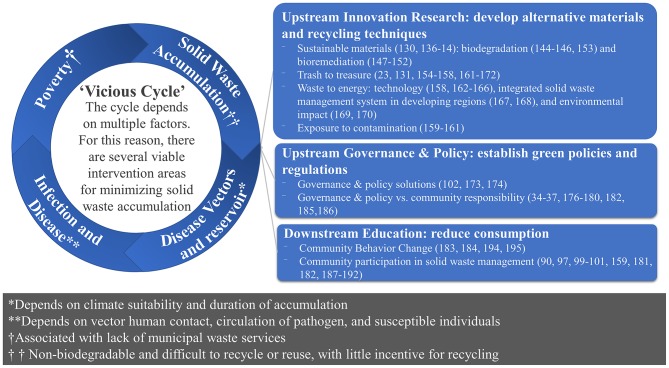
Infectious disease epidemiology and planetary health literature often cite solid waste and plastic pollution as risk factors for vector-borne diseases and urban zoonoses; however, no rigorous reviews of the risks to human health have been published since 1994. This paper aims to identify research gaps and outline potential solutions to interrupt the vicious cycle of solid wastes; disease vectors and reservoirs; infection and disease; and poverty. We searched peer-reviewed publications from PubMed, Google Scholar, and Stanford Searchworks, and references from relevant articles using the search terms ("disease" OR "epidemiology") AND ("plastic pollution," "garbage," and "trash," "rubbish," "refuse," OR "solid waste"). Abstracts and reports from meetings were included only when they related directly to previously published work. Only articles published in English, Spanish, or Portuguese through 2018 were included, with a focus on post-1994, after the last comprehensive review was published. Cancer, diabetes, and food chain-specific articles were outside the scope and excluded. After completing the literature review, we further limited the literature to "urban zoonotic and biological vector-borne diseases" or to "zoonotic and biological vector-borne diseases of the urban environment." Urban biological vector-borne diseases, especially borne diseases, are associated with solid waste accumulation but vector preferences vary over season and region. Urban zoonosis, especially rodent and canine disease reservoirs, are associated with solid waste in urban settings, especially when garbage accumulates over time, creating burrowing sites and food for reservoirs. Although evidence suggests the link between plastic pollution/solid waste and human disease, measurements are not standardized, confounders are not rigorously controlled, and the quality of evidence varies. Here we propose a framework for solutions-based research in three areas: innovation, education, and policy. Disease epidemics are increasing in scope and scale with urban populations growing, climate change providing newly suitable vector climates, and immunologically naïve populations becoming newly exposed. Sustainable solid waste management is crucial to prevention, specifically in urban environments that favor urban vectors such as species. We propose that next steps should include more robust epidemiological measurements and propose a framework for solutions-based research.
传染病流行病学和行星健康文献经常将固体废物和塑料污染列为媒介传播疾病和城市人畜共患病的风险因素;然而,自1994年以来,尚未发表过对人类健康风险的严格综述。本文旨在找出研究空白,并概述中断固体废物、疾病媒介和宿主、感染和疾病以及贫困之间恶性循环的潜在解决方案。我们检索了来自PubMed、谷歌学术和斯坦福搜索工具的同行评审出版物,以及使用搜索词(“疾病”或“流行病学”)和(“塑料污染”、“垃圾”、“废弃物”、“废物”、“垃圾”或“固体废物”)从相关文章中获取的参考文献。仅当会议摘要和报告与先前发表的工作直接相关时才予以纳入。仅纳入2018年之前以英文、西班牙文或葡萄牙文发表的文章,重点关注1994年之后,即上次全面综述发表之后的文章。癌症、糖尿病和特定食物链的文章不在范围内,予以排除。完成文献综述后,我们进一步将文献范围限定为“城市人畜共患病和生物媒介传播疾病”或“城市环境中的人畜共患病和生物媒介传播疾病”。城市生物媒介传播疾病,尤其是虫媒疾病,与固体废物堆积有关,但媒介偏好随季节和地区而异。城市人畜共患病,尤其是啮齿动物和犬类疾病宿主,与城市环境中的固体废物有关,尤其是当垃圾长期堆积,为宿主创造洞穴和食物时。尽管有证据表明塑料污染/固体废物与人类疾病之间存在联系,但测量方法不规范,混杂因素未得到严格控制,证据质量也各不相同。在此,我们提出一个基于解决方案的研究框架,涵盖三个领域:创新、教育和政策。随着城市人口增长、气候变化为媒介提供新的适宜气候以及免疫未接触人群新暴露,疾病流行的范围和规模正在扩大。可持续的固体废物管理对于预防至关重要,特别是在有利于城市媒介(如 物种)的城市环境中。我们建议下一步应包括更有力的流行病学测量,并提出一个基于解决方案的研究框架。