Epidemiology and Population Health Research Group, School of Public Health, Universidad del Valle, Calle 4B No. 36-00 Edif 118 Escuela de Salud Pública, Universidad del Valle Campus San Fernando, Cali, Colombia.
School of Medicine, Universidad del Valle, Cali, Colombia.
Infect Dis Poverty. 2018 Sep 3;7(1):87. doi: 10.1186/s40249-018-0474-8.
Health personnel face challenges in diagnosing vector-borne and other diseases of poverty in urban settings. There is a need to know what rapid diagnostic technologies are available, have been properly assessed, and are being implemented to improve control of these diseases in the urban context. This paper characterizes evidence on the field validation and implementation in urban areas of rapid diagnostics for vector-borne diseases and other diseases of poverty.
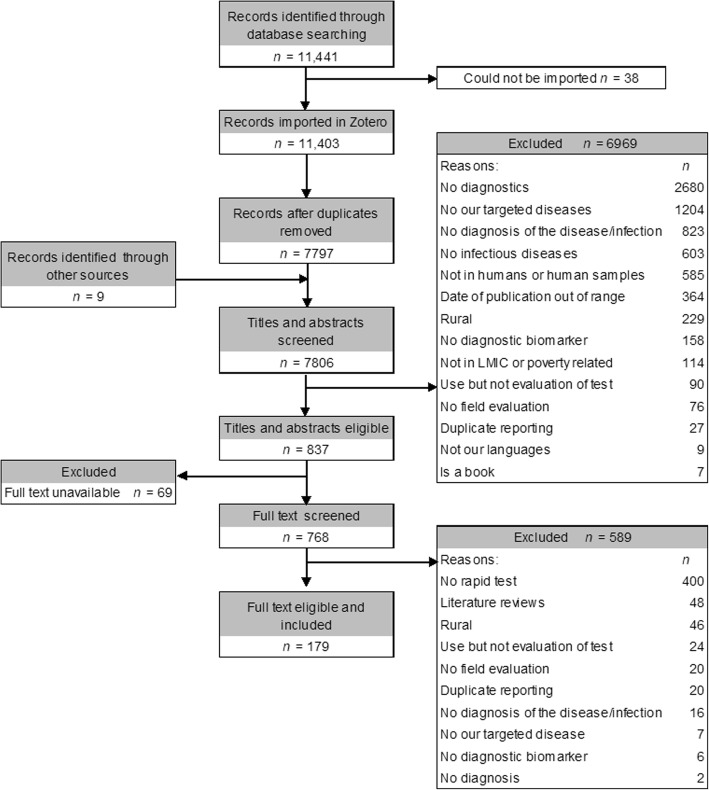
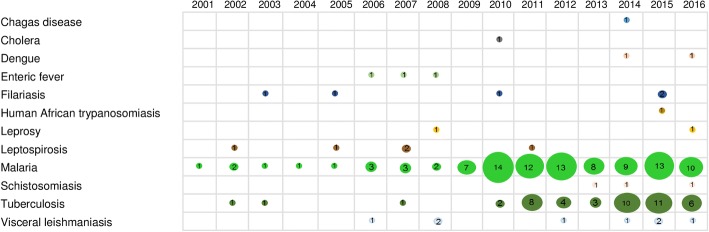
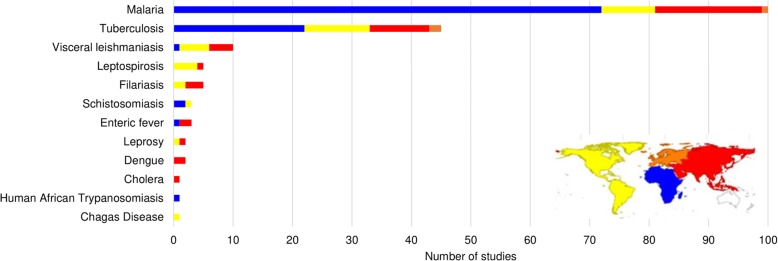
A scoping review was conducted. Peer-reviewed and grey literature were searched using terms describing the targeted infectious diseases, diagnostics evaluations, rapid tests, and urban setting. The review was limited to studies published between 2000 and 2016 in English, Spanish, French, and Portuguese. Inclusion and exclusion criteria were refined post hoc to identify relevant literature regardless of study design and geography. A total of 179 documents of the 7806 initially screened were included in the analysis. Malaria (n = 100) and tuberculosis (n = 47) accounted for the majority of studies that reported diagnostics performance, impact, and implementation outcomes. Fewer studies, assessing mainly performance, were identified for visceral leishmaniasis (n = 9), filariasis and leptospirosis (each n = 5), enteric fever and schistosomiasis (each n = 3), dengue and leprosy (each n = 2), and Chagas disease, human African trypanosomiasis, and cholera (each n = 1). Reported sensitivity of rapid tests was variable depending on several factors. Overall, specificities were high (> 80%), except for schistosomiasis and cholera. Impact and implementation outcomes, mainly acceptability and cost, followed by adoption, feasibility, and sustainability of rapid tests are being evaluated in the field. Challenges to implementing rapid tests range from cultural to technical and administrative issues.
Rapid diagnostic tests for vector-borne and other diseases of poverty are being used in the urban context with demonstrated impact on case detection. However, most evidence comes from malaria rapid diagnostics, with variable results. While rapid tests for tuberculosis and visceral leishmaniasis require further implementation studies, more evidence on performance of current tests or development of new alternatives is needed for dengue, Chagas disease, filariasis, leptospirosis, enteric fever, human African trypanosomiasis, schistosomiasis and cholera.
卫生人员在城市环境中诊断媒介传播疾病和其他贫困疾病面临挑战。需要了解哪些快速诊断技术可用、已经过适当评估并正在实施,以改善这些疾病在城市环境中的控制。本文描述了针对媒介传播疾病和其他贫困疾病的快速诊断技术在城市环境中的现场验证和实施情况的证据特征。
进行了范围界定审查。使用描述目标传染病、诊断评估、快速检测和城市环境的术语,对同行评议和灰色文献进行了搜索。审查仅限于 2000 年至 2016 年期间以英文、西班牙文、法文和葡萄牙文发表的研究。纳入和排除标准是在事后根据研究设计和地理位置确定的,以确定相关文献。从最初筛选的 7806 份文件中,有 179 份文件纳入分析。疟疾(n=100)和结核病(n=47)占报道诊断性能、影响和实施结果的大多数研究。评估主要性能的内脏利什曼病(n=9)、血丝虫病和钩端螺旋体病(各 n=5)、肠热病和血吸虫病(各 n=3)、登革热和麻风病(各 n=2)和恰加斯病、人类非洲锥虫病和霍乱(各 n=1)的研究较少。快速检测的报告敏感性取决于多种因素而有所不同。总体而言,特异性较高(>80%),除了血吸虫病和霍乱。正在现场评估快速检测的影响和实施结果,主要是可接受性和成本,其次是采用、可行性和可持续性。实施快速检测的挑战从文化到技术和行政问题都有。
用于城市环境的媒介传播疾病和其他贫困疾病的快速诊断技术正在使用,并已证明对病例检测有影响。然而,大多数证据来自疟疾快速诊断,结果各不相同。虽然结核病和内脏利什曼病的快速检测需要进一步的实施研究,但需要更多关于当前检测的性能或开发新替代方法的证据,以用于登革热、恰加斯病、血丝虫病、钩端螺旋体病、肠热病、人类非洲锥虫病、血吸虫病和霍乱。