Wonner Kevin, Rurainsky Christian, Tschulik Kristina
Chair of Analytical Chemistry II, Faculty of Chemistry and Biochemistry, Ruhr University Bochum, Bochum, Germany.
Front Chem. 2020 Jan 17;7:912. doi: 10.3389/fchem.2019.00912. eCollection 2019.
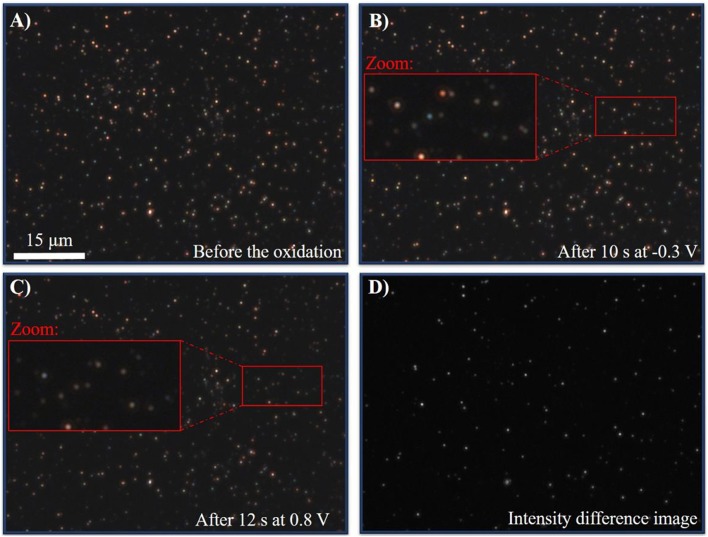
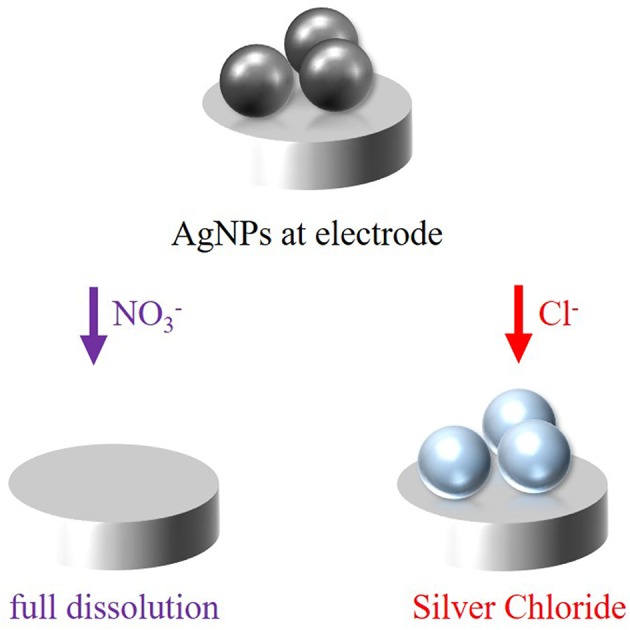
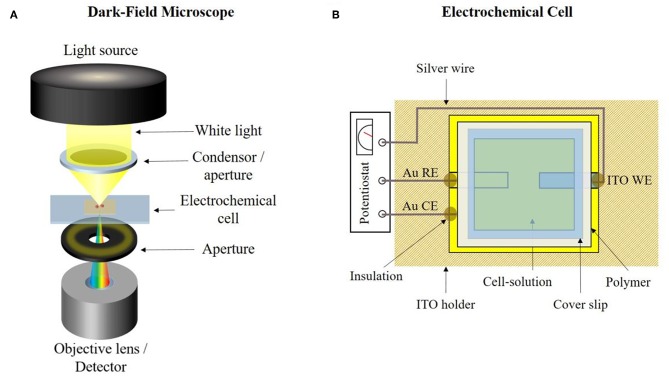
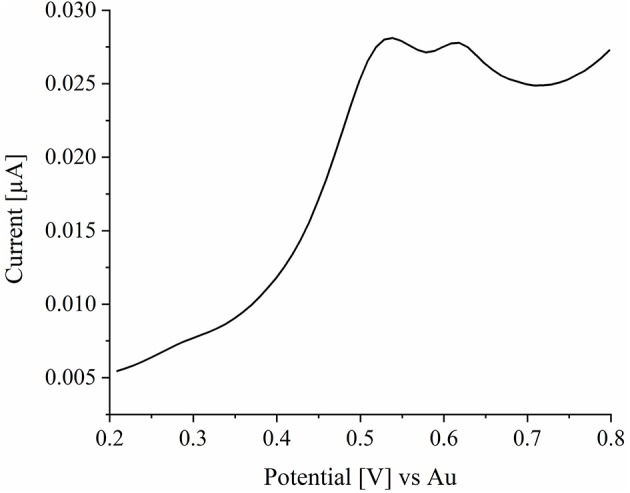
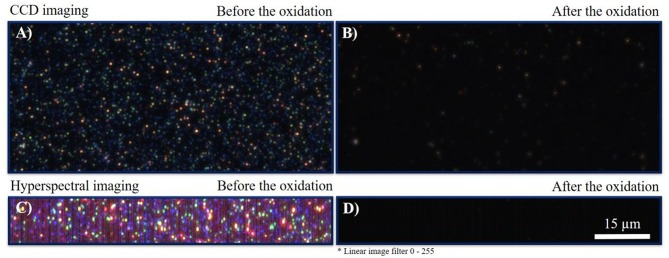
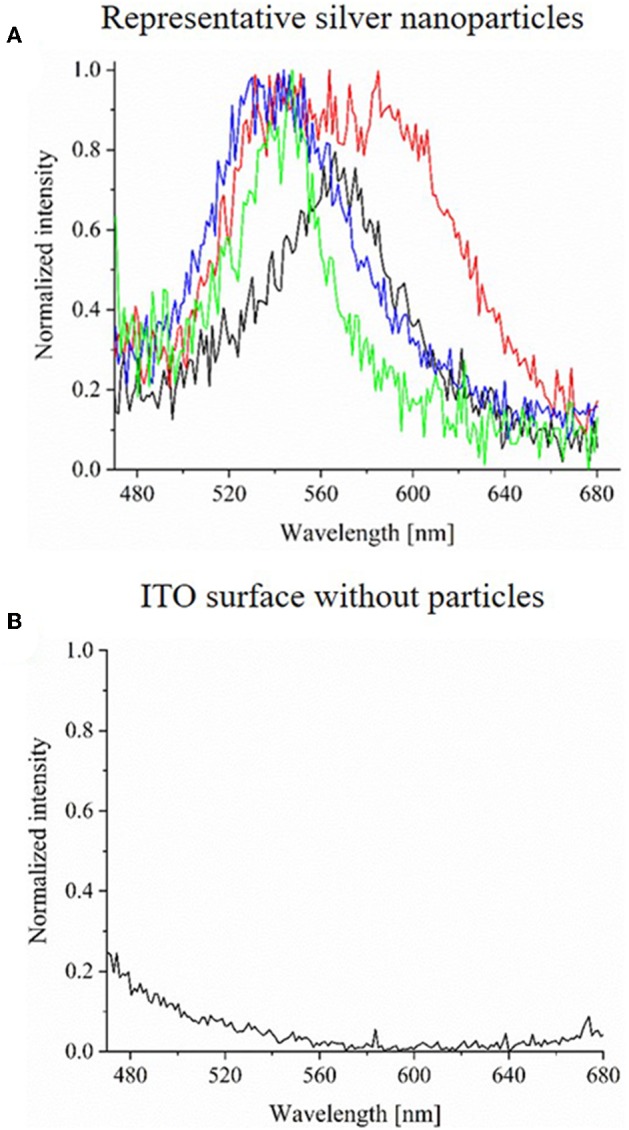
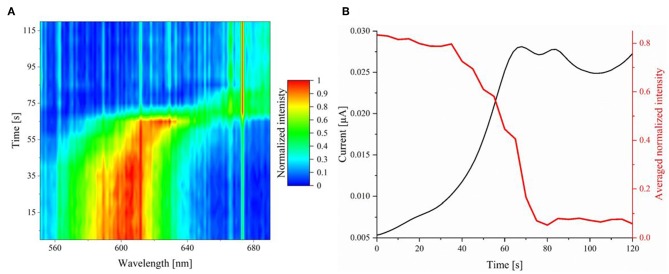
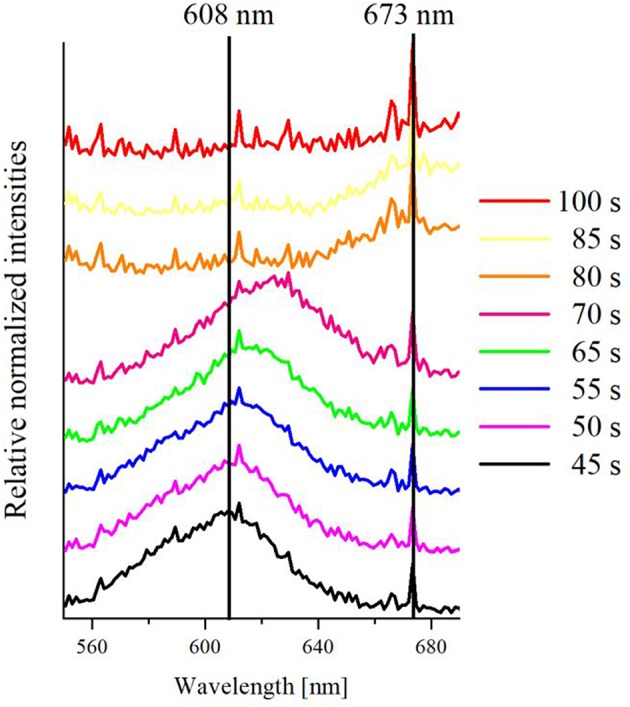
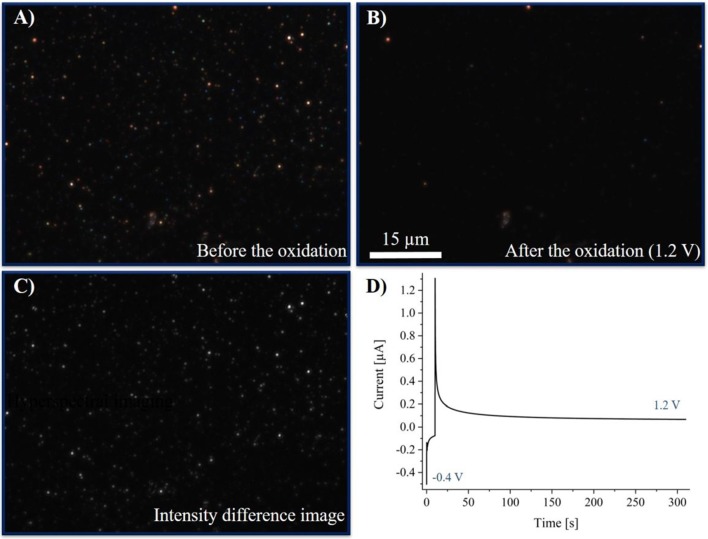
Since nanoparticles are frequently used in commercial applications, there is a huge demand to obtain deeper insights into processes at the nanoscale. Especially, catalysis, chemical and electrochemical reaction dynamics are still poorly understood. Thus, simultaneous and coupled opto-and spectro-electrochemical dark-field microscopy is used to study and the electrochemically driven dissolution mechanism of single silver nanoparticles in the presence of nitrate ions as non-complexing counter-ions, herein. Hyperspectral imaging is used to probe the intrinsic localized surface plasmon resonance of individual silver nanospheres before, during and after their electrochemical oxidation on a transparent indium tin oxide (ITO) electrode. Furthermore, optical video imaging was performed for additional information. Based on the complete loss of spectral information and intensity, a dissolution of the particles during the reaction was concluded. This way it is revealed that the dissolution of individual particles proceeds over several seconds, indicating a hindrance by the nitrate ions. Only electrochemical analysis does not provide this insight as the measured current does not allow distinguishing between successive fast dissolution of one particle after another or slow dissolution of several particles in a concerted manner. For comparison, experiments were performed in the presence of chloride ions. It was observed that the silver chloride formation is an instantaneous process. Thus, it is possible to study and define the reaction dynamics on the single nanoparticle level in various electrochemical systems and electrolyte solutions. Accordingly, opto- and spectro-electrochemical studies allow us to conclude, that the oxidation of silver to solvated silver cations is a kinetically slow process, while the oxidation to silver chloride is fast. We propose this approach as a new method to study electrocatalyst materials, their transformation and degradation under conditions.
由于纳米颗粒在商业应用中被广泛使用,因此对于深入了解纳米尺度下的过程有着巨大需求。特别是,催化、化学和电化学反应动力学仍未得到充分理解。因此,本文采用同步耦合的光控和光谱电化学暗场显微镜来研究单个银纳米颗粒在作为非络合抗衡离子的硝酸根离子存在下的电化学驱动溶解机制。在透明氧化铟锡(ITO)电极上,利用高光谱成像探测单个银纳米球在电化学氧化之前、期间和之后的固有局域表面等离子体共振。此外,还进行了光学视频成像以获取更多信息。基于光谱信息和强度的完全丧失,得出反应过程中颗粒发生溶解的结论。通过这种方式揭示了单个颗粒的溶解过程持续数秒,表明受到硝酸根离子的阻碍。仅通过电化学分析无法获得这一见解,因为所测量的电流无法区分一个颗粒接一个颗粒的连续快速溶解或几个颗粒协同的缓慢溶解。为作比较,在氯离子存在的情况下进行了实验。观察到氯化银的形成是一个瞬间过程。因此,有可能在各种电化学系统和电解质溶液中研究和定义单个纳米颗粒水平上的反应动力学。相应地,光控和光谱电化学研究使我们能够得出结论,即银氧化为溶剂化银阳离子是一个动力学缓慢的过程,而氧化为氯化银则很快。我们提出这种方法作为研究电催化剂材料及其在特定条件下的转化和降解的一种新方法。