Verghese Shilpi, Moberg Ken
Department of Cell Biology, Emory University School of Medicine, Atlanta, GA, United States.
Front Cell Dev Biol. 2020 Jan 10;7:384. doi: 10.3389/fcell.2019.00384. eCollection 2019.
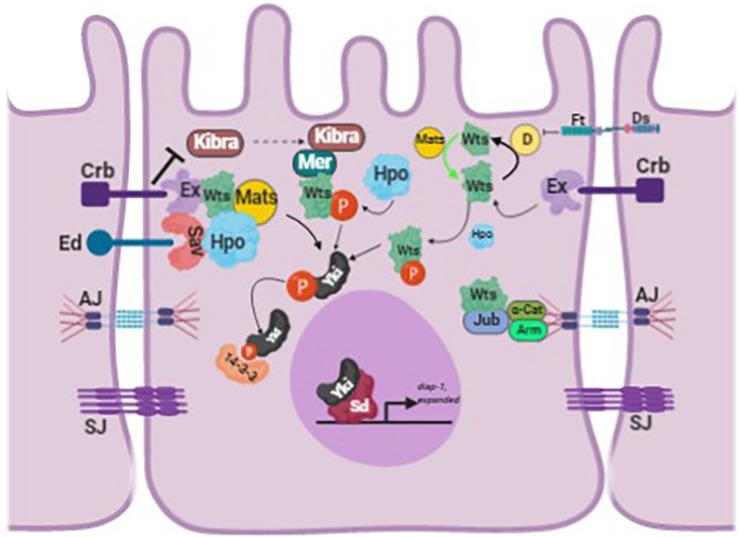
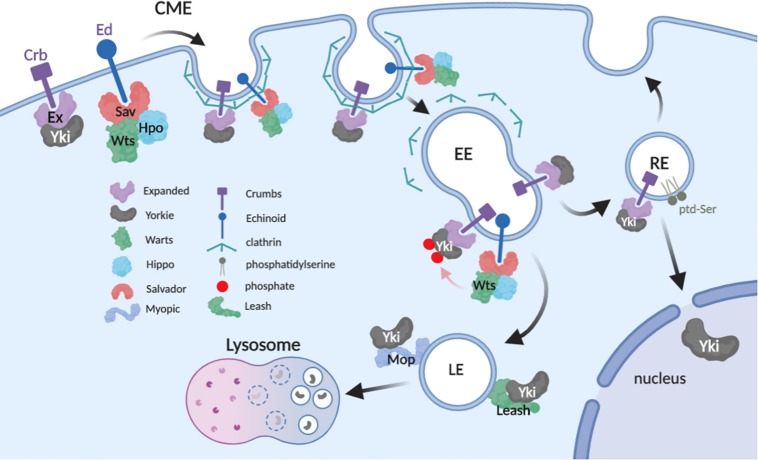
The Hippo pathway is a well conserved signaling cascade that modulates cell proliferation and survival in response to external cues such as cell:cell contact, injury, and nutritional status. Models of the Hippo pathway have evolved from a series of genetic interactions defined in the fruit fly into a complex series of biochemical mechanisms in which transmembrane and cytoskeletal proteins modulate cytoplasmic phosphatase and kinase activities that converge on the serine/threonine kinase Warts (Wts) to regulate nuclear entry of the co-activator protein Yorkie (Yki; vertebrate Yap1). This pathway is well conserved in human cells and broadly implicated in cancer. Progress in understanding biochemical events within the Hippo pathway highlights a need for improved understanding of the cell biological contexts in which these molecular interactions occur. A significant body of data linking Hippo signaling to membranes and proteins involved in intracellular membrane trafficking raise the possibility that some molecular regulatory events occur on the cytoplasmic face of vesicles. In , a Yki-vesicle link was solidified by discoveries that cytoplasmic Yki concentrates at late-endosomes and physically interacts with two endosomal adaptor proteins, Myopic (Mop) and Leash. These two proteins are required for Yki to transit the endolysosomal pathway and be turned over in lysosomes. Molecules involved in recruiting and tethering Yki along this endosomal route are not defined but are predicted to play key roles in regulating Yki levels and thus Hippo-responsiveness of cells. As Wts is recruited to the apical membrane by upstream Hippo components, endosomal internalization could also affect complexes involved in Yki phosphorylation events that alter nucleocytoplasmic shuttling. Recent work has revealed an unexpected, non-transcriptional role of membrane-associated Yki in triggering actinomyosin contractility via the myosin-regulatory light chain Spaghetti squash (Sqh). How Yki interacts with the membrane and controls Sqh is unclear, but this mechanism represents a novel regulatory mechanism based on induced localization of Yki to a specific membrane compartment. These and other data will be discussed as we review data linking Yki to membrane and vesicular traffic in development and homeostasis and speculate on missing elements of these membrane-linked Yki regulatory mechanisms.
Hippo信号通路是一条保守性良好的信号级联反应,可根据细胞与细胞接触、损伤及营养状况等外部信号来调节细胞增殖和存活。Hippo信号通路模型已从果蝇中定义的一系列遗传相互作用,发展为一系列复杂的生化机制,其中跨膜蛋白和细胞骨架蛋白调节细胞质磷酸酶和激酶活性,这些活性汇聚于丝氨酸/苏氨酸激酶Warts(Wts),以调节共激活蛋白Yorkie(Yki;脊椎动物的Yap1)进入细胞核。该通路在人类细胞中保守性良好,且与癌症广泛相关。对Hippo信号通路内生化事件理解的进展凸显出,需要更好地理解这些分子相互作用发生的细胞生物学背景。大量将Hippo信号传导与参与细胞内膜运输的膜和蛋白质联系起来的数据,增加了某些分子调节事件发生在囊泡细胞质面的可能性。在[具体文献]中,通过发现细胞质中的Yki集中在晚期内体并与两种内体衔接蛋白Myopic(Mop)和Leash发生物理相互作用,巩固了Yki与囊泡的联系。这两种蛋白是Yki通过内溶酶体途径转运并在溶酶体中被降解所必需的。沿此内体途径招募和拴系Yki的分子尚未明确,但预计它们在调节Yki水平从而调节细胞的Hippo反应性方面发挥关键作用。由于Wts被上游Hippo成分招募到顶端膜,内体内化也可能影响参与Yki磷酸化事件的复合物,这些事件会改变核质穿梭。最近的研究揭示了膜相关Yki在通过肌球蛋白调节轻链Spaghetti squash(Sqh)触发肌动球蛋白收缩方面的意外非转录作用。Yki如何与膜相互作用并控制Sqh尚不清楚,但这种机制代表了一种基于Yki诱导定位到特定膜区室的新型调节机制。当我们回顾将Yki与发育和体内平衡中的膜及囊泡运输联系起来的数据,并推测这些膜相关Yki调节机制中缺失的元素时,将讨论这些及其他数据。