Department of Communication Studies, Northwestern University, Evanston, IL, United States.
Department of Communication and Journalism, University of New Mexico, Albuquerque, NM, United States.
JMIR Mhealth Uhealth. 2020 Jan 24;8(1):e14082. doi: 10.2196/14082.
Theoretically designed mobile health (mHealth) breast cancer interventions are essential for achieving positive behavior change. In the case of breast cancer, they can improve the health outcomes of millions of women by increasing prevention and care efforts. However, little is known about the theoretical underpinnings of breast cancer apps available to the general public.
Given that theories may strengthen mHealth interventions, this study aimed to identify breast cancer apps designed to support behavior change, to assess the extent to which they address content along the cancer care continuum and contain behavior change techniques, and to assess the degree to which star rating is related to theory-based design.
Using a criteria-based screening process, we searched 2 major app stores for breast cancer apps designed to promote behavior change. Apps were coded for content along the cancer care continuum and analyzed for behavior change techniques. The Mann-Whitney U test was used to examine the relationship between star ratings and the use of behavior change techniques in apps with star ratings compared to those without ratings.
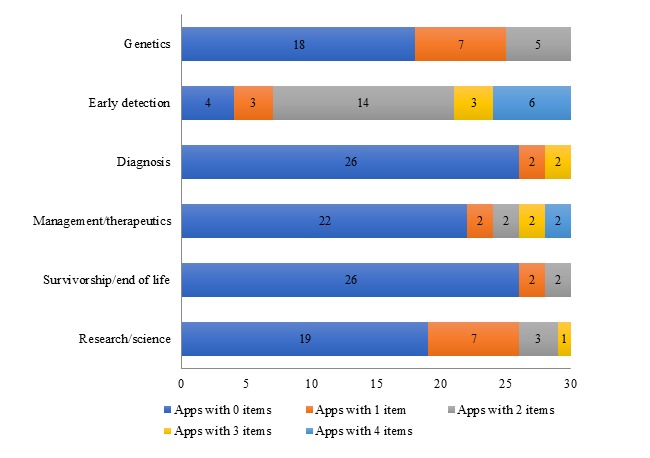
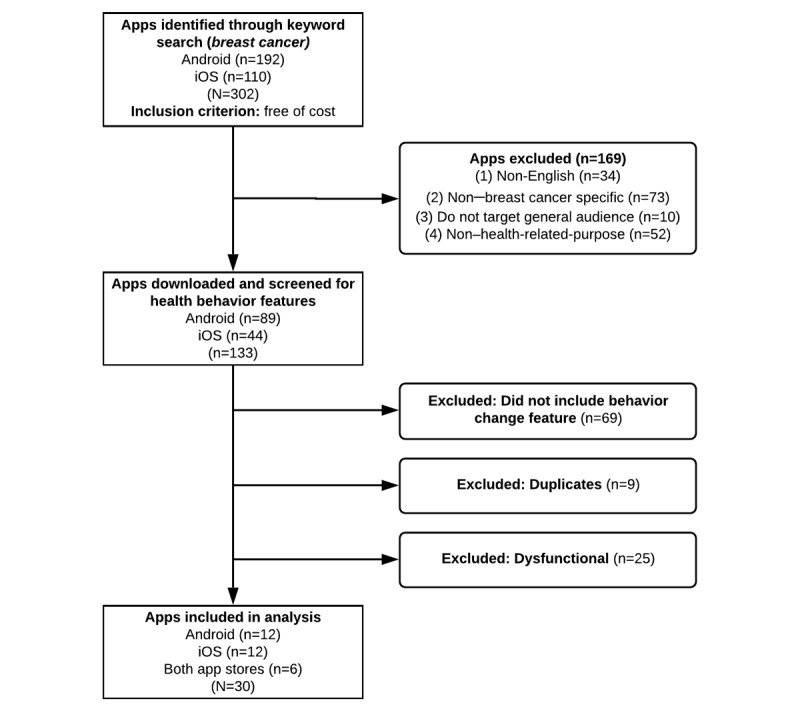
The search resulted in a total of 302 apps, of which 133 were identified as containing breast cancer content. Only 9.9% (30/302) of apps supported behavior change and were further analyzed. These apps were disproportionally focused on behaviors to enhance early detection, whereas only a few apps supported care management, treatment, and posttreatment behaviors. Regarding theories, 63% (19/30) of apps customized content to users, 70% (21/30) established a health-behavior link, and 80% (24/30) provided behavior change instructions. Of the 30 apps, 15 (50%) prompted intention formation whereas less than half of the apps included goal setting (9/30, 30%) and goal reviewing (7/30, 23%). Most apps did not provide information on peer behavior (7/30, 23%) or allow for social comparison (6/30, 20%). None of the apps mobilized social norms. Only half of the apps (15/30, 50%) were user rated. The results of the Mann-Whitney U test showed that apps with star ratings contained significantly more behavior change techniques (median 6.00) than apps without ratings. The analysis of behavior change techniques used in apps revealed their shortcomings in the use of goal setting and social influence features.
Our findings indicate that commercially available breast cancer apps have not yet fully realized their potential to promote behavior change, with only a minority of apps focusing on behavior change, and even fewer including theoretical design to support behavior change along the cancer care continuum. These shortcomings are likely limiting the effectiveness of apps and their ability to improve public health. More attention needs to be paid to the involvement of professionals in app development and adherence to theories and best practices in app design to support individuals along the cancer care continuum.
理论上设计的移动健康(mHealth)乳腺癌干预措施对于实现积极的行为改变至关重要。在乳腺癌的情况下,通过增加预防和护理工作,可以改善数以百万计的女性的健康状况。然而,对于公众可获得的乳腺癌应用程序的理论基础知之甚少。
鉴于理论可能会增强 mHealth 干预措施,本研究旨在确定旨在支持行为改变的乳腺癌应用程序,评估它们在多大程度上解决了癌症护理连续体中的内容并包含行为改变技术,以及评估星级评分与基于理论的设计的相关性。
使用基于标准的筛选过程,我们在两个主要的应用程序商店中搜索了旨在促进行为改变的乳腺癌应用程序。对应用程序进行了癌症护理连续体内容的编码,并对行为改变技术进行了分析。使用曼-惠特尼 U 检验比较了有星级评分的应用程序与没有评分的应用程序之间的星级评分与应用程序中使用行为改变技术之间的关系。
搜索结果共产生了 302 个应用程序,其中 133 个被确定为包含乳腺癌内容。只有 9.9%(30/302)的应用程序支持行为改变并进一步进行了分析。这些应用程序主要集中在增强早期检测行为上,而只有少数应用程序支持护理管理、治疗和治疗后行为。关于理论,63%(19/30)的应用程序根据用户定制内容,70%(21/30)建立健康行为联系,80%(24/30)提供行为改变指导。在 30 个应用程序中,有 15 个(50%)提示形成意图,而不到一半的应用程序包括目标设定(9/30,30%)和目标审查(7/30,23%)。大多数应用程序没有提供有关同伴行为的信息(7/30,23%)或允许进行社会比较(6/30,20%)。没有应用程序调动社会规范。只有一半的应用程序(15/30,50%)获得用户评级。曼-惠特尼 U 检验的结果表明,有星级评分的应用程序包含的行为改变技术明显多于没有评分的应用程序(中位数 6.00)。对应用程序中使用的行为改变技术的分析表明,它们在目标设定和社会影响功能的使用方面存在不足。
我们的研究结果表明,商业上可用的乳腺癌应用程序尚未充分发挥其促进行为改变的潜力,只有少数应用程序关注行为改变,甚至更少的应用程序包括理论设计来支持癌症护理连续体中的行为改变。这些缺点可能限制了应用程序的有效性及其改善公众健康的能力。需要更加关注专业人员在应用程序开发中的参与以及在应用程序设计中坚持理论和最佳实践,以支持癌症护理连续体中的个人。