Life and Health Sciences Research Institute (ICVS), School of Medicine, University of Minho, 4710-057 Braga, Portugal.
ICVS/3B's Associate Lab, PT Government Associated Lab, 4710-057 Braga, Portugal.
Cells. 2020 Jan 28;9(2):315. doi: 10.3390/cells9020315.
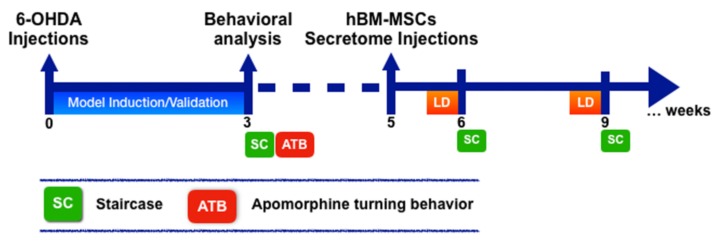
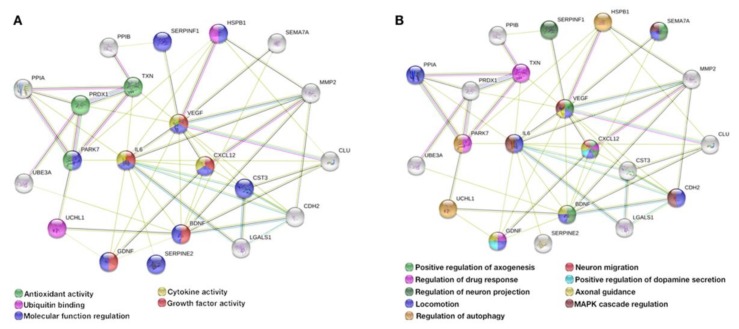
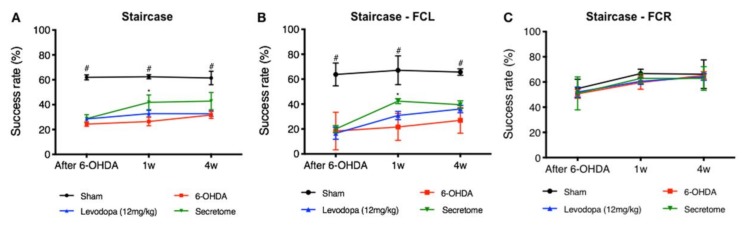
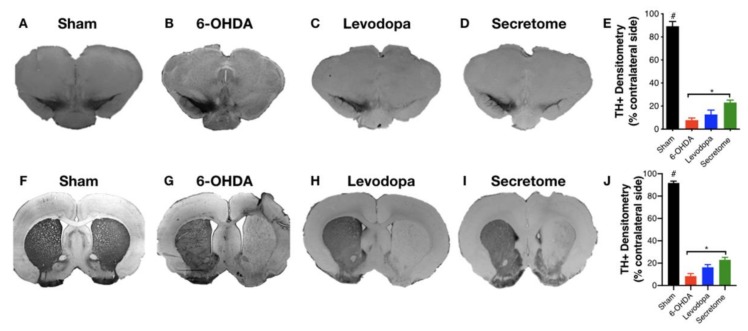
Parkinson's Disease (PD) is characterized by the massive loss of dopaminergic neurons, leading to the appearance of several motor impairments. Current pharmacological treatments, such as the use of levodopa, are yet unable to cure the disease. Therefore, there is a need for novel strategies, particularly those that can combine in an integrated manner neuroprotection and neuroregeneration properties. In vitro and in vivo models have recently revealed that the secretome of mesenchymal stem cells (MSCs) holds a promising potential for treating PD, given its effects on neural survival, proliferation, differentiation. In the present study, we aimed to access the impact of human bone marrow MSCs (hBM-MSCs) secretome in 6-hydroxydopamine (6-OHDA) PD model when compared to levodopa administration, by addressing animals' motor performance, and substantia nigra (SN), and striatum (STR) histological parameters by tyrosine hydroxylase (TH) expression. Results revealed that hBM-MSCs secretome per se appears to be a modulator of the dopaminergic system, enhancing TH-positive cells expression (e.g., dopaminergic neurons) and terminals both in the SN and STR when compared to the untreated group 6-OHDA. Such finding was positively correlated with a significant amelioration of the motor outcomes of 6-OHDA PD animals (assessed by the staircase test). Thus, the present findings support hBM-MSCs secretome administration as a potential therapeutic tool in treating PD, and although we suggest candidate molecules (Trx1, SEMA7A, UCHL1, PEDF, BDNF, Clusterin, SDF-1, CypA, CypB, Cys C, VEGF, DJ-1, Gal-1, GDNF, CDH2, IL-6, HSP27, PRDX1, UBE3A, MMP-2, and GDN) and possible mechanisms of hBM-MSCs secretome-mediated effects, further detailed studies are needed to carefully and clearly define which players may be responsible for its therapeutic actions. By doing so, it will be reasonable to presume that potential treatments that can, per se, or in combination modulate or slow PD may lead to a rational design of new therapeutic or adjuvant strategies for its functional modeling and repair.
帕金森病(PD)的特征是多巴胺能神经元大量丧失,导致出现多种运动障碍。目前的药物治疗方法,如使用左旋多巴,仍无法治愈这种疾病。因此,需要新的策略,特别是那些能够将神经保护和神经再生特性结合起来的策略。最近的体外和体内模型表明,间充质干细胞(MSCs)的分泌组具有治疗 PD 的巨大潜力,因为它对神经存活、增殖、分化有影响。在本研究中,我们旨在研究人骨髓间充质干细胞(hBM-MSCs)分泌组对 6-羟多巴胺(6-OHDA)PD 模型的影响,与左旋多巴给药相比,通过评估动物的运动表现以及黑质(SN)和纹状体(STR)的酪氨酸羟化酶(TH)表达的组织学参数。结果表明,hBM-MSCs 分泌组本身似乎是多巴胺能系统的调节剂,与未经处理的 6-OHDA 组相比,增强了 SN 和 STR 中 TH 阳性细胞的表达(例如,多巴胺能神经元)和末梢。这种发现与 6-OHDA PD 动物运动结果的显著改善呈正相关(通过阶梯试验评估)。因此,本研究结果支持 hBM-MSCs 分泌组给药作为治疗 PD 的一种潜在治疗工具,尽管我们提出了候选分子(Trx1、SEMA7A、UCHL1、PEDF、BDNF、Clusterin、SDF-1、CypA、CypB、Cys C、VEGF、DJ-1、Gal-1、GDNF、CDH2、IL-6、HSP27、PRDX1、UBE3A、MMP-2 和 GDN)和 hBM-MSCs 分泌组介导作用的可能机制,但需要进一步详细研究,以仔细和清楚地确定哪些因素可能对其治疗作用负责。这样,就可以合理地假设,能够单独或联合调节或减缓 PD 的潜在治疗方法可能会导致对其功能建模和修复的新治疗或辅助策略的合理设计。