Department of Biochemistry and Physiology, School of Pharmacy and Food Sciences, Institut de Biomedicina de la Universitat de Barcelona (IBUB), Universitat de Barcelona, E-08028 Barcelona, Spain.
Centro de Investigación Biomédica en Red de Fisiopatología de la Obesidad y la Nutrición (CIBEROBN), Instituto de Salud Carlos III, E-28029 Madrid, Spain.
Cells. 2020 Jan 28;9(2):316. doi: 10.3390/cells9020316.
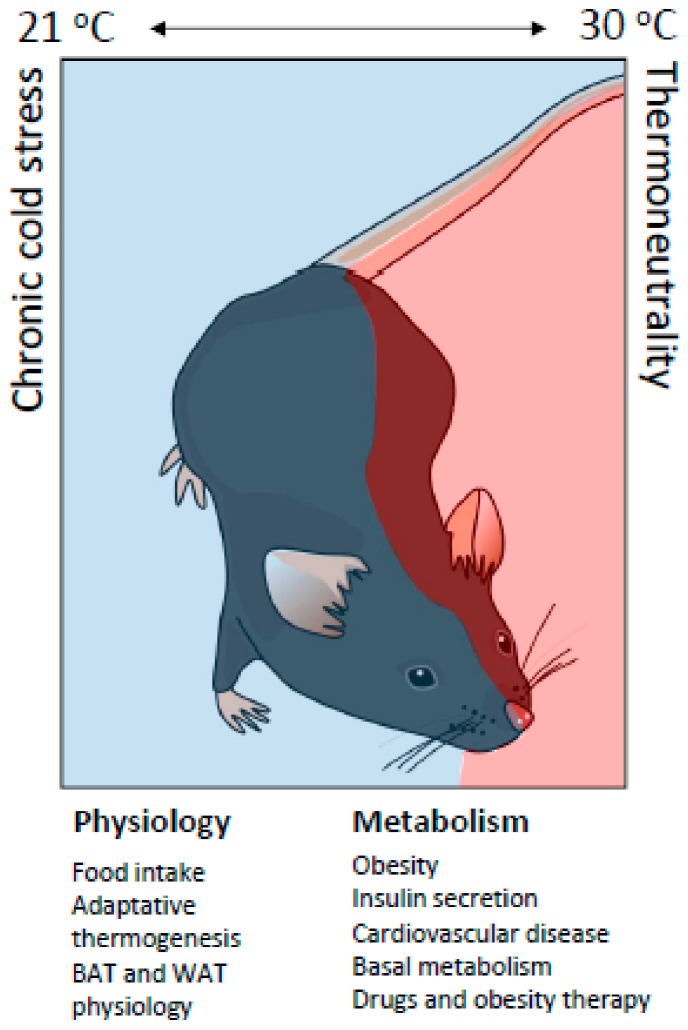
Obesity and associated metabolic diseases have become a priority area of study due to the exponential increase in their prevalence and the corresponding health and economic impact. In the last decade, brown adipose tissue has become an attractive target to treat obesity. However, environmental variables such as temperature and the dynamics of energy expenditure could influence brown adipose tissue activity. Currently, most metabolic studies are carried out at a room temperature of 21 °C, which is considered a thermoneutral zone for adult humans. However, in mice this chronic cold temperature triggers an increase in their adaptive thermogenesis. In this review, we aim to cover important aspects related to the adaptation of animals to room temperature, the influence of housing and temperature on the development of metabolic phenotypes in experimental mice and their translation to human physiology. Mice studies performed in chronic cold or thermoneutral conditions allow us to better understand underlying physiological mechanisms for successful, reproducible translation into humans in the fight against obesity and metabolic diseases.
肥胖症和相关代谢性疾病的患病率呈指数级增长,对健康和经济造成了相应的影响,因此成为了研究的重点领域。在过去十年中,棕色脂肪组织已成为治疗肥胖症的一个有吸引力的目标。然而,环境变量(如温度和能量消耗的动态)可能会影响棕色脂肪组织的活性。目前,大多数代谢研究都是在 21°C 的室温下进行的,这被认为是成年人类的一个舒适温度区。然而,在老鼠中,这种慢性低温会引发其适应性产热的增加。在这篇综述中,我们旨在涵盖与动物适应室温、饲养环境和温度对实验小鼠代谢表型发展的影响以及它们向人类生理学的转化相关的重要方面。在慢性寒冷或舒适温度条件下进行的老鼠研究,使我们能够更好地理解潜在的生理机制,从而成功地将其复制到人类肥胖症和代谢性疾病的治疗中。