School of Pharmacy, Guangdong Pharmaceutical University, Guangzhou 510006, China.
Guangzhou Key Laboratory of Construction and Application of New Drug Screening Model Systems, Guangdong Pharmaceutical University, Guangzhou 510006, China.
Int J Mol Sci. 2020 Jan 29;21(3):876. doi: 10.3390/ijms21030876.
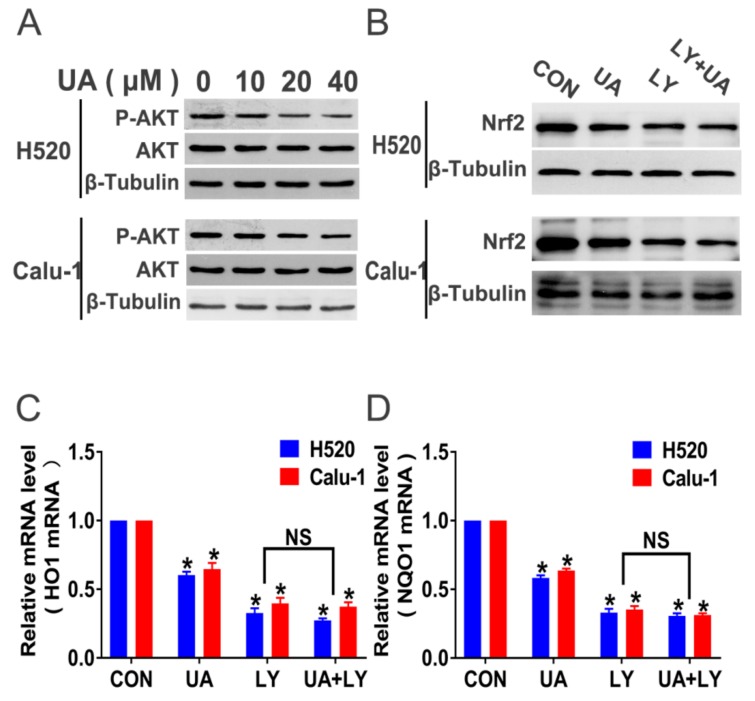
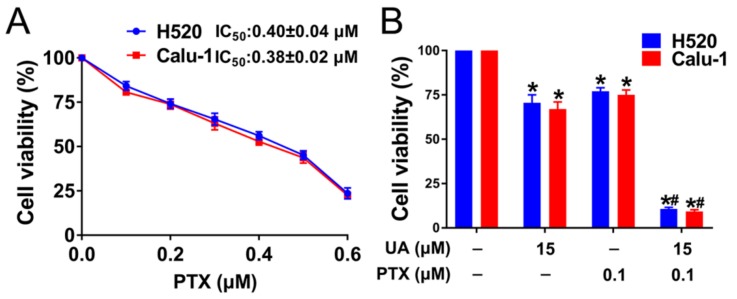
Lung squamous cell carcinoma (LUSC) has a poor prognosis, in part due to poor therapeutic response and limited therapeutic alternatives. Lichens are symbiotic organisms, producing a variety of substances with multiple biological activities. (+)-Usnic acid, an important biologically active metabolite of lichens, has been shown to have high anti-cancer activity at low doses. However, there have been no reports regarding the effect of (+)-usnic acid on LUSC cells. This study found that (+)-usnic acid reduced viability and induced apoptosis in LUSC cells by reactive oxygen species (ROS) accumulation. (+)-Usnic acid induced mitochondria-derived ROS production via inhibition of complex I and complex III of the mitochondrial respiratory chain (MRC). Interestingly, the elimination of mitochondrial ROS by Mito-TEMPOL only partially reversed the effect of (+)-usnic acid on cellular ROS production. Further study showed that (+)-usnic acid also induced ROS production via reducing Nrf2 stability through disruption of the PI3K/Akt pathway. The in vitro and in vivo xenograft studies showed that combined treatment of (+)-usnic acid and paclitaxel synergistically suppressed LUSC cells. In conclusion, this study indicates that (+)-usnic acid induces apoptosis of LUSC cells through ROS accumulation, probably via disrupting the mitochondrial respiratory chain (MRC) and the PI3K/Akt/Nrf2 pathway. Therefore, although clinical use of (+)-usnic acid will be limited due to toxicity issues, derivatives thereof may turn out as promising anticancer candidates for adjuvant treatment of LUSC.
肺鳞状细胞癌 (LUSC) 的预后较差,部分原因是治疗反应不佳和治疗选择有限。地衣是共生生物,可产生多种具有多种生物活性的物质。(+)-松萝酸是地衣的一种重要生物活性代谢物,已被证明在低剂量下具有很高的抗癌活性。然而,目前还没有关于(+)-松萝酸对 LUSC 细胞影响的报道。本研究发现,(+)-松萝酸通过活性氧(ROS)积累降低 LUSC 细胞活力并诱导其凋亡。(+)-松萝酸通过抑制线粒体呼吸链(MRC)的复合物 I 和复合物 III 诱导线粒体来源的 ROS 产生。有趣的是,线粒体 ROS 的消除仅部分逆转了(+)-松萝酸对细胞 ROS 产生的作用。进一步的研究表明,(+)-松萝酸还通过破坏 PI3K/Akt 通路减少 Nrf2 稳定性来诱导 ROS 产生。体外和体内异种移植研究表明,(+)-松萝酸与紫杉醇联合治疗可协同抑制 LUSC 细胞。总之,本研究表明(+)-松萝酸通过 ROS 积累诱导 LUSC 细胞凋亡,可能通过破坏线粒体呼吸链(MRC)和 PI3K/Akt/Nrf2 通路。因此,尽管(+)-松萝酸的临床应用会受到毒性问题的限制,但它的衍生物可能成为 LUSC 辅助治疗的有前途的抗癌候选药物。