State Key Joint Laboratory of Environmental Simulation and Pollution Control, College of Environmental Sciences and Engineering, Peking University, 100871 Beijing, China.
State Key Joint Laboratory of Environmental Simulation and Pollution Control, College of Environmental Sciences and Engineering, Peking University, 100871 Beijing, China;
Proc Natl Acad Sci U S A. 2020 Feb 18;117(7):3427-3432. doi: 10.1073/pnas.1916366117. Epub 2020 Feb 3.
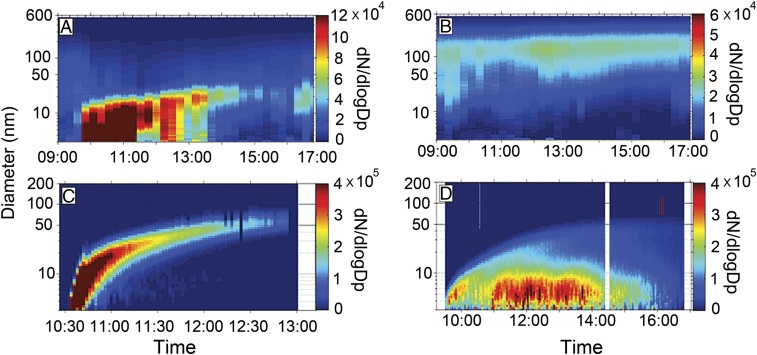
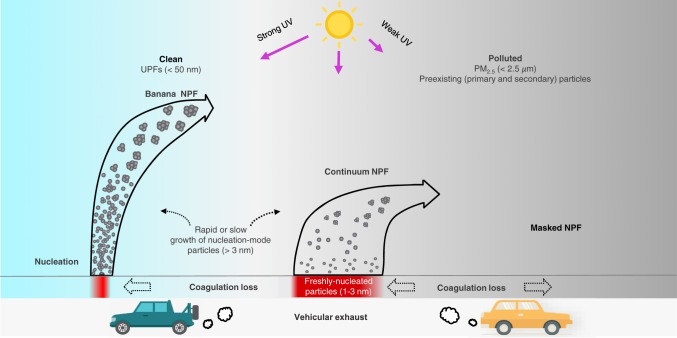
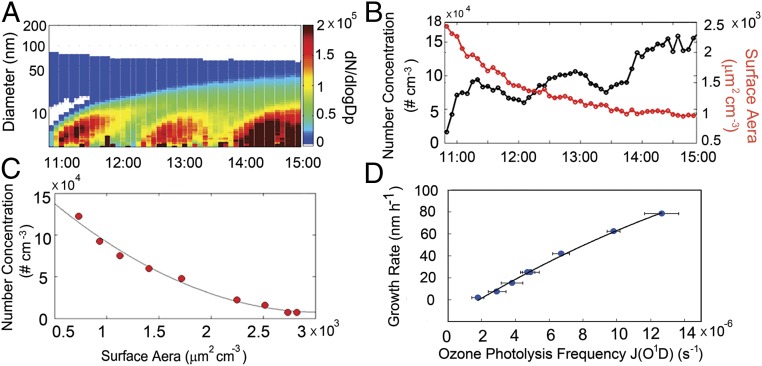
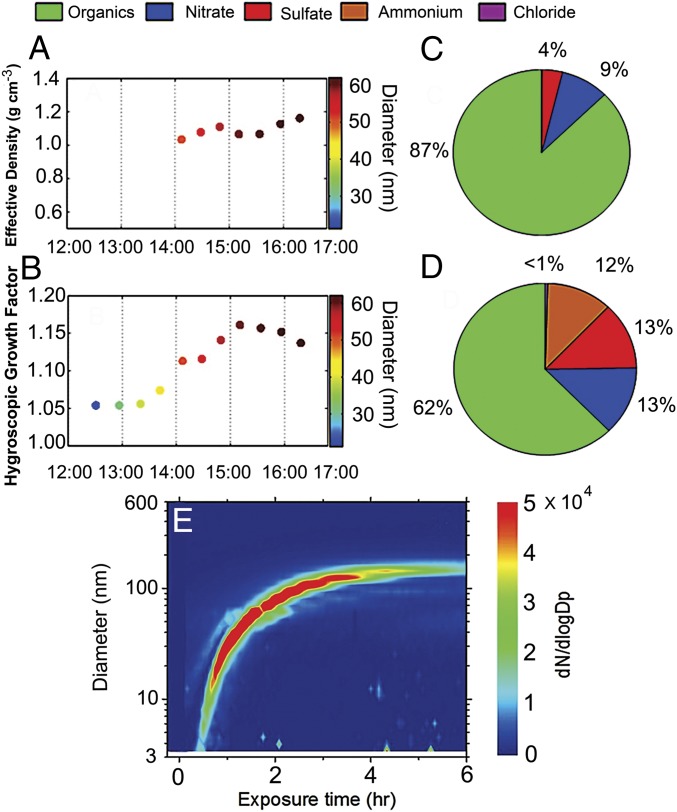
High levels of ultrafine particles (UFPs; diameter of less than 50 nm) are frequently produced from new particle formation under urban conditions, with profound implications on human health, weather, and climate. However, the fundamental mechanisms of new particle formation remain elusive, and few experimental studies have realistically replicated the relevant atmospheric conditions. Previous experimental studies simulated oxidation of one compound or a mixture of a few compounds, and extrapolation of the laboratory results to chemically complex air was uncertain. Here, we show striking formation of UFPs in urban air from combining ambient and chamber measurements. By capturing the ambient conditions (i.e., temperature, relative humidity, sunlight, and the types and abundances of chemical species), we elucidate the roles of existing particles, photochemistry, and synergy of multipollutants in new particle formation. Aerosol nucleation in urban air is limited by existing particles but negligibly by nitrogen oxides. Photooxidation of vehicular exhaust yields abundant precursors, and organics, rather than sulfuric acid or base species, dominate formation of UFPs under urban conditions. Recognition of this source of UFPs is essential to assessing their impacts and developing mitigation policies. Our results imply that reduction of primary particles or removal of existing particles without simultaneously limiting organics from automobile emissions is ineffective and can even exacerbate this problem.
超细颗粒(UFPs;直径小于 50nm)在城市条件下经常由新粒子形成产生,对人类健康、天气和气候有深远影响。然而,新粒子形成的基本机制仍然难以捉摸,并且很少有实验研究真实地再现了相关的大气条件。以前的实验研究模拟了一种化合物或几种化合物的混合物的氧化,将实验室结果推断到化学复杂的空气中是不确定的。在这里,我们通过结合环境和腔室测量显示了城市空气中 UFPs 的惊人形成。通过捕获环境条件(即温度、相对湿度、阳光以及化学物质的类型和丰度),我们阐明了现有颗粒、光化学和多污染物协同作用在新粒子形成中的作用。城市空气中的气溶胶成核受到现有颗粒的限制,但受氮氧化物的限制可以忽略不计。机动车尾气的光氧化产生了丰富的前体,而在城市条件下,有机物而不是硫酸或碱基物质主导着 UFPs 的形成。认识到这种 UFPs 的来源对于评估其影响和制定缓解政策至关重要。我们的结果表明,减少初级颗粒或去除现有颗粒而不同时限制汽车排放物中的有机物是无效的,甚至可能使这个问题恶化。