Zheng Yang, Duan Xiangdong, Qi Shangfeng, Hu Haibo, Wang Mengran, Ren Conglin, Xu Haipeng, Quan Renfu
Clinical Medical College, Zhejiang Chinese Medical University, Hangzhou 310051, China.
Department of Orthopedics, Shandong Provincial Hospital of Traditional Chinese Medicine, Jinan 250014, China.
Evid Based Complement Alternat Med. 2020 Jan 13;2020:4034105. doi: 10.1155/2020/4034105. eCollection 2020.
This meta-analysis aimed to investigate the effectiveness of acupuncture therapy plus hyaluronic acid injection versus hyaluronic acid injection alone for patients with knee osteoarthritis.
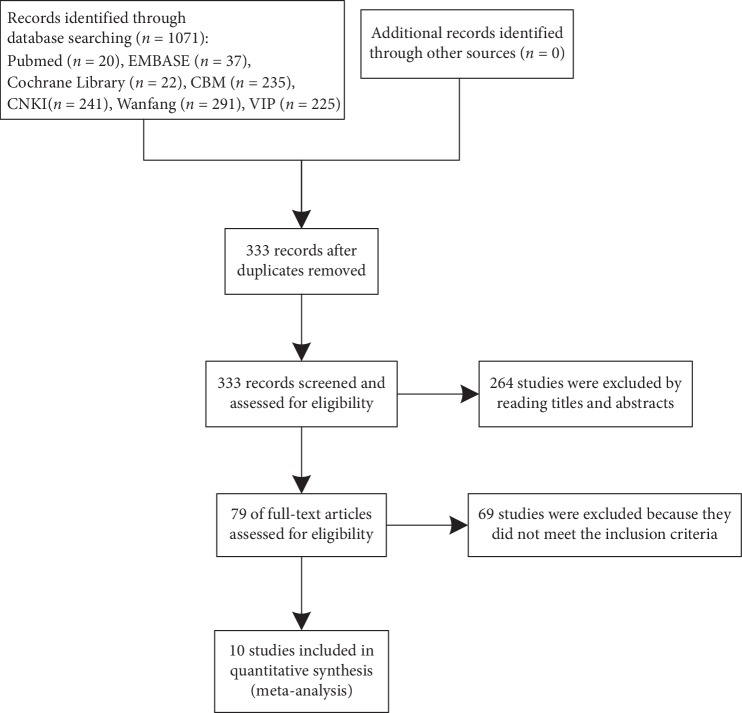
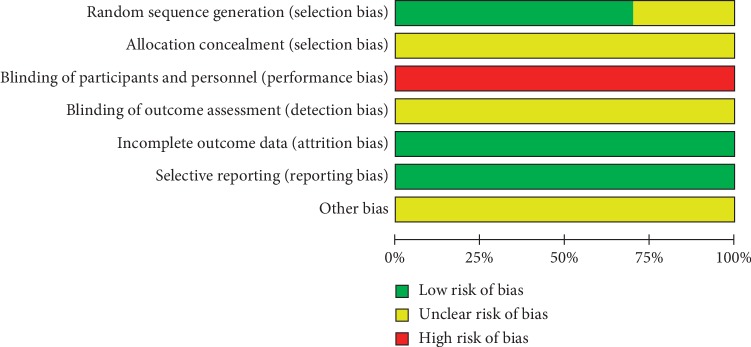
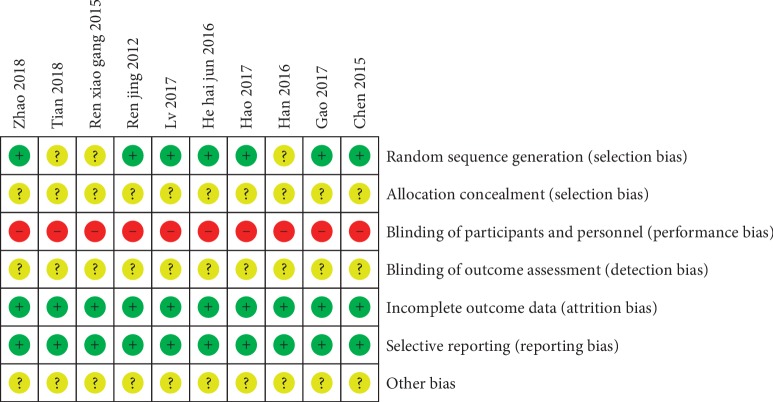
Relevant randomized controlled trials that compared the combined effect of acupuncture therapy and hyaluronic acid injection with hyaluronic acid injection alone for knee osteoarthritis patients were included. 10 studies were included in this meta-analysis, and the relative risk (RR) and weight mean difference (MD) with 95% CI for the Lysholm knee score (LKSS), visual analogue scale (VAS), and effective rate (ER) were evaluated by using RevMan 5.3 software. Besides, the bias assessment of the included studies was evaluated using the Cochrane risk of bias tool, and the GRADE (Grading of Recommendations, Assessment Development, and Evaluation) system was applied to assess the overall quality of the evidence.
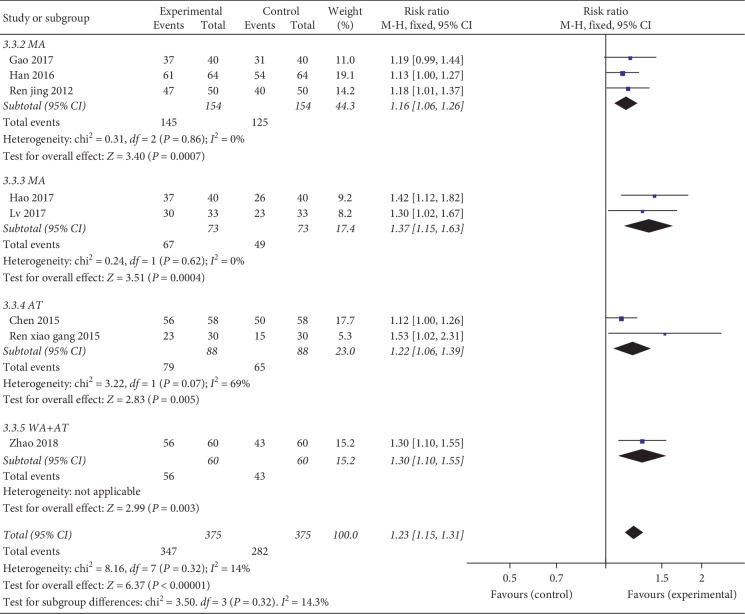
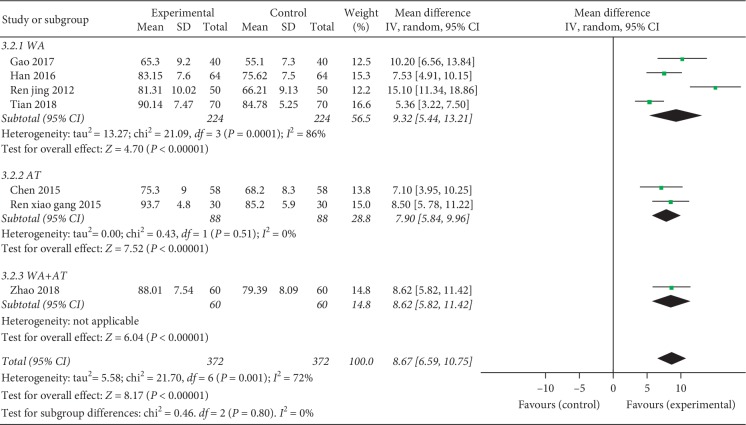
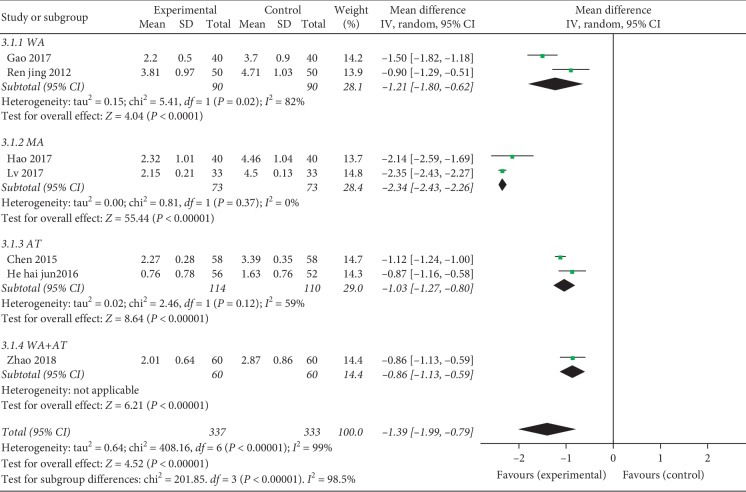
A total of 10 studies involving 998 participants were included in this study. Compared to hyaluronic acid injection alone, the combined therapy significantly reduced pain on the visual analogue scale (VAS) and improved the ER and knee function on the Lysholm knee score (LKSS). Of these, the pooled LKSS (MD = 8.09, 95% CI = [7.02, 9.16], < 0.00001, 7 studies) and ER (RR = 1.23, 95% CI 1.15 to 1.31, < 0.00001, 7 studies) and ER (RR = 1.23, 95% CI 1.15 to 1.31, < 0.00001, 7 studies) and ER (RR = 1.23, 95% CI 1.15 to 1.31.
Current evidence suggests that acupuncture therapy combined with hyaluronic acid injection is more effective in alleviating pain, improving the ER and knee function compared with hyaluronic acid injection alone. However, considering the low quality, small size, and high risk of the studies identified in this meta-analysis, more higher methodological quality, rigorously designed randomized controlled trials with large sample sizes are needed to confirm the results.
本荟萃分析旨在研究针刺疗法联合透明质酸注射与单纯透明质酸注射治疗膝骨关节炎患者的疗效。
纳入比较针刺疗法与透明质酸联合注射与单纯透明质酸注射治疗膝骨关节炎患者综合疗效的相关随机对照试验。本荟萃分析纳入10项研究,采用RevMan 5.3软件评估Lysholm膝关节评分(LKSS)、视觉模拟评分(VAS)和有效率(ER)的相对风险(RR)和加权均数差(MD)及95%可信区间。此外,使用Cochrane偏倚风险工具对纳入研究进行偏倚评估,并应用GRADE(推荐分级、评估发展和评价)系统评估证据的总体质量。
本研究共纳入10项研究,涉及998名参与者。与单纯透明质酸注射相比,联合治疗显著降低了视觉模拟评分(VAS)上的疼痛,并提高了有效率(ER)和Lysholm膝关节评分(LKSS)上的膝关节功能。其中,汇总的LKSS(MD = 8.09,95% CI = [7.02, 9.16],< 0.00001,7项研究)和ER(RR = 1.23,95% CI 1.15至1.31,< 0.00001,7项研究)以及ER(RR = 1.23,95% CI 1.15至1.31,< 0.00001,7项研究)和ER(RR = 1.23,95% CI 1.15至1.31)。
目前的证据表明,与单纯透明质酸注射相比,针刺疗法联合透明质酸注射在减轻疼痛、提高有效率和膝关节功能方面更有效。然而,考虑到本荟萃分析中所纳入研究的质量较低、样本量较小且风险较高,需要更多方法学质量更高、设计严谨的大样本随机对照试验来证实这些结果。