Department of Hematology and Critical Care Medicine.
Department of Physiology, School of Basic Medical Science, and.
Blood. 2020 Apr 2;135(14):1087-1100. doi: 10.1182/blood.2019002282.
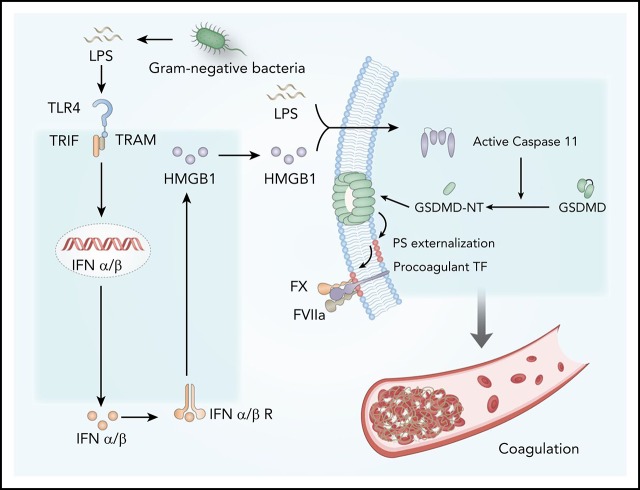
Bacterial infection not only stimulates innate immune responses but also activates coagulation cascades. Overactivation of the coagulation system in bacterial sepsis leads to disseminated intravascular coagulation (DIC), a life-threatening condition. However, the mechanisms by which bacterial infection activates the coagulation cascade are not fully understood. Here we show that type 1 interferons (IFNs), a widely expressed family of cytokines that orchestrate innate antiviral and antibacterial immunity, mediate bacterial infection-induced DIC by amplifying the release of high-mobility group box 1 (HMGB1) into the bloodstream. Inhibition of the expression of type 1 IFNs and disruption of their receptor IFN-α/βR or downstream effector (eg, HMGB1) uniformly decreased gram-negative bacteria-induced DIC. Mechanistically, extracellular HMGB1 markedly increased the procoagulant activity of tissue factor by promoting the externalization of phosphatidylserine to the outer cell surface, where phosphatidylserine assembles a complex of cofactor-proteases of the coagulation cascades. These findings not only provide novel insights into the link between innate immune responses and coagulation, but they also open a new avenue for developing novel therapeutic strategies to prevent DIC in sepsis.
细菌感染不仅会刺激先天免疫反应,还会激活凝血级联反应。细菌败血症中凝血系统的过度激活会导致弥漫性血管内凝血(DIC),这是一种危及生命的情况。然而,细菌感染激活凝血级联反应的机制尚不完全清楚。在这里,我们表明,I 型干扰素(IFNs)是一种广泛表达的细胞因子家族,可协调先天抗病毒和抗菌免疫,通过放大高迁移率族蛋白 B1(HMGB1)向血液中的释放来介导细菌感染引起的 DIC。I 型 IFNs 表达的抑制及其受体 IFN-α/βR 或下游效应物(如 HMGB1)的破坏均均匀降低了革兰氏阴性菌诱导的 DIC。从机制上讲,细胞外 HMGB1 通过促进磷脂酰丝氨酸向细胞外表面的外化,显著增加组织因子的促凝活性,在那里磷脂酰丝氨酸组装凝血级联反应的辅助因子蛋白酶复合物。这些发现不仅为先天免疫反应和凝血之间的联系提供了新的见解,而且为开发预防败血症中 DIC 的新治疗策略开辟了新途径。