Anwar Areeba, Ting Elaine Lim Siew, Anwar Ayaz, Ain Noor Ul, Faizi Shaheen, Shah Muhammad Raza, Khan Naveed Ahmed, Siddiqui Ruqaiyyah
Department of Biological Sciences, School of Science and Technology, Sunway University, Subang Jaya, 47500, Selangor, Malaysia.
Department of Chemistry, University of Karachi, Karachi, 75270, Pakistan.
AMB Express. 2020 Feb 3;10(1):24. doi: 10.1186/s13568-020-0960-9.
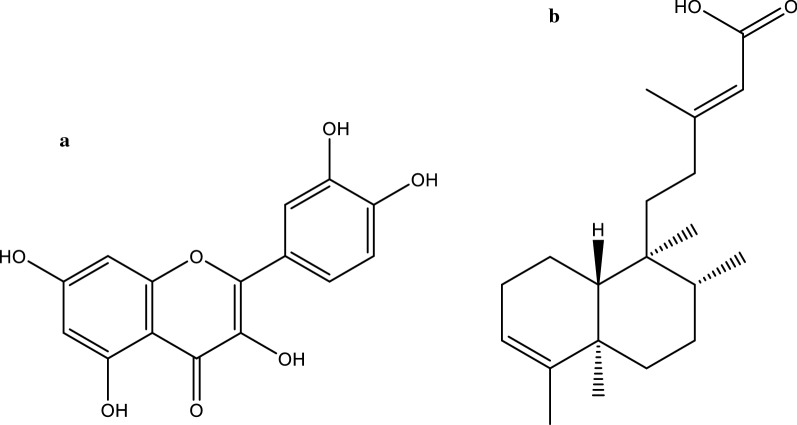
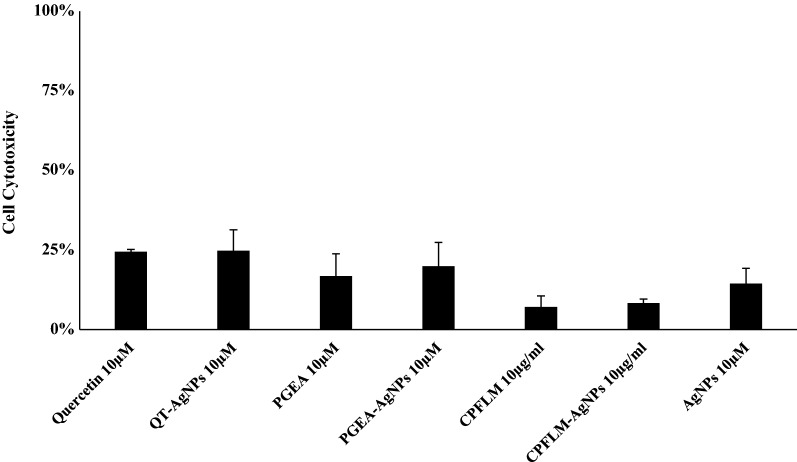
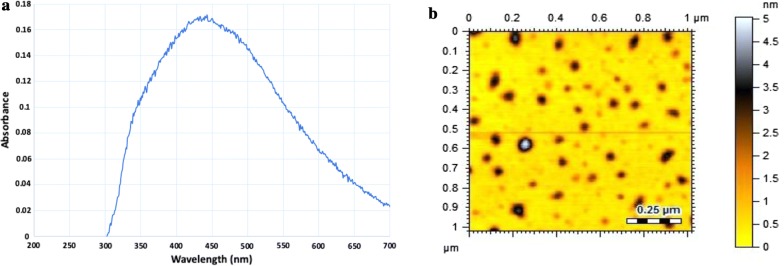
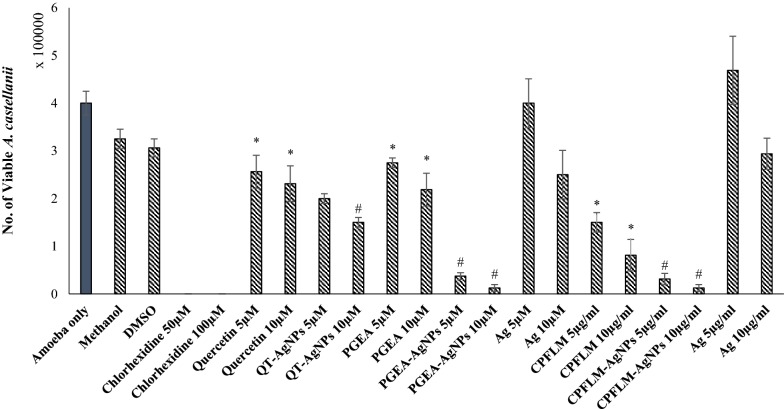
Acanthamoeba spp. are the causative agent of Acanthamoeba keratitis and granulomatous amoebic encephalitis (GAE). The current options to treat Acanthamoeba infections have limited success. Silver nanoparticles show antimicrobial effects and enhance the efficacy of their payload at the specific biological targets. Natural folk plants have been widely used for treating diseases as the phytochemicals from several plants have been shown to exhibit amoebicidal effects. Herein, we used natural products of plant or commercial sources including quercetin (QT), kolavenic acid (PGEA) isolated from plant extracts of Polyalthia longifolia var pendula and crude plant methanolic extract of Caesalpinia pulcherrima (CPFLM) as antiacanthamoebic agents. Furthermore, these plant-based materials were conjugated with silver nanoparticles (AgNPs) to determine the effects of the natural compounds and their nanoconjugates against a clinical isolate of A. castellanii from a keratitis patient (ATCC 50492) belonging to the T4 genotype. The compounds were conjugated with AgNPs and characterized by using ultraviolet visible spectrophotometry and atomic force microscopy. Quercetin coated silver nanoparticles (QT-AgNPs) showed characteristic surface plasmon resonance band at 443 nm and the average size distribution was found to be around 45 nm. The natural compounds alone and their nanoconjugates were tested for the viability of amoebae, encystation and excystation activity against A. castellanii. The natural compounds showed significant growth inhibition of A. castellanii while QT-AgNPs specifically exhibited enhanced antiamoebic effects as well as interrupted the encystation and excystation activity of the amoebae. Interestingly, these compounds and nanoconjugates did not exhibit in vitro cytotoxic effects against human cells. Plant-based compounds and extracts could be an interesting strategy in development of alternative therapeutics against Acanthamoeba infections.
棘阿米巴属是棘阿米巴角膜炎和肉芽肿性阿米巴脑炎(GAE)的病原体。目前治疗棘阿米巴感染的方法成效有限。银纳米颗粒具有抗菌作用,并能增强其在特定生物靶点的有效载荷。天然民间植物已被广泛用于治疗疾病,因为几种植物的植物化学物质已被证明具有杀阿米巴作用。在此,我们使用了植物或商业来源的天然产物,包括槲皮素(QT)、从长叶暗罗变种植物提取物中分离出的柯拉韦尼克酸(PGEA)以及美丽决明粗植物甲醇提取物(CPFLM)作为抗棘阿米巴剂。此外,这些基于植物的材料与银纳米颗粒(AgNPs)结合,以确定天然化合物及其纳米共轭物对一名属于T4基因型的角膜炎患者临床分离的卡氏棘阿米巴(ATCC 50492)的影响。这些化合物与AgNPs结合,并通过紫外可见分光光度法和原子力显微镜进行表征。槲皮素包被的银纳米颗粒(QT-AgNPs)在443nm处显示出特征性表面等离子体共振带,平均粒径分布约为45nm。对天然化合物及其纳米共轭物进行了对卡氏棘阿米巴的阿米巴活力、包囊形成和脱囊活性测试。天然化合物对卡氏棘阿米巴有显著的生长抑制作用,而QT-AgNPs特别表现出增强的抗阿米巴作用,并中断了阿米巴的包囊形成和脱囊活性。有趣的是,这些化合物和纳米共轭物对人类细胞没有体外细胞毒性作用。基于植物的化合物和提取物可能是开发抗棘阿米巴感染替代疗法的一个有趣策略。