Korea Institute of Science & Technology Evaluation and Planning, Chungcheongbuk-do, South Korea.
PLoS One. 2020 Feb 4;15(2):e0228616. doi: 10.1371/journal.pone.0228616. eCollection 2020.
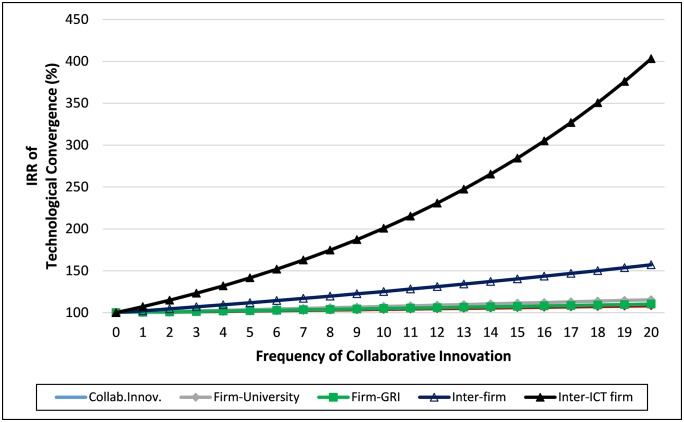
Collaborative innovation is widely recognized as an instrument to promote technological convergence. However, its effects on technological convergence remain debatable. Using firm-level panel data of patenting in the Korean ICT industry from 1980 to 2015, I examine the effects of four collaborative innovation types (i.e., Inter-firm, Inter-ICT firm, Firm-University, and Firm-Government Research Institution (GRI) on ICT-based technological convergence. The results reveal the magnitude of Inter-ICT firm collaborative innovation was found to be significant and largest. The effects of the remaining three collaborative innovation types were significant but inconsiderable. Governments may consider the differential effects of collaboration types when designing incentive systems to promote technological convergence.
协同创新被广泛认为是促进技术融合的手段。然而,其对技术融合的影响仍存在争议。本文利用 1980 年至 2015 年韩国信息通信技术产业的专利企业层面面板数据,考察了四种协同创新类型(即企业间、信息通信技术企业间、企业-大学和企业-政府研究机构)对基于信息通信技术的技术融合的影响。结果表明,信息通信技术企业间协同创新的规模最大且最为显著。其余三种协同创新类型的影响虽显著,但程度较小。政府在设计激励制度以促进技术融合时,可能需要考虑协同创新类型的差异效应。